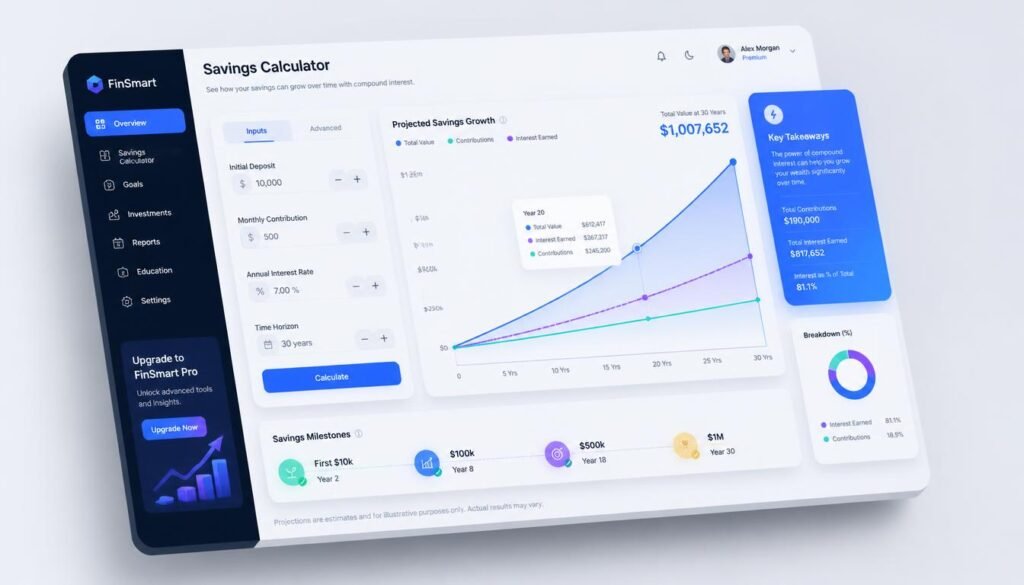
Savings Calculator
Project your financial growth over time, model compound interest impacts, and systematically plan your wealth-building milestones with our interactive savings forecasting engine.
Growth Trend Over Time
AnnualPortfolio Balance Composition
Final Balance| Year | Starting Balance | Deposit | Interest Earned | Total Interest | Future Value Balance |
|---|
How to Use Our Savings Calculator
Enter Initial Deposit
Input the starting balance or lump sum amount you currently have set aside for your savings goals.
Add Regular Contributions
Specify how much money you plan to add on a monthly or yearly basis to build your capital faster.
Set Rate & Timeline
Enter your expected annual interest rate and choose the number of years you want to grow your funds.
Analyze Your Growth
Review your final balance, total contributions, and cumulative interest earned instantly on the chart.
See How Compound Interest Works in Real Life
Compare these two common savings journeys to see how initial deposits, monthly contributions, and compounding interest work together over time.
The "Set-and-Forget" Starter Fund
Sarah wants to build a reliable emergency cushion. She starts with a modest initial deposit and commits to a highly manageable monthly contribution in a High-Yield Savings Account (HYSA).
The 3-Year Home Down Payment Plan
Marcus and Elena are aggressively saving to buy their first home. They start with a larger lump sum and allocate a significant portion of their monthly income to hit their target quickly.
The Savings Calculator can help project future financial growth and compare contribution scenarios, but a digital tool cannot account for unpredictable market fluctuations, changing inflation rates, or individual tax implications. Always combine online estimates with personalized financial planning and professional advice.
The Compound Interest Formula
Compound interest is often called the "eighth wonder of the world" because it allows your money to grow exponentially. Discover the exact mathematical formula our calculator uses to project your future savings.
What Each Variable Represents:
| A | Future Value | The total amount of money accumulated after n periods, including interest. |
| P | Principal Amount | The initial sum of money deposit or invested before earning interest. |
| r | Annual Interest Rate | The nominal interest rate per year (expressed as a decimal, e.g., 5% = 0.05). |
| n | Compounding Frequency | The number of times interest is calculated and added per year (e.g., Monthly = 12). |
| t | Timeline (Years) | The total number of years the money is left to compound. |
Step-by-Step Calculation Walkthrough
Let's calculate how much $1,000 grows in 2 years at an annual rate of 6%, compounded monthly.
P = $1,000 | r = 0.06 (6%) | n = 12 (monthly) | t = 2
0.06 / 12 = 0.005 (or 0.5% interest per month)
12 compounds/year × 2 years = 24 periods
A = 1,000 × (1.005)24
A = 1,000 × 1.12715978
A = $1,127.16
Mastering the Basics of Saving
Building wealth doesn't require a massive income—it requires smart habits, consistency, and a solid strategy. Here are the core pillars of a successful savings plan.
The 50/30/20 Budgeting Rule
A simple, highly effective framework to organize your monthly income and ensure you are consistently paying yourself first.
- 50% Needs: Rent, utilities, groceries, and minimum debt payments.
- 30% Wants: Dining out, entertainment, hobbies, and shopping.
- 20% Savings: High-yield savings, investments, and debt paydown.
Your Financial Safety Net
Before investing in riskier assets, you must build an emergency fund to protect yourself from life's unexpected expenses.
Keep this money liquid (easily accessible) in a separate account so you never have to swipe a high-interest credit card or pull funds from retirement accounts when emergencies happen.
High-Yield vs. Traditional Banks
Where you put your savings matters. Standard checking and savings accounts practically lose money over time due to inflation.
Your money sits idle, slowly losing purchasing power as inflation outpaces your minimal interest earnings.
Compounding works rapidly in your favor, adding hundreds of dollars in free cash to your balance annually.
The easiest way to save is to remove human error. Set up an automatic transfer on every payday that routes 10% to 20% of your paycheck directly into your high-yield savings account before you ever have a chance to spend it.
How to Maximize Your Savings
Ready to take your savings to the next level? Moving money into a savings account is only step one. Use these advanced tactics to squeeze every drop of interest and growth out of your hard-earned cash.
Build a CD Ladder
Certificates of Deposit (CDs) often offer higher interest rates than standard savings accounts, but they lock up your cash. A "CD Ladder" gives you the best of both worlds: high yields and regular liquidity.
Divide your savings into 4 equal parts. Put them into 1-year, 2-year, 3-year, and 4-year CDs. As each CD matures, reinvest it into a new 4-year CD. You'll soon have a top-tier rate maturing every single year.
Stop Paying "Sneaky" Bank Fees
Traditional banks thrive on monthly maintenance fees, out-of-network ATM charges, and paper statement fees. These small expenses silently eat away at your compounding interest gains.
Leverage Tax-Advantaged Accounts
If you are saving for long-term goals like retirement or medical expenses, standard savings accounts subject your interest to annual income tax. Utilizing tax-advantaged accounts protects your growth.
Harvest Bank Sign-Up Bonuses
Many online institutions offer lucrative cash bonuses (ranging from $100 to $500+) simply for opening a new account and keeping a specific deposit balance for a few months.
Treat bank bonuses like an artificial interest rate hike. Earning a $300 bonus on a $10,000 deposit held for 90 days is equivalent to an extra 12% annualized return!
The 1% Rule of Compounding
Never underestimate small adjustments. Moving $20,000 from a traditional bank paying 0.1% to a High-Yield account or CD paying 4.5% turns $20 in annual interest into $900. Over 10 years, that single 10-minute decision yields over $11,000 in entirely free passive wealth.
While our Savings Calculator helps you map out long-term projections, maximizing your actual returns requires consistency. Accelerate your financial growth by automating regular deposits into high-yield accounts, eliminating unnecessary recurring expenses, and redirecting salary increases straight into your principal balance to leverage the full power of compound interest.
Types of Savings Accounts Explained
Not all savings accounts are built the same. Choosing the right vehicle depends on how quickly you need access to your cash and how much interest you want to earn.
Traditional Savings Account
The standard savings account offered by brick-and-mortar neighborhood banks. Highly convenient but pays virtually zero interest.
High-Yield Savings Account (HYSA)
Offered primarily by online banks. Because these institutions don't pay for physical branches, they pass those savings onto you through massive interest rates.
Money Market Account (MMA)
A hybrid banking account that combines the high-yielding interest of a savings account with the transactional flexibility of a checking account.
Certificate of Deposit (CD)
A savings agreement where you lock your cash in the bank for a predetermined period (e.g., 6 months to 5 years) in exchange for a fixed, guaranteed interest rate.
Every single account type detailed above is fully backed by federal insurance. As long as you bank with an FDIC-insured bank (or an NCUA-insured credit union), your personal deposits are legally protected by the U.S. Government up to $250,000 per depositor, per ownership category. If the bank goes out of business, you will not lose a single penny.
How to Build an Emergency Fund
An emergency fund is the ultimate insurance policy against life's unexpected turns. It keeps you from spiraling into high-interest credit card debt or being forced to liquidate long-term investments when trouble strikes. Here is your step-by-step roadmap to building a bulletproof cash reserve.
The Starter Goal ($1,000)
Don't let the grand total intimidate you. Your immediate priority is saving a baseline of $1,000 as fast as possible. This initial buffer is designed to cover minor unexpected expenses—like a flat tire, a broken appliance, or a quick trip to the urgent care.
Target: 1 - 3 Months3 Months of Living Expenses
Once your starter fund is secure, calculate your absolute baseline monthly expenses (rent, utilities, groceries, and debt minimums). Multiply this by three. This phase protects you against short-term income disruptions or a temporary job transition.
Target: 3 - 6 Months6 Months of Living Expenses
This is the gold standard of financial security. Having half a year of expenses locked away gives you complete career flexibility and total peace of mind. A larger buffer is especially critical if you are self-employed, have dependents, or own a home.
Target: 6 - 12 MonthsThe Quick-Start Action Plan
Building your fund doesn't require a massive financial overhaul. Small, automated steps are the proven key to long-term success:
-
1
Separate Your Money: Keep your emergency fund in a dedicated High-Yield Savings Account. If it sits in your primary checking account, you will accidentally spend it.
-
2
Automate the Transfers: Set up a "split direct deposit" with your employer to automatically route 5% to 10% of every paycheck directly to your emergency fund before you see it.
-
3
Capture Your Windfalls: Whenever you receive unexpected cash—like a tax refund, work bonus, or birthday gift—funnel at least 50% of it straight into your reserve.
🚨 Emergency Rules of Engagement
To protect your hard work, define what constitutes a true financial emergency. Use this quick checklist before touching the fund:
Sudden job loss, medical emergencies, or critical car repairs needed to get to work.
Holiday shopping, last-minute travel deals, concert tickets, or down payments on non-essential upgrades.
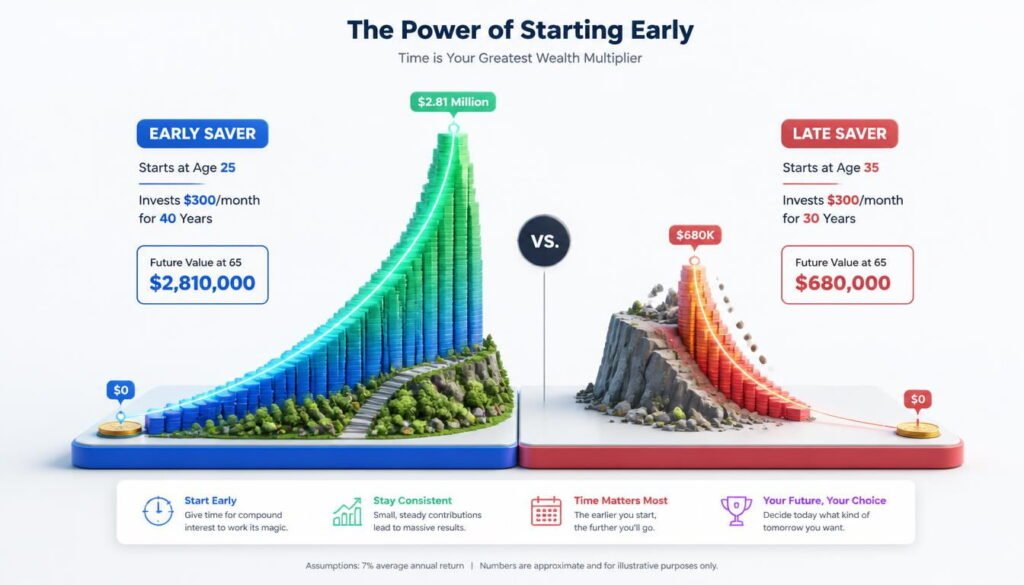
Saving Early vs. Saving Late
When it comes to building massive wealth, **time is infinitely more valuable than the amount of money you invest**. Let's look at a classic financial case study that proves why starting today—even with a tiny amount—is the smartest move you can make.
Emma: The "Early Bird"
Starts saving at age 25Emma saves $200 a month for just 10 years (from age 25 to 35), and then stops completely. She leaves her accumulated balance untouched in a high-yield account compounding at 7% annually until she retires at age 65.
$242,430
Luis: The "Late Starter"
Starts saving at age 35Luis waits until age 35 to start. Recognizing he is behind, he saves the same $200 a month, but he keeps saving consistently for 30 solid years (from age 35 to 65) at the exact same 7% annual interest rate.
$224,000
📊 The Verdict: How Emma Beat Luis
Even though Luis deposited 3x more money out-of-pocket ($72,000 vs. $24,000) and saved for three times as many years, Emma still ended up with $18,430 more!
Emma's Win Margin
Emma won the race because her early deposits had a 30-year head start to compound exponentially without interruptions.
Emma's Out-of-Pocket Savings
Emma kept an extra $48,000 of her lifestyle income over her working years compared to Luis, yet retired wealthier.
Interest to Principal Ratio
An incredible 90% of Emma's final balance was purely free compound interest generated by the banking system.
Ready to Project Your Financial Growth?
Use the Savings Calculator to estimate future balances, model compound interest impacts, and plan your long-term wealth milestones.
Calculate Your SavingsHow Interest Rates Affect Your Savings
Interest rates aren't static—they shift based on global economic conditions, central bank policies, and inflation. Understanding how these forces impact your yield is key to preserving your purchasing power.
The Federal Reserve Connection
When you hear that the Federal Reserve (the "Fed") is raising or lowering interest rates, it directly impacts your wallet. The Fed sets the Federal Funds Rate—the rate banks charge each other for overnight loans.
- When the Fed raises rates: Online banks quickly raise their HYSA yields to attract your deposits, allowing you to earn more passive income.
- When the Fed cuts rates: Savings yields across the board will eventually drift downward. Locking in fixed rates with CDs during peak rate cycles is a popular defensive strategy.
The "Real" Rate of Return (vs. Inflation)
An interest rate on paper (your nominal rate) only tells half the story. To understand if your wealth is actually growing, you must subtract the rate of Inflation to find your Real Rate of Return.
If your bank pays 4.5% APY and annual inflation is running at 2.5%, your money's purchasing power is growing by a healthy +2.0%. However, if your traditional bank only pays 0.1% APY, you are effectively losing -2.4% in purchasing power every single year!
The Math: $10,000 Over Time at Different Rates
See exactly how much a single, one-time deposit of $10,000 grows over 5 years (compounded monthly) depending entirely on the interest rate category you choose.
| Account Tier | Typical APY | Year 1 Interest | 5-Year Balance | Total Interest Earned |
|---|---|---|---|---|
| Traditional Savings Brick-and-Mortar Banks | 0.05% | $5 | $10,025 | $25 |
| National Average All US Banks Combined | 0.45% | $45 | $10,227 | $227 |
| Top-Tier HYSA / CD Online Banks & Specials Recommended | 4.50% | $459 | $12,518 | $2,518 |
Leaving money in a checking or basic savings account during high-interest-rate cycles is essentially leaving free money on the table. Moving a $10,000 balance to a high-yield account secures an extra $2,493 in entirely passive, risk-free profit over 5 years without changing your spending habits.
How Taxes Affect Your Savings
Earning a high yield on your savings is incredibly satisfying, but it's important to remember that Uncle Sam wants his share. In the eyes of the IRS, the passive interest your money generates is treated exactly like ordinary income.
Taxed as Ordinary Income
The interest you earn on traditional savings accounts, High-Yield Savings Accounts (HYSAs), money market accounts, and Certificates of Deposit (CDs) does not qualify for preferential tax rates (unlike long-term capital gains or qualified dividends). Instead, it is taxed at your marginal ordinary income tax rate (ranging from 10% to 37%), matching the tax bracket of your wages or salary.
The $10 Threshold & Form 1099-INT
If you earn $10 or more in interest from a single financial institution in a calendar year, that institution is legally required to send both you and the IRS a copy of Form 1099-INT. This form details your total taxable interest income. Note that even if you earn less than $10 and do not receive a form, you are still legally required to report and pay taxes on that interest.
Crossing the $1,500 Mark
If your total taxable interest income across all of your bank accounts and investments adds up to more than $1,500 for the year, you cannot simply report the lump sum on your main tax return. You must complete and attach a dedicated tax schedule: Schedule B (Form 1040), which lists each individual payer and the respective amount earned.
Four Ways to Minimize Tax Drag
Tax drag is the reduction of your investment or savings growth caused by taxes. You can protect your yields using these legitimate financial strategies:
- 1. Utilize Tax-Advantaged Accounts: Keep long-term savings in tax-advantaged vehicles like Roth IRAs, traditional IRAs, or 401(k)s. The growth in these accounts compounds tax-free or tax-deferred.
- 2. Consider Treasury Bills (T-Bills): Interest earned on U.S. government Treasury bills, notes, and bonds is subject to federal income tax, but it is 100% exempt from all state and local income taxes—a massive benefit for savers in high-tax states.
- 3. Look into Municipal Bonds: For high-income earners, municipal bonds (issued by state and local governments) offer interest that is typically exempt from federal income taxes, and often state/local taxes if you reside in the issuing municipality.
- 4. Match Account Types to Goals: Only keep money in high-yield taxable accounts if you need it highly liquid (such as emergency funds, near-term travel funds, or down payment reserves).
🔗 Official Tax Resources & Filing Links
To ensure your savings strategy complies with current IRS guidelines, consult these official references:
- IRS Topic No. 403: Interest Received ↗ The official IRS breakdown of what constitutes taxable and tax-exempt interest income.
- About Form 1099-INT ↗ Official instructions, PDF copies, and updates regarding Interest Income reporting requirements.
- About Schedule B (Form 1040) ↗ Official guidelines for reporting taxable interest or ordinary dividends totaling over $1,500.
How Compounding Frequency Affects Your Savings
Most savers focus solely on the interest rate (APY), but **how often your interest is calculated and added to your balance** plays a massive role in how fast your money grows. The more frequent the compounding, the faster your wealth builds.
What is Compounding Frequency?
Compounding is the process where you earn interest on your original deposit, *plus* interest on the interest you've already accumulated. The **compounding frequency** is simply how often the bank runs this calculation:
- Daily: Your interest is calculated every single day. This yields the fastest growth.
- Monthly: Calculated 12 times a year (common for HYSAs).
- Quarterly: Calculated 4 times a year.
- Annually: Calculated once at the end of each year.
The Difference: APR vs. APY
Banks often list two different numbers: **APR (Annual Percentage Rate)** and **APY (Annual Percentage Yield)**. Compounding frequency is the bridge between them.
APR is the base, uncompounded annual interest rate.
APY is the *actual* rate of return you earn over a year because it accounts for compounding.
- Compounded **Annually**: Your APY is exactly 5.00%
- Compounded **Monthly**: Your APY bumps up to 5.12%
- Compounded **Daily**: Your APY reaches its peak at 5.13%
The Comparison: $10,000 Over 10 Years at 5.00% APR
See exactly how much your final balance changes based on different compounding frequencies, assuming a single $10,000 deposit left untouched for a decade.
| Compounding Interval | Calculations Per Year | Effective APY | 10-Year Balance | Total Interest Earned |
|---|---|---|---|---|
| Annual | 1 time | 5.00% | $16,288.95 | $6,288.95 |
| Quarterly | 4 times | 5.09% | $16,436.19 | $6,436.19 |
| Monthly | 12 times | 5.12% | $16,470.09 | $6,470.09 |
| Daily Fastest Growth | 365 times | 5.13% | $16,486.65 | $6,486.65 |
Master Your Compounding Math
Formulas can be intimidating. Skip the manual scratchpad and use these official federal tools and educational resources to easily map out your compounding trajectory:
Compound Interest & Inflation Disclaimer: While our Savings Calculator utilizes precise compound growth formulas to project your future wealth, these estimates do not account for future inflation rates, account maintenance fees, or potential tax liabilities on earned interest. Use these projections as a foundational baseline for your financial planning rather than guaranteed returns.
Mistakes That Can Hurt Your Savings
Saving money is only half the battle. Even if you are diligently putting cash aside, subtle structural pitfalls, bank policy traps, and market forces can quietly erode your hard-earned wealth.
Leaving Cash in Traditional Banks
Keeping your primary savings in a traditional brick-and-mortar checking or savings account is a silent wealth killer. With average yields hovering near 0.01% to 0.40%, inflation rapidly outpaces your growth, actively reducing your money’s purchasing power every year.
Exceeding Federal Insurance Limits
The standard FDIC and NCUA limit is $250,000 per depositor, per institution. If you keep more than this at one bank or credit union, any amount over the threshold is entirely unprotected if that institution fails.
Ignoring the Interest Tax Drag
Many savers are caught off guard when they realize the interest earned in high-yield accounts is fully taxable as ordinary income. Banks report these earnings on Form 1099-INT, meaning a high interest year can push you into a higher tax obligation.
Ignoring Hidden Fees & Fine Print
Maintenance fees, excessive transaction penalties, out-of-network ATM fees, and minimum balance rules can quickly devour your earned interest. Savers often don't check their statements closely enough to spot these regular leaks.
Take Action: Audit Your Savings Safety
Don't guess where your money stands. Use these official federal tools and authoritative tax guidelines to securely evaluate, optimize, and insulate your cash reserves:
Smart Strategies to Grow Your Savings
Don't just set money aside—make it work for you. By shifting from passive saving to strategic cash management, you can compound your wealth safely and outpace inflation.
Leverage High-Yield Savings Accounts (HYSAs)
Traditional banks pay pennies on the dollar. Moving your liquid emergency fund to a top-tier High-Yield Savings Account (HYSA) allows you to secure competitive yields (often up to 4% or more) with the exact same FDIC/NCUA insurance protections as a brick-and-mortar bank.
Automate "Pay-Yourself-First" Sweeps
Human discipline is finite; automation is absolute. By configuring automatic direct deposits to transfer a portion of your paycheck straight into your savings account before you ever see it in your checking account, you eliminate the temptation to spend it first.
Build a Certificate of Deposit (CD) Ladder
If you have savings earmarked for a future goal, lock in high rates using a CD ladder. By dividing your cash and buying multiple CDs maturing at staggered intervals (e.g., 3, 6, 9, and 12 months), you consistently capture top yields while securing regular liquidity.
Utilize Tax-Advantaged Accounts
While standard savings accounts trigger annual tax liabilities on interest, you can insulate your growth. Maximizing contributions to tax-advantaged vehicles (like HSAs, IRAs, or Treasury Bills) shields your compounding growth from unnecessary annual tax drag.
Compare, Calculate & Capitalize
To maximize your returns safely, cross-reference rates and strategies using these leading, independent financial databases and official calculators:
Frequently Asked Questions
Everything you need to know about optimizing, protecting, and multiplying your cash reserves without hidden traps.
1. What is the difference between a traditional savings account and a High-Yield Savings Account (HYSA)?
The primary difference is the interest rate (APY). Traditional savings accounts from major national retail banks typically offer interest yields of less than 0.10% (often as low as 0.01%).
In contrast, High-Yield Savings Accounts (HYSAs)—usually offered by online-only banks—offer interest rates that are significantly higher (often ranging from 3.50% to upwards of 4.50% APY depending on market conditions). This allows your principal balance to compound and grow much faster over time with the exact same level of federal insurance protection.
2. What does APY mean and how does it differ from APR?
APR (Annual Percentage Rate) is the base, uncompounded annual interest rate the bank pays. APY (Annual Percentage Yield) is the actual rate of return you earn over a full year because it takes into account the effect of compounding interest.
Because interest compounds (meaning you earn interest on your original deposit, plus interest on the interest you've already accumulated), your APY will always be slightly higher than the APR. The more frequently interest compounds, the wider the gap between APR and APY.
3. Is my money safe in an online-only savings account?
Yes, online-only banks are completely safe, provided they are federally insured. Ensure the bank you choose displays the "Member FDIC" (Federal Deposit Insurance Corporation) logo. For credit unions, look for "NCUA" (National Credit Union Administration) insurance.
These government-backed agencies legally guarantee your deposits up to standard limits, giving online institutions the exact same security backing as large, physical brick-and-mortar banks.
4. How does the FDIC $250,000 protection limit work?
The FDIC protects depositors up to $250,000 per depositor, per insured bank, and per ownership category. If a bank fails, the federal government covers losses up to this threshold.
You can safely keep more than $250,000 at a single bank by utilizing different ownership categories. For example, a single account is insured up to $250,000, while a joint account owned by two people is insured up to $500,000 ($250,000 per co-owner).
5. How much of an emergency fund should I keep in savings?
Most financial experts recommend maintaining 3 to 6 months' worth of essential living expenses in an easily accessible savings account.
This buffer should cover rent or mortgage, utility bills, groceries, insurance premiums, healthcare, and debt minimums. If you are self-employed, have variable income, or have several dependents, aiming for 9 to 12 months is highly recommended to provide a deeper safety net.
6. Can I lose my principal cash inside an insured savings account?
No, you cannot lose your principal cash balance in an FDIC- or NCUA-insured account up to the legal coverage limits. Unlike investing in stocks or mutual funds, your balance is fully guaranteed and does not fluctuate with market changes.
However, you can lose purchasing power over time if the interest rate on your savings account is lower than the prevailing annual rate of inflation.
7. What is a Certificate of Deposit (CD) and when should I open one?
A CD (Certificate of Deposit) is a specialized savings account where you deposit a set sum of money for a fixed length of time (e.g., 6 months, 1 year, or 5 years) in exchange for a locked-in, guaranteed interest rate.
You should open a CD if you have a specific short-term financial goal (such as buying a car or paying a house downpayment in 12 months) and want to secure a high interest rate without taking any market risk or having the rate drop if interest rates decline.
8. How do early withdrawal penalties work on CDs?
If you withdraw your money from a CD before its maturity date, the bank will charge an **early withdrawal penalty**. This penalty is typically calculated as a set number of days or months of interest.
For example, a 12-month CD might require you to forfeit 90 or 180 days of earned interest if you withdraw early. If you withdraw very soon after opening the CD, the penalty can actually eat into your initial deposit principal.
9. What is a CD Ladder and why should I build one?
A CD Ladder is a strategy designed to capture the high interest rates of long-term CDs while keeping regular access to your cash. You divide your total savings into equal amounts and open multiple CDs with staggered maturity dates.
For example, you might split $10,000 into four $2,500 CDs maturing in 3, 6, 9, and 12 months. Every three months, a CD matures, giving you access to cash. If you don't need the money, you reinvest it into a new 12-month CD. This ensures a portion of your money is liquid every three months while capturing the yield benefits of longer-term CDs.
10. What is a Money Market Account (MMA) and how is it different?
A Money Market Account (MMA) is a hybrid account that combines the features of both checking and savings accounts. MMAs usually offer competitive interest rates similar to HYSAs, but they also provide debit card access and check-writing privileges.
The trade-off is that MMAs often require higher minimum opening deposits or daily balances (such as $5,000 or $10,000) to secure the best rates or avoid monthly maintenance fees.
11. What is a Cash Management Account (CMA)?
A Cash Management Account (CMA) is a non-bank financial account offered by online brokerages, wealth management firms, or robo-advisors. It is designed to act as a central hub for your uninvested cash.
Behind the scenes, CMAs automatically sweep your cash into several partner banks. This structure allows brokerage clients to earn highly competitive interest rates, access checking utilities, and benefit from aggregate FDIC insurance limits that can reach $1 million to $5 million.
12. How do savings accounts compare to investing in the stock market?
Savings accounts and stock market investments are designed for completely different goals:
- Savings Accounts: Prioritize capital preservation and near-instant access. Your balance is guaranteed safe from market drops, but your long-term growth is limited by the interest rate.
- Stock Market Investing: Prioritizes wealth building. While historical market returns (7% to 10% on average over decades) are much higher than savings yields, investing exposes your money to short-term losses and should only be used for money you won't need for at least 3 to 5 years.
13. Do I have to pay taxes on the interest I earn in my savings?
Yes. The interest you earn in savings accounts, CDs, MMAs, or CMAs is considered ordinary taxable income by the IRS and state governments, rather than capital gains.
If your account earns more than $10 in interest over the course of a calendar year, your bank will issue you a Form 1099-INT. You are legally required to report this interest income on your annual tax return, regardless of whether you withdrew the interest or let it remain in the account.
14. Are there federal limits on how many times I can withdraw from savings?
Historically, a federal rule called Regulation D limited savings account withdrawals or outgoing transfers to a maximum of six per month. While the Federal Reserve indefinitely suspended enforcement of this limit, many banks still enforce it under their own terms.
Exceeding your bank's designated limit can result in an "excessive withdrawal fee" (often $10 to $15 per transaction) or eventually prompt the bank to convert your savings account into a standard checking account.
15. How often can the interest rate on my savings account change?
Except for CDs, savings accounts have **variable interest rates**. This means the bank can adjust the APY at any time, up or down, without providing advance notice.
These rate adjustments are heavily influenced by macroeconomic factors, specifically the federal funds rate set by the Federal Reserve. When the Fed raises rates, banks generally increase savings yields; when the Fed cuts rates, savings APYs typically fall as well.
16. What are common bank fees I should watch out for on savings accounts?
To keep your interest earnings from being wiped out by bank fees, always read the account disclosure. Be mindful of:
- Monthly Maintenance Fees: Fee for holding the account (usually waived if you maintain a certain minimum balance or arrange regular direct deposits).
- Paper Statement Fees: Fee for mailing hardcopy statements (avoid this by switching to paperless online delivery).
- Inactivity/Dormancy Fees: Charged if you do not make any deposits or withdrawals over a long period (typically 12 to 24 months).
17. Can I link my savings account directly to pay my bills?
Yes, you can use your savings account routing and account numbers to arrange ACH payments for utilities, credit cards, or loans. However, this is **not recommended** as a routine practice.
Because savings accounts are meant for accumulation rather than regular transactions, linking multiple bills can quickly put you over your monthly withdrawal limits. It is always safer to pay bills out of checking and schedule targeted, automated transfers from your savings account to cover those larger bills.
18. How does compounding frequency impact my savings growth?
Compounding frequency refers to how often the bank calculates your interest and adds it to your balance. The most common intervals are daily, monthly, quarterly, or annually.
The more frequently your interest compounds, the faster your money grows, because you begin earning interest on your newly earned interest sooner. For example, a $10,000 balance at a 5.00% interest rate will earn slightly more interest over a year with **daily compounding** compared to quarterly or annual compounding.
Our Trusted Sources
Our compound interest calculations, future value formulas, and financial growth projections are built upon verified guidelines, economic data, and methodologies from leading financial regulators, central banks, and investor education authorities.
Related Calculators
Calculate future investment growth, plan retirement savings, determine loan amortization schedules, and evaluate mortgage interest expenses with our suite of specialized financial planning tools.
Investment Calculator
Project the long-term growth of your portfolio, stock market returns, and regular contributions using advanced compounding formulas.
Launch Calculator →Retirement Calculator
Determine how much you need to save each month to reach your target retirement nest egg and maintain your lifestyle.
Launch Calculator →Loan Calculator
Calculate monthly loan payments, total interest over the life of the loan, and complete amortization schedules for personal or auto loans.
Launch Calculator →Mortgage Calculator
Estimate monthly mortgage payments including principal, interest, property taxes, homeowner's insurance, and private mortgage insurance.
Launch Calculator →