
Roof Shingle Calculator
Accurately estimate the exact shingle bundles, roofing squares, and waste factor required for your roof replacement or installation project with our interactive calculator.
Roof Shingle Calculation & Summary
Based on a 2,000 sq. ft. roof and a 15% waste factor, the calculator estimates 23.0 adjusted roofing squares. Using architectural shingles with approximately 33.3 sq. ft. of coverage per bundle, you would need about 70 bundles. Actual material requirements vary by manufacturer, roof layout, cuts, starter requirements, ridge details, and installation specifications.
- Roof Area
- 2,000 sq. ft.
- Shingle Type
- Architectural Shingles
- Base Roofing Squares
- 20.0 sq
- Adjusted Roofing Squares
- 23.0 sq
- Waste Factor
- 15%
- Coverage per Bundle
- 33.3 sq. ft.
- Estimated Bundles
- 70 bundles
- Total Shingle Coverage
- 2,331 sq. ft.
- Existing Roof Layers
- 1 Layer
- Roof Complexity
- Moderate
Shingle Material Breakdown
Proportion of usable roof area vs. waste allowance.
Roofing Material Quantities
Estimated totals across bundles, underlayment rolls, and nails.
Roof Area vs. Adjusted Material Area
Demonstrating how waste factor expands planning area.
FREE LOCAL ROOFING QUOTES
Enter your ZIP code to compare Licensed contractors near you.
How Many Shingles Do I Need?
To determine how many shingles you need for your roof, you must calculate your total roof surface area, factor in a waste allowance for cuts and fitting, and divide by the manufacturer's specified coverage per bundle.
Finding out how many shingles do I need for my roof is the most critical step in ordering roofing materials accurately without overspending or coming up short. Homeowners frequently search for how many bundles of shingles do I need or how to calculate shingles needed when planning a roofing project.
2. Shingle Bundles Needed = Adjusted Roof Area ÷ Coverage per Bundle (Rounded Up)
Understanding Roofing Squares
Roofing materials are measured in units called roofing squares. One roofing square equals exactly 100 square feet of roof area. To find your base roofing squares, divide your total roof area by 100. While industry standards traditionally assume that approximately 3 standard asphalt shingle bundles cover one roofing square, actual shingle bundle coverage varies depending on the specific product, manufacturer, and packaging.
Practical Example: 2,000 Sq. Ft. Roof
Consider a typical project using a 2,000 sq. ft. roof, a 15% waste factor, and standard architectural shingles providing about 33.3 sq. ft. of coverage per bundle:
- Base Roofing Squares: 2,000 sq. ft. ÷ 100 = 20.0 squares
- Adjusted Material Area: 2,000 sq. ft. × 1.15 (15% waste) = 2,300 sq. ft.
- Adjusted Roofing Squares: 2,300 sq. ft. ÷ 100 = 23.0 squares
- Estimated Bundles Needed: 2,300 sq. ft. ÷ 33.3 sq. ft. per bundle ≈ 69.07 (Rounded up to 70 bundles)
This provides a reliable material planning estimate, though exact figures should always be cross-referenced with your supplier's guidelines.
Surface Area vs. Floor Area
A common mistake when using a roof shingle quantity calculator is entering the home's interior floor area or ground footprint instead of the actual roof surface area. Sloped roofs have a significantly larger surface area than the footprint of the home, which must be accounted for to ensure you calculate correct roofing materials.
Roof Pitch & Slope
Steeper roofs require more surface area relative to the home's horizontal footprint and demand careful safety and handling allowances.
Roof Complexity
Valleys, hips, ridges, dormers, and multiple roof sections increase cutting waste and necessitate higher waste factors (often 15% to 20%).
Penetrations
Chimneys, skylights, plumbing vents, and roof flashing create custom cuts that affect overall material utilization.
To get an instant, customized breakdown of your shingle bundles, roofing squares, and material quantities tailored to your exact roof layout, use the interactive Calculante Roof Shingle Calculator above.
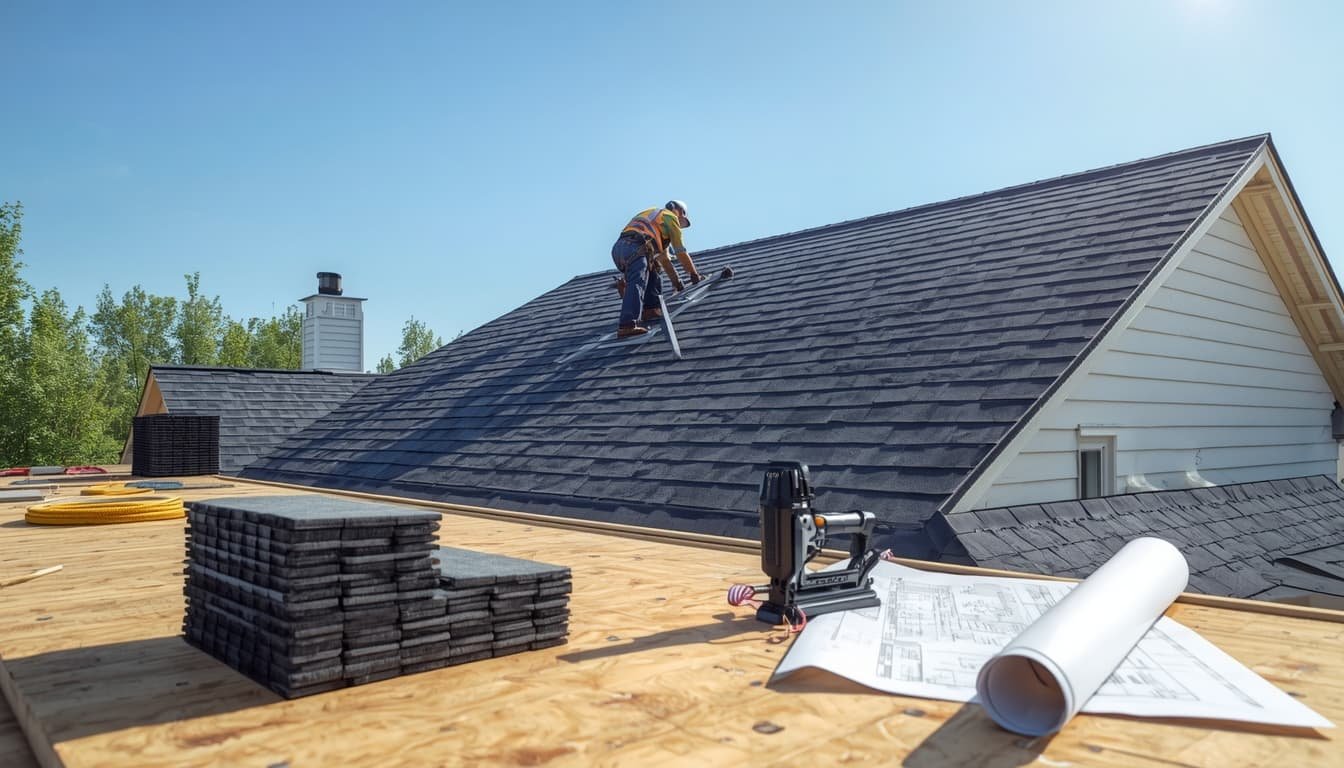
How the Roof Shingle Calculator Works
Understanding how a roof shingle calculator determines your required materials helps ensure your roofing project is properly planned. By processing key variables like roof surface dimensions, pitch, shingle type, and complexity, the tool delivers accurate material estimates.
Using a dedicated shingle quantity calculator or roofing material calculator eliminates guesswork, ensuring you know precisely how many roofing squares and shingle bundles are required for the job.
Roof Area Input
Enter your actual roof surface area in square feet. Note that a home's exterior footprint differs from total sloped roof area.
Roof Pitch & Details
Select your roof slope and complexity. While pitch reflects steepness, complexity helps gauge planning allowances for custom cuts.
Shingle Type & Coverage
Choose your shingle category. Different products have unique shingle coverage limits per bundle.
Waste Factor Allowance
Apply a roofing waste factor (typically 10% to 20%) to account for cuts, starters, fitting, and trimming around features.
Mathematical Methodology & Formulas
The how a roof shingle calculator works principle relies on standard industry conversions. First, base roofing squares are determined by dividing the roof area by 100, because one roofing square equals 100 square feet. Next, a waste multiplier expands that area to establish total material needs before calculating final bundle counts rounded upward.
• Adjusted Material Area = Roof Area × (1 + Waste Factor)
• Shingle Bundles Needed = Adjusted Material Area ÷ Coverage per Bundle (Rounded Up)
Practical Worked Example
Consider evaluating a project with a 2,000 sq. ft. roof area, a 15% waste factor, and standard architectural shingles providing 33.3 sq. ft. coverage per bundle:
- Base Roofing Squares: 2,000 ÷ 100 = 20.0 squares
- Adjusted Material Area: 2,000 × 1.15 = 2,300 sq. ft.
- Adjusted Roofing Squares: 2,300 ÷ 100 = 23.0 squares
- Bundles Needed: 2,300 ÷ 33.3 ≈ 69.07 (Rounded up to 70 bundles)
Supporting Materials Estimation
Beyond main shingles, the calculator generates planning figures for supporting materials like underlayment rolls and roofing nails. These serve as useful baseline guidelines, though actual requirements will ultimately depend on local building codes, manufacturer instructions, and unique architectural design elements.
How Many Shingle Bundles Do I Need?
To determine exactly how many shingle bundles do I need, you must divide your adjusted roof surface area by the specific coverage provided per shingle bundle, ensuring you have enough material to complete your roofing project without costly shortages.
Homeowners often research how many bundles of shingles do I need or look for a reliable roof shingle calculator when planning material orders for a standard residential roof, such as determining how many shingles for a 2,000 sq ft roof.
Understanding Roofing Squares and Bundles
Roofing materials are measured using units called roofing squares, where one roofing square equals exactly 100 square feet of roof area. In general estimation rules, many standard asphalt shingles are planned at approximately 3 bundles per roofing square. However, this is only a general planning rule of thumb, not a universal standard.
Actual shingle bundle coverage varies considerably by manufacturer, shingle product line, package sizing, and installation specifications. You should always prioritize the manufacturer's stated coverage printed on the product packaging.
2. Estimated Bundles = Roofing Squares × Bundles per Square
3. Precise Coverage Calculation: Bundles Needed = Adjusted Roof Area ÷ Coverage per Bundle (Rounded Up)
Approximate Bundle Quantities by Roof Size
The table below outlines baseline bundle estimates for common roof sizes assuming the traditional 3 bundles per roofing square planning metric, before accounting for waste or specific product coverage variations:
| Roof Area | Roofing Squares | Approx. Bundles at 3 Bundles/Square |
|---|---|---|
| 1,000 sq. ft. | 10 | 30 |
| 1,500 sq. ft. | 15 | 45 |
| 2,000 sq. ft. | 20 | 60 |
| 2,500 sq. ft. | 25 | 75 |
| 3,000 sq. ft. | 30 | 90 |
Keep in mind that these are baseline planning figures. Adding a waste factor (such as 15% for cutting, hips, ridges, and starter courses) will increase the material area. For example, a 2,000 sq. ft. roof with 15% waste results in an adjusted material area of 2,300 sq. ft., requiring more than the base 60 bundles.
Shingle Coverage
Different shingle products cover varying square footage per bundle, directly changing total bundle requirements.
Roof Waste
Cutting trim, valleys, and starter courses require additional material allowances (typically 10% to 20%).
Roof Complexity
Dormers, multiple peaks, and chimneys increase cutting waste and total material needs.
Shingle Type
3-tab, architectural, and premium designer shingles feature different packaging and weights per bundle.
Important Clarification on Shingle Packaging
Homeowners should never blindly assume every shingle product requires precisely three bundles per square. While convenient for quick estimates, always verify shingle bundle coverage directly from the manufacturer specifications to calculate shingles needed accurately.
Quick Shingle Bundle Estimate
Calculate required bundles and adjusted area instantly.
How Many Roofing Squares Do I Need?
One roofing square equals exactly 100 square feet of roof area, serving as the standard measurement unit used by contractors and material calculators to simplify material planning.
When planning a roofing project, homeowners frequently search for how many roofing squares do I need, how to use a roofing squares calculator, or how to calculate roofing squares. Understanding how roofing squares to square feet conversions work ensures accurate material estimates.
2. Adjusted Roof Area = Roof Area × (1 + Waste Factor)
3. Adjusted Roofing Squares = Adjusted Roof Area ÷ 100
Roofing Squares by Roof Size
The table below breaks down standard roof surface areas into base roofing squares before accounting for material waste allowances:
| Roof Area | Base Roofing Squares |
|---|---|
| 1,000 sq. ft. | 10 squares |
| 1,500 sq. ft. | 15 squares |
| 2,000 sq. ft. | 20 squares |
| 2,500 sq. ft. | 25 squares |
| 3,000 sq. ft. | 30 squares |
| 4,000 sq. ft. | 40 squares |
For example, if you have a 2,000 sq. ft. roof, your base measurement is 20 roofing squares. However, adding waste factors like 10%, 15%, or 20% increases your material planning quantity. With a 15% waste factor, your adjusted material area becomes 2,300 sq. ft., which equals 23 adjusted roofing squares.
Roofing Squares
Measure overall roof surface area where 1 square equals 100 sq. ft. This is the standard terminology used throughout the roofing industry.
Shingle Bundles
Represent packaged shingles. Actual coverage varies by product, and multiple bundles are required to cover a single roofing square.
Adding Waste to Material Planning
The 23-square figure in our example represents the material planning quantity after the selected waste allowance, accounting for cuts, starter rows, hips, ridges, and valleys. It ensures you order enough stock to complete installation without unexpected shortages.
Important Measurement Clarification
Roofing squares should always be calculated using the actual roof surface area rather than your home's interior floor area or ground footprint. A home's roof area can differ substantially from its ground footprint due to roof pitch, overhangs, multiple roof sections, dormers, and architectural geometry.
To get an accurate breakdown of your material needs, use the Calculante Roof Shingle Calculator to process your precise dimensions.
Disclaimer: Calculante is an independent service connecting homeowners with local professionals.
How Much Shingle Waste Should I Add?
A standard waste allowance is added because shingles must be cut and fitted around roof edges, valleys, hips, ridges, dormers, chimneys, skylights, and other roof features. Homeowners frequently evaluate how much shingle waste should I add, how much extra shingles should I buy, the appropriate roofing waste factor and shingle waste percentage, or how much extra roofing material do I need when using a roof shingle calculator for roofing material calculation.
While a simple roof may need less waste, a complex roof generally requires more. Practical planning ranges include:
- 10% roofing waste — simple roof with relatively straightforward geometry
- 15% roofing waste — common planning allowance for many residential roofs
- 20% roofing waste or more — complex roofs with numerous cuts, valleys, hips, dormers, or other features
Clearly, these are practical planning guidelines, not universal manufacturer requirements.
For a 2,000 sq. ft. roof:
- 10% waste → 2,200 sq. ft.
- 15% waste → 2,300 sq. ft.
- 20% waste → 2,400 sq. ft.
The adjusted area can then be used to estimate shingle bundles and other material quantities.
Waste by Roof Complexity
Around 10%
Basic geometry with minimal cuts and uninterrupted runs.
Around 15%
Typical residential structures with standard valleys and hips.
Around 20%+
Multiple dormers, valleys, steep pitches, and various penetrations.
Note: These are practical planning ranges rather than mandatory rules.
What Creates Shingle Waste?
Valleys, Hips & Ridges
Diagonal cuts and interlocking caps required along intersecting planes and peaks.
Dormers, Chimneys & Skylights
Perimeter trimming and flashing transitions around structural projections.
Starter Courses & Mistakes
Initial starter row sizing, awkward end pieces, and occasional unusable cuts or minor errors.
Waste vs. Extra Material
“Waste” does not necessarily mean material that is completely unusable. Some leftover shingles may be retained for future repairs. Also, users should not apply the same waste allowance twice. If the user enters the actual roof surface area and the calculator applies a waste factor, they should not manually increase the roof area again for the same waste.
Material-Specific Clarification
Different roofing materials and products can have different installation and coverage requirements. Keep this discussion general and do not turn it into detailed material-specific guides.
Roofing Waste Calculator
Calculate extra material required based on your roof area and complexity.
Calculation Summary
Shingle Quantity by Roof Size
Shingle quantity is primarily determined by the actual roof surface area, not simply the home's interior square footage. Homeowners frequently research shingle quantity by roof size, wonder how many shingles do I need, or calculate specifics like how many shingles for a 1,000 sq ft roof, how many shingles for a 1,500 sq ft roof, how many shingles for a 2,000 sq ft roof, how many shingles for a 2,500 sq ft roof, and how many shingles for a 3,000 sq ft roof using a reliable roof shingle calculator to accurately calculate shingles needed in terms of shingle bundles and roofing squares.
Roofing Squares = Roof Area ÷ 100, and shingle bundles depend on the coverage of the specific shingle product. A common planning assumption is approximately 3 bundles per roofing square for many standard asphalt shingles, though actual manufacturer coverage should always be used when available.
Roof Size Reference Examples
| Roof Area | Roofing Squares | Approx. Bundles* |
|---|---|---|
| 1,000 sq. ft. | 10 | 30 |
| 1,500 sq. ft. | 15 | 45 |
| 2,000 sq. ft. | 20 | 60 |
| 2,500 sq. ft. | 25 | 75 |
| 3,000 sq. ft. | 30 | 90 |
| 4,000 sq. ft. | 40 | 120 |
Roof Size vs. Home Size
A 2,000 sq. ft. house does not necessarily have a 2,000 sq. ft. roof due to several physical factors:
- Roof pitch — steeper slopes increase surface area relative to footprint.
- Overhangs — eaves and gable overhangs extend past exterior walls.
- Multiple roof sections — intersecting gables and complex layouts.
- Garages and additions — attached structures expand total surface area.
- Dormers & geometry — architectural projections and structural angles.
Additional Material Considerations
A larger roof generally requires more than just additional field shingles. Essential components include starter shingles, ridge caps, underlayment, roofing nails, and ice and water protection where required.
Shingle Quantity by Roof Size
Adjust sliders below to instantly compute squares, adjusted areas, and bundle requirements.
How Many Shingles Do I Need by Roof Pitch?
Understanding shingles by roof pitch and how roof pitch affects shingles is essential when figuring out how many shingles do I need for a steep roof. Homeowners often utilize a roof pitch calculator alongside a roof shingle calculator to evaluate roof pitch and shingle quantity, determine precise roof surface area and roofing squares, estimate required shingle bundles, and accurately calculate shingles needed.
Roof Pitch Categories
Roof pitch is expressed using the standard rise-over-run format (e.g., 2/12, 4/12, 6/12, 8/12, 10/12, 12/12), where the first number represents the vertical rise for every 12 inches of horizontal run.
2/12 to 4/12
Gentle slope with minimal vertical rise over horizontal distance.
5/12 to 7/12
Standard residential slope range with balanced drainage and walkability.
8/12 to 10/12
Pronounced slope resulting in a larger physical surface relative to footprint.
11/12+
Aggressive vertical rise demanding specialized installation care.
How Pitch Affects Material Quantity
A steeper roof has a larger physical surface area than its horizontal footprint. For example, the same horizontal roof footprint requires more shingle-covered surface area as the pitch increases. Because real roofs can feature multiple slopes and sections, professional measurements or accurate roof-surface figures are always preferred over oversimplified multipliers.
Shingle Calculation Methodology
Once the actual roof surface area is known, the calculation proceeds cleanly:
- Roofing Squares = Actual Roof Surface Area ÷ 100
- Adjusted Material Area = Actual Roof Surface Area × (1 + Waste Factor)
- Shingle Bundles = Adjusted Material Area ÷ Coverage per Bundle (rounded up to the next whole bundle)
Roof Pitch and Waste Factors
Pitch also influences material planning indirectly because steep or complicated roofs involve more cutting, challenging installation conditions, intricate geometry, and specific safety requirements.
Roof Pitch Reference Table
| Roof Pitch | General Description | Material Planning Consideration |
|---|---|---|
| 2/12–4/12 | Low | Relatively straightforward geometry |
| 5/12–7/12 | Moderate | Common residential range |
| 8/12–10/12 | Steep | Larger surface relative to footprint |
| 11/12+ | Very Steep | More complex surface and installation conditions |
Roof Pitch & Shingle Area Calculator
Calculate surface area and material requirements based on your horizontal footprint, pitch, and waste factor.
How Many Shingles Do I Need for a Roof Replacement?
To determine how many shingles do I need for a roof replacement, start with the actual roof surface area, then account for shingle coverage, roofing waste, roof complexity, existing roof layers, starter strips, ridge caps, underlayment, and fasteners. Homeowners frequently research shingles needed for roof replacement, look for roof replacement shingles guidance, evaluate how many bundles of shingles do I need, measure roofing squares, check shingle coverage specifications, account for roofing waste using a reliable roof shingle calculator, and accurately calculate shingles needed.
Removing an existing roof does not automatically increase the physical roof area. Instead, a replacement project may require additional materials depending on roof geometry, condition, and specific installation requirements.
Step-by-Step Replacement Calculation Process
- 1. Measure the Roof Area: Use the actual roof surface area whenever available.
- 2. Convert Roof Area to Roofing Squares: Roofing Squares = Roof Area ÷ 100.
- 3. Add a Waste Allowance: Adjusted Area = Roof Area × (1 + Waste Factor).
- 4. Determine Bundle Quantity: Bundles = Adjusted Area ÷ Coverage per Bundle (rounded upward).
- 5. Account for Supporting Materials: Remember that field shingles are only one component of a complete material list.
Existing Roof Layers
Existing roof layers are vital for project planning but generally do not change the amount of new shingle-covered surface area. The number of existing layers primarily affects tear-off requirements, debris disposal, deck inspection, potential decking replacement, and overall project scheduling.
Replacement Materials Checklist
Field Shingles
The primary protective and aesthetic roof covering.
Starter Shingles
Installed along appropriate roof edges according to system instructions.
Ridge/Hip Caps
Specialized pieces used on applicable ridges and hips.
Underlayment
Laid beneath shingles per system guidelines and local codes.
Roofing Nails
Quantities depend on shingle type, method, and wind requirements.
Flashing & Weatherproofing
Needed around roof penetrations, valleys, and vulnerable junctions.
Practical Replacement Example
Consider a standard replacement scenario featuring a 2,000 sq. ft. actual roof surface, a 15% waste allowance, and standard shingles providing 33.3 sq. ft. coverage per bundle:
- Base roof area = 2,000 sq. ft.
- Base roofing squares = 20
- Adjusted material area = 2,300 sq. ft. (2,000 × 1.15)
- Estimated shingle bundles = approximately 70 bundles (2,300 ÷ 33.3, rounded up)
Roof Replacement Shingle Calculator
Estimate basic shingle quantities for your roof replacement project using adjustable sliders.
What Roofing Materials Do I Need Besides Shingles?
Shingles are only one component of a roofing system. Depending on roof design, shingle manufacturer, climate, local building requirements, and installation method, homeowners researching roofing materials besides shingles, asking what materials do I need for a roof or what goes under roof shingles, compiling a complete roofing materials list, looking for materials needed for a shingle roof, specifying roofing underlayment, starter shingles, ridge cap shingles, and roofing nails via a reliable roof shingle calculator will find that a typical asphalt shingle roofing system requires several vital supporting components.
A resilient, weather-tight roof requires a coordinated combination of protective layers, edge treatments, ventilation components, and fastening accessories designed to work seamlessly together.
Essential Roofing Materials Breakdown
1. Starter Shingles
Installed along roof eaves and rakes to secure the first course of field shingles and resist wind uplift. Installation must follow manufacturer instructions.
2. Ridge Cap Shingles
Pre-formed or cut specialized pieces used to cover roof ridges and provide durable weather protection at peak intersections.
3. Hip & Ridge Materials
Required along hip and ridge lines. Exact quantities depend on overall roof geometry and selected product lines.
4. Underlayment
Installed directly onto the roof deck beneath shingles to offer secondary weather protection. The appropriate product choice depends on system specifications and local codes.
5. Ice and Water Protector
A self-adhering waterproofing membrane recommended or required in vulnerable roof areas, cold-climate eaves, valleys, and around penetrations.
6. Roofing Nails
Corrosion-resistant fasteners whose quantity depends on roof area, shingle type, fastening pattern, wind requirements, and manufacturer guidelines.
7. Flashing
Metal sheets installed around chimneys, walls, roof intersections, skylights, and other vulnerable penetrations to prevent water entry.
8. Ventilation Components
Ridge vents, intake vents, and box vents that maintain balanced attic airflow and prevent moisture accumulation.
9. Drip Edge
Metal flashing installed along eaves and rakes to direct water away from the fascia and support shingle overhangs.
10. Roofing Cement / Sealants
Specialized mastics and sealants used for specific detailing, flashings, and penetrations per manufacturer specifications.
Material Quantity Basis Reference
Because roof geometry and product specifications vary significantly across projects, there is no single fixed universal quantity for supporting materials.
| Material | Quantity Usually Based On |
|---|---|
| Field Shingles | Roof surface area + waste |
| Starter Shingles | Roof edge/perimeter length |
| Ridge Caps | Ridge/hip length |
| Underlayment | Roof area + product coverage |
| Roofing Nails | Roof area + fastening requirements |
| Flashing | Roof penetrations and intersections |
| Drip Edge | Applicable roof edges |
| Ice & Water Protector | Applicable areas and local requirements |
The Calculante Roof Shingle Calculator primarily estimates field shingle quantity and major material-planning figures. For items like starter shingles, ridge caps, flashing, and ice/water protection, exact quantities require additional roof measurements such as perimeter length, ridge length, hip length, valley length, and penetration dimensions.
Note: Actual material requirements should always be verified against the shingle manufacturer's installation instructions, roofing-system specifications, and applicable local building requirements. Generic estimates should not be interpreted as strict code mandates.
Ready to Calculate Your Shingle Quantity?
Use the Calculante Roof Shingle Calculator to quickly estimate roofing squares, shingle bundles, waste allowances, and core material requirements for your project.
Calculate Your ShinglesRoof Shingle Quantity Examples
The number of shingles needed for a project depends primarily on actual roof surface area, shingle coverage per bundle, and the amount of shingle waste added. Review these practical roof shingle quantity examples to understand how many shingles do I need, how many shingle bundles do I need, and how to verify outputs from the main roof shingle calculator regarding roofing squares, shingle waste, shingles needed for a roof, and roof area.
Worked Shingle Calculation Examples
1,000 Sq Ft Roof
Roof Area: 1,000 sq ft | Waste: 15% | Coverage: 33.3 sq ft/bundle
- Base roofing squares: 1,000 ÷ 100 = 10 squares
- Adjusted roof area: 1,000 × 1.15 = 1,150 sq ft
- Estimated bundles: 1,150 ÷ 33.3 ≈ 34.5
- Round up to: 35 bundles
Note: Quantities are always rounded UP to ensure you don't run short during installation due to cuts and starter courses.
1,500 Sq Ft Roof
Roof Area: 1,500 sq ft | Waste: 15% | Coverage: 33.3 sq ft/bundle
- Base roofing squares: 15 squares
- Adjusted roof area: 1,500 × 1.15 = 1,725 sq ft
- Estimated bundles: 1,725 ÷ 33.3 ≈ 51.8
- Round up to: 52 bundles
2,000 Sq Ft Roof
Roof Area: 2,000 sq ft | Waste: 15% | Coverage: 33.3 sq ft/bundle
- Base roofing squares: 20 squares
- Adjusted roof area: 2,000 × 1.15 = 2,300 sq ft
- Adjusted roofing squares: 23 squares
- Estimated bundles: 2,300 ÷ 33.3 ≈ 69.1
- Round up to: 70 bundles
Matches default assumptions used by the main Calculante tool.
2,500 Sq Ft Roof (Higher Waste)
Roof Area: 2,500 sq ft | Waste: 20% | Coverage: 33.3 sq ft/bundle
- Base roofing squares: 25 squares
- Adjusted roof area: 2,500 × 1.20 = 3,000 sq ft
- Adjusted roofing squares: 30 squares
- Estimated bundles: 3,000 ÷ 33.3 ≈ 90.1
- Round up to: 91 bundles
Higher waste is appropriate for complex roofs with valleys, hips, dormers, and multiple sections.
3,000 Sq Ft Roof (Lower Waste)
Roof Area: 3,000 sq ft | Waste: 10% | Coverage: 33.3 sq ft/bundle
- Base roofing squares: 30 squares
- Adjusted roof area: 3,000 × 1.10 = 3,300 sq ft
- Adjusted roofing squares: 33 squares
- Estimated bundles: 3,300 ÷ 33.3 ≈ 99.1
- Round up to: 100 bundles
Lower waste may suit simple gable roofs with minimal cutting, depending on exact roof geometry.
Roof Shingle Quantity Examples at a Glance
| Roof Area | Waste | Adjusted Area | Roofing Squares | Estimated Bundles |
|---|---|---|---|---|
| 1,000 sq ft | 15% | 1,150 sq ft | 10 | 35 |
| 1,500 sq ft | 15% | 1,725 sq ft | 15 | 52 |
| 2,000 sq ft | 15% | 2,300 sq ft | 20 | 70 |
| 2,500 sq ft | 20% | 3,000 sq ft | 25 | 91 |
| 3,000 sq ft | 10% | 3,300 sq ft | 30 | 100 |
Your actual shingle quantity may vary from these examples due to:
- Actual roof surface area vs. building footprint
- Roof pitch and geometry
- Valleys, hips, ridges, and dormers
- Chimneys, skylights, and multiple sections
- Selected waste percentage and shingle manufacturer coverage
- Starter shingles and ridge-cap requirements
Important: The calculator's shingle quantity is based on the entered roof area and selected coverage/waste assumptions. If you already have the actual roof surface area, do NOT apply a pitch factor again, as this would double-count the roof slope.
Quick Rule for Estimating Shingle Bundles
A common planning assumption is approximately 3 standard asphalt shingle bundles per roofing square when each bundle covers about 33.3 sq ft.
- Roofing Squares = Roof Area ÷ 100
- Adjusted Roof Area = Roof Area × (1 + Waste Factor)
- Shingle Bundles = Adjusted Roof Area ÷ Coverage per Bundle (always round up)
Always check manufacturer packaging and specifications before purchasing materials.
Ready to Calculate Your Shingle Quantity?
Use the Roof Shingle Calculator to estimate roofing squares, adjusted material area, and the number of shingle bundles you may need.
Calculate Your ShinglesFrequently Asked Questions
Estimating your shingle requirements accurately is essential for budgeting and material ordering. Use this comprehensive FAQ guide alongside our Roof Shingle Calculator to determine exact bundle quantities, waste factors, and material specifications for your project.
No matching questions found
Try searching using different keywords like "bundles", "squares", "pitch", or "waste factor".
In roofing terminology, a "square" is a unit of measurement equal to 100 square feet of roof surface area. Roofers and material calculators measure projects in squares rather than total square footage to simplify estimating bundles and accessories.
A waste factor accounts for shingle cutting, starter strips, hip and ridge caps, and material breakage during installation. Because roofs require cutting triangular ends along valleys and gables, you will always need more material than your flat surface area calculation suggests.
- Simple Gable Roofs: 10% waste factor
- Complex Roofs with Valleys/Dormers: 15% waste factor
- Highly Cut-up or Mansard Roofs: 20%+ waste factor
For standard architectural and 3-tab asphalt shingles, it typically takes 3 bundles to cover 1 square (100 square feet) of roof area. Some heavy-duty designer or multi-layer shingles may require 4 or more bundles per square, which our calculator automatically factors in based on your selection.
You must always use the actual inclined surface area of your roof, not just the ground-level footprint of your house. Because a sloped roof covers more surface area than the flat footprint underneath it, entering ground dimensions alone will lead to a severe undercount of required shingles.
3-tab shingles are manufactured from a single flat layer, offering a uniform, traditional look and a lower initial cost with a 20 to 25-year lifespan. Architectural (dimensional) shingles are multi-layered, heavier, feature a textured dimensional appearance, and typically come with enhanced wind resistance and 30-year to lifetime warranties.
Roof pitch represents the steepness of your roof, expressed as a ratio of vertical rise to horizontal run (e.g., 6/12 pitch). Steeper roofs cover more actual surface area relative to their horizontal footprint and require pitch multipliers to determine exact shingle quantities. Furthermore, steep roofs often require specialized safety equipment and higher labor waste factors.
Our advanced calculator estimates field shingles based on your square footage and adds necessary safety buffers. However, accessory materials like starter strips (measured in linear feet along eaves/rakes) and hip and ridge caps (measured along peak lengths) are calculated separately based on your roof perimeter and ridge length inputs.
If you don't have architectural plans, you can measure the ground perimeter of your house, add overhang lengths, and multiply by your pitch multiplier. Alternatively, you can measure individual roof planes from the ground using a tape measure or leverage online satellite mapping tools that estimate roof surface area automatically.
Roof underlayment (either synthetic felt or ice-and-water shield) is typically sold in rolls covering approximately 2 to 4 squares (200 to 400 sq. ft.) per roll, factoring in standard horizontal overlaps of 2 to 4 inches. Divide your total roof square footage by your roll coverage rating to determine the exact number of rolls needed.
It is standard practice to have 1 to 3 spare bundles left over from the waste factor calculation. Store 1 or 2 bundles flat in a dry garage or shed for future emergency repairs or storm patches. Many local building supply stores will also accept unopened bundles for return, though restocking fees may apply.
Standard installation requires 4 nails per standard shingle, which translates to roughly 320 nails per roof square (or about 2.5 to 3 lbs of roofing nails per square). For high-wind zones requiring 6 nails per shingle, anticipate needing approximately 480 nails per square.
Our calculator provides a highly reliable material estimate based on standard mathematical geometry and industry-standard waste factors. However, it serves as a planning and budgeting tool. Professional roofing contractors perform physical on-site measurements accounting for precise penetrations, complex valleys, and localized building codes before placing final material orders.
Ready to Calculate Your Shingles?
Plug your roof dimensions and pitch into our interactive Roof Shingle Calculator to get exact bundle counts and material lists instantly.
Our Trusted Sources
Our roof replacement cost models, material durability metrics, and installation standards are built upon verified insights from leading government agencies, independent safety codes, and top roofing industry associations.
Accurate roof replacement estimates and material longevity forecasts rely heavily on standardized metrics like structural code compliances, wind resistance ratings, and proper installation guidelines. By aligning our calculator's algorithms with ICC building codes and NRCA technical recommendations, we ensure that the financial and structural insights provided match real-world building requirements and material durability data.
Related Calculators
Compare roofing material options, calculate accurate square footage, analyze ventilation requirements, and estimate complete home improvement project expenses with our suite of specialized tools.
Roof Square Footage Calculator
Calculate the total surface area, pitch multipliers, and number of roofing squares required for your specific house layout.
Launch Calculator →Metal Roof Cost Calculator
Estimate expenses for standing seam or corrugated metal panels, specialized contractor labor, and long-term energy savings.
Launch Calculator →Roof Pitch Calculator
Determine your roof slope ratio, angle in degrees, and rise-over-run measurements necessary for proper material selection.
Launch Calculator →Siding Replacement Cost Calculator
Estimate complete exterior upgrade expenses, including vinyl, fiber cement, or wood siding materials and professional installation.
Launch Calculator →