
Input your local energy rates and home specs into the Heat Pump Savings Calculator below to instantly model your yearly utility savings.
Heat Pump Savings Calculator
Calculate operating costs, annual savings, payback timeline, and long-term ROI before upgrading.
Your Home & Heating System
Current Energy Prices
New Heat Pump System
Installation & Incentives
Compared to your current heating system under standard assumptions.
Investment Diagnostics
Cumulative Savings & Payback
Annual Heating Cost Comparison
| HEATING | CURRENT | HEAT PUMP |
|---|---|---|
| Annual Cost | $1,365 | $1,580 |
| 5-Year Cost | $7,247 | $8,587 |
| 10-Year Cost | $15,645 | $18,111 |
Compare HVAC contractors near you
Connect with certified local professionals to verify your load calculations.
How to Interpret Your Heat Pump Savings Results
Running a heat pump financial calculation yields several crucial output metrics. Understanding what these numbers mean for your household budget is essential to making an informed investment decision and planning your home energy upgrade confidently.
Savings models rely on projected efficiency ratings, local climate factors, and current fuel tariffs. By breaking down the results into distinct financial indicators, you can look past the initial price tag to see the long-term value of electrification.
Key Output Metrics to Evaluate
When reviewing your calculator results, pay close attention to three primary financial markers:
- Annual Operating Savings: The projected difference between what you currently spend on heating and cooling fuel versus what you will spend running a high-efficiency heat pump. This forms the baseline of your ongoing cash flow improvement.
- Net Upfront Cost: Your total equipment and labor quotation minus all applicable federal tax credits, state rebates, and utility incentives. This represents your actual financial exposure.
- Payback Horizon: The timeline required for cumulative annual savings to equal your net upfront cost. A payback window under 8 to 10 years is generally considered an exceptional return for major home improvements.
Accounting for Future Energy Inflation
The Impact of Utility Price Escalation:
Standard payback calculations often assume static energy prices. However, fossil fuels (propane, heating oil, and natural gas) historically experience higher price volatility than electricity. If fossil fuel costs rise faster than electricity tariffs over time, your actual annual savings—and your overall return on investment—will exceed initial conservative estimates.
Putting Your Results Into Context
If your calculation shows a longer payback period than expected, consider exploring additional regional incentives, checking income-qualified clean energy tiers, or evaluating how pairing your heat pump with a solar PV system changes your operational costs. Even after equipment has fully paid for itself, a well-maintained heat pump continues to deliver free or low-cost comfort for another decade or more.
How the Heat Pump Savings Calculator Works
The Heat Pump Savings Calculator is designed to estimate the potential financial difference between your current heating costs and the projected cost of operating a modern heat pump. Rather than relying on generic rules of thumb or blanket national averages, the tool uses the specific local data, energy prices, and system parameters you provide to build a personalized financial comparison.
Understanding how these numbers interact can help you interpret your results accurately and determine whether upgrading aligns with your financial and comfort goals.
What Information Does the Calculator Use?
To generate a reliable estimate, the calculator processes a structured set of variables divided into your home profile, energy pricing, and equipment specifications:
- ZIP Code and Home Size: Your location helps establish baseline regional climate considerations, while your home's square footage scales the overall heating load required to keep the space comfortable.
- Current Heating System & Efficiency: The tool accounts for whether you use a natural gas furnace, oil boiler, electric resistance heat, or propane, factoring in your current system's efficiency rating (such as AFUE or COP) to determine your baseline costs.
- Energy and Fuel Prices: Local electricity rates ($ / kWh) and fossil fuel prices ($ / therm or gallon) dictate the core unit economics of what you pay today versus what you will pay tomorrow.
- New Heat Pump Specifications: The calculator integrates your chosen system type and efficiency rating (HSPF2) alongside estimated equipment costs, rebates, and grants to project initial net investments and long-term operating dynamics.
How the Calculator Estimates Your Savings
The underlying mechanics of the tool translate your inputs into a side-by-side financial projection through a straightforward, transparent estimation flow:
- Establish Current Heating Costs: The tool calculates the annual energy units required for your home size and computes your total yearly heating expenditure based on your current fuel price and system efficiency.
- Estimate Heat Pump Operating Costs: It calculates the electrical energy required by the heat pump using its efficiency rating (HSPF2) and applies your local electric rate to project annual utility expenses.
- Compare Operating Costs: The calculator measures the direct gap between your current annual heating cost and the estimated heat pump operating cost to find your prospective yearly utility difference.
- Project Net Investment & Payback: By factoring in installation costs minus any available rebates, it estimates your net investment, projects cumulative multi-year savings, and calculates an estimated payback period and 10-year ROI.
Understanding Your Results
Once you populate your inputs, the calculator outputs several key metrics designed to provide a comprehensive financial overview:
- Estimated Annual Savings: Shows the projected yearly difference in operating costs compared to your baseline system.
- Net Installation Cost: Reflects your upfront expenses after accounting for estimated rebates and grants.
- Estimated Payback & 10-Year ROI: Illustrates the timeline required for cumulative operational savings to offset your net equipment investment, alongside long-term return percentages.
- Visual Charts & Tables: Break down cumulative savings trajectories, year-by-year cost comparisons, and multi-year projections to give you a clear look at how the economics scale over time.
Why Your Actual Savings May Differ
While the calculator serves as a powerful heat pump cost and savings estimator, it produces projections rather than guarantees. Real-world financial outcomes can vary due to factors outside a generalized model. Local weather fluctuations, individual thermostat habits, household occupancy patterns, changes in utility rates, actual equipment performance, and home insulation quality all influence how your system performs day-to-day.
To see how these variables impact your home, enter your specific heating and energy information into the calculator above to generate a personalized estimate.
How Much Can a Heat Pump Save?
When homeowners consider upgrading their HVAC system, the most common question is about the financial return. However, there is no single, universal dollar amount or guaranteed percentage that applies to every home. Your potential heat pump utility bill savings depend entirely on the gap between what you currently pay to heat your home and what it will cost to run a new, highly efficient electric system.
To determine if upgrading makes financial sense, you must evaluate your current heating fuel price, your local electricity rate, your climate, and the efficiency of the new equipment. Replacing an older, inefficient system powered by expensive fuel yields a drastically different financial result than replacing a modern, cheap-to-run system.
What Determines Your Heat Pump Savings?
The underlying math of any reliable heat pump cost and savings estimator comes down to a straightforward comparison: the cost to operate your existing system versus the cost to operate the heat pump. This comparison is primarily influenced by the amount of energy your home requires, multiplied by the price of that energy, divided by the efficiency of your heating equipment.
- Your Existing Heating System: This is arguably the largest factor in determining your financial benefit. If you are replacing expensive heating sources—such as electric resistance baseboards, heating oil, or delivered propane—your potential for savings is typically much higher. Conversely, if you currently heat with low-cost natural gas, the operating cost difference may be narrower.
- Local Electricity Prices: Heat pumps transfer outdoor heat indoors rather than generating it from scratch, making them incredibly efficient. But they still require electricity to run. Your local electric rate directly dictates your new utility costs. Areas with high electricity rates will naturally see a longer payback period compared to regions with cheaper power.
- Climate and Heating Demand: The colder your winter, the more total energy your home requires. While modern cold-climate heat pumps can operate effectively in sub-zero temperatures, heavier usage means higher overall utility bills. Your home's baseline heating demand significantly influences the baseline costs you are comparing.
- Heat Pump Efficiency: More efficient equipment can deliver a greater amount of heating for the electricity consumed. However, the actual performance will always fluctuate based on your local outdoor operating conditions.
Imagine a hypothetical homeowner currently spending $2,500 a year on delivered heating oil. If a highly efficient heat pump can deliver the exact same amount of warmth using only $1,300 worth of electricity, their annual operating-cost savings would be $1,200. However, if that same homeowner was currently spending $1,400 on natural gas, the financial benefit would look vastly different. This variance is exactly why calculating your specific baseline is so important.
Why Savings Vary From Home to Home
It is easy to find generic claims online promising massive utility reductions, but these blanket averages rarely reflect individual realities. Two seemingly identical houses located in the exact same neighborhood can experience completely different financial outcomes.
Beyond fuel prices, the physical characteristics of your home play a major role. A well-insulated home retains the warmth produced by a heat pump, reducing the time the system needs to run. Drafty homes with poor insulation, leaky ductwork, or older windows force the system to work harder, which eats into your potential savings.
Furthermore, equipment sizing and installation quality are critical. A heat pump must be accurately sized for your specific floor plan. An oversized unit will cycle on and off too frequently, while an undersized unit will struggle to keep up, potentially forcing the system to rely on expensive electric backup heating strips or supplemental fuel sources.
Calculate Your Potential Heat Pump Savings
Because there are so many unique variables—from local utility rates to the specific efficiency rating of your current furnace—relying on a generic average is risky. To get a realistic assessment, you need to crunch your own numbers using your own local data.
Instead of relying on a generic estimate, use the Heat Pump Savings Calculator located above to compare your own numbers. By inputting your specific ZIP code, home size, current heating fuel, and local energy prices, you can generate a personalized estimate of your potential operating-cost savings.
The tool is designed to act as a comprehensive heat pump ROI calculator, allowing you to model different scenarios based on your actual environment. Whether you are using it as a simple heat pump payback period calculator to see when the initial installation cost might be recovered, or you want to thoroughly calculate heat pump return on investment over the system's long-term lifespan, the interactive tool provides a customized financial picture that helps answer if upgrading makes sense for you.
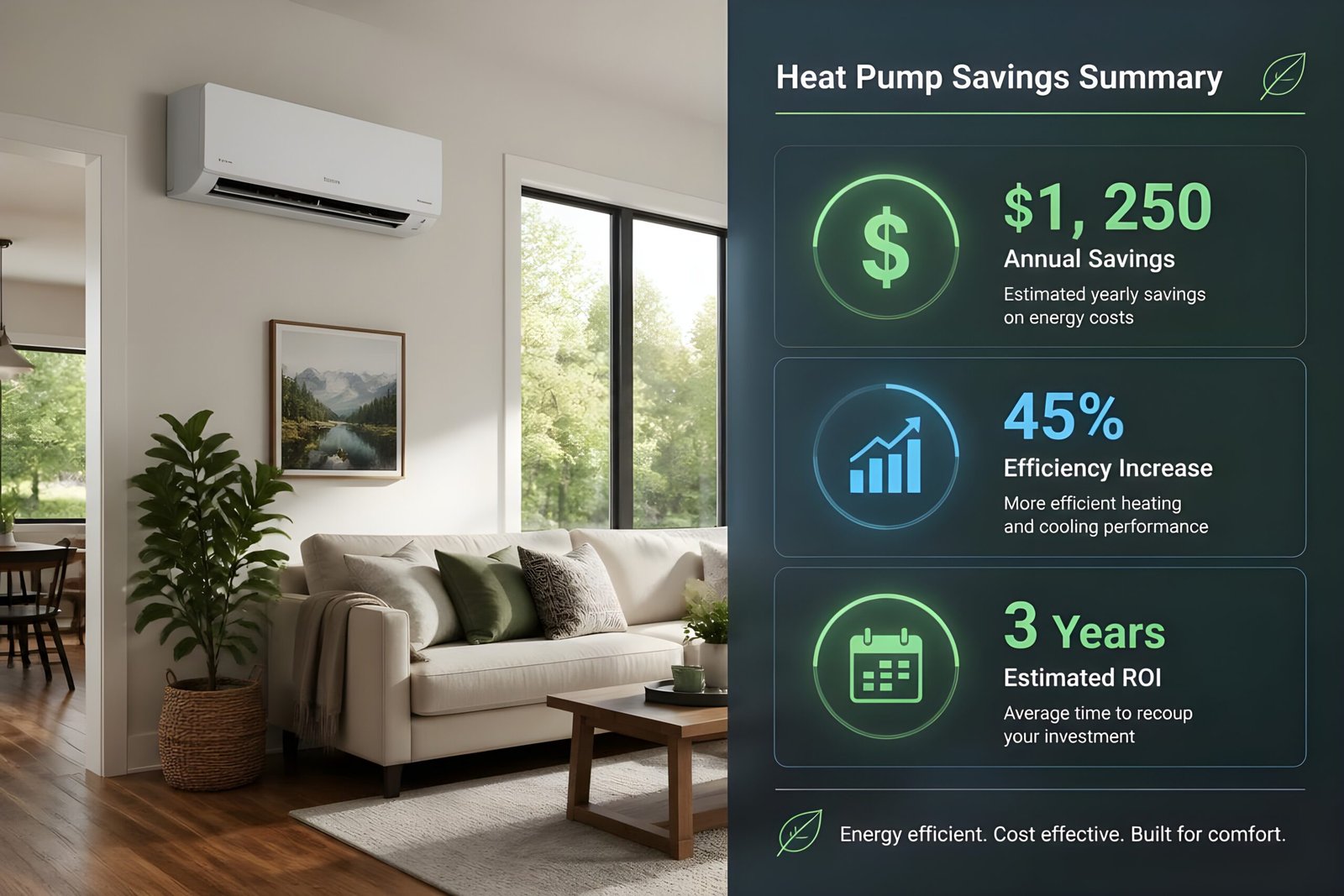
Heat Pump Savings Compared With Other Heating Systems
When researching home heating upgrades, homeowners frequently ask whether a heat pump will cost less to operate than their existing setup. Because every household relies on a different combination of equipment and local energy tariffs, the financial comparison varies significantly. Evaluating a heat pump cost comparison requires looking directly at how your current fuel type and system efficiency stack up against modern electric heat pump operating costs.
There is no universal winner that applies to every region. Whether a heat pump reduces your utility bills depends heavily on local utility prices, your climate, and the specific fuel source you are replacing.
Heat Pump vs. Natural Gas
In many regions, natural gas has historically been a low-cost option for home heating. When comparing a heat pump vs gas, the financial outcome depends closely on the prevailing price of natural gas relative to your local electricity rates, as well as the efficiency of your existing gas furnace or boiler.
Because heat pumps achieve high operational efficiency by moving heat rather than creating it through combustion, they use significantly less energy than older gas equipment. However, if local gas prices are exceptionally low and electricity rates are high, a gas furnace may still offer competitive operating costs during milder winter weather. Conversely, in regions with higher gas prices or robust electricity pricing structures, a modern heat pump can achieve competitive utility bill savings.
Heat Pump vs. Heating Oil
Heating oil prices are notoriously volatile, subject to sudden spikes driven by global market conditions and seasonal delivery pressures. When analyzing a heat pump vs oil setup, homeowners replacing older, lower-efficiency oil boilers often find a stark contrast in ongoing operating expenses.
Because oil systems require fuel storage and are frequently less efficient over time, switching to a high-efficiency heat pump can significantly alter winter utility expenses. Nevertheless, actual outcomes depend on your specific oil purchasing costs, local electricity rates, and how harshly your local climate drives up seasonal heating demand.
Heat Pump vs. Propane
Propane is another delivered fuel commonly used in rural areas or homes without natural gas pipeline access. Evaluating a heat pump vs propane comparison typically reveals that delivered propane can carry a high per-unit energy cost compared to standard grid electricity.
While a propane furnace can deliver reliable warmth, the operating expenses fluctuate based on regional fuel delivery rates. Because heat pumps utilize electrical energy to transfer heat efficiently, homes transitioning away from high-priced propane often experience a favorable shift in operating costs, provided local electricity rates remain balanced.
Heat Pump vs. Electric Resistance Heating
The comparison changes entirely when looking at electric resistance heating, such as baseboard heaters, electric furnaces, or radiant ceiling cables. Both systems use electricity as their primary power source, but their operational mechanics are fundamentally different.
Electric resistance systems must convert every unit of electricity directly into heat, making them expensive to run. In contrast, a heat pump moves multiple units of heat energy for every unit of electricity consumed. Because of this mechanical advantage, homes transitioning from electric resistance heating generally see substantial reductions in their monthly heating utility bills.
Core Factors That Shape the Comparison
To determine how a heat pump will perform against your current setup, a fair financial evaluation must consider several core variables:
- Energy Price: The local cost per kilowatt-hour of electricity versus the local price of your current fuel source (per therm, gallon, or kWh).
- System Efficiency: How efficiently your existing heating system converts its fuel source into useful indoor warmth.
- Heat Pump Efficiency: How effectively the heat pump maintains performance under actual outdoor operating conditions.
- Heating Demand: The overall quantity of heat your specific home requires based on floor plan and spatial layout.
- Climate: Local outdoor winter temperatures and seasonal heating duration, which dictate how frequently your system runs.
- Installation and Equipment: Proper equipment sizing, installation quality, and overall home insulation condition, which govern real-world energy consumption.
| Heating System | Main Energy Source | Primary Factors Affecting Operating Cost |
|---|---|---|
| Heat Pump | Electricity | Electricity rate, equipment efficiency, climate, heating demand |
| Gas Heating | Natural Gas | Gas utility rate, furnace/boiler efficiency, heating demand |
| Oil Heating | Heating Oil | Delivered oil price, system efficiency, seasonal usage |
| Propane Heating | Propane | Propane delivery price, system efficiency, climate |
| Electric Resistance | Electricity | Electricity rate, direct conversion ratio, heating demand |
Relying on generic rules of thumb or blanket averages can be misleading because energy markets and home characteristics vary drastically. Instead of guessing how your setup compares, use the Heat Pump Savings Calculator above to evaluate your own numbers using your local energy rates and current heating configuration.
What Determines Heat Pump Savings?
When evaluating whether a home upgrade makes financial sense, homeowners frequently want to know what variables drive the outcome. There is no single universal dollar amount or blanket percentage that applies to every house. Instead, your actual heat pump utility bill savings are dictated by a unique combination of structural, mechanical, and economic variables.
Understanding these underlying variables can help clarify why two different households can experience distinct financial results even when installing identical equipment. A reliable heat pump cost and savings estimator accounts for these interconnected elements rather than relying on generic rules of thumb.
1. Your Current Heating System
The baseline you are transitioning away from plays a primary role in your potential savings. Replacing a heating source with high operating costs naturally creates a different financial dynamic than replacing a system that runs on lower-cost energy. As discussed in previous comparisons, the financial gap between what you currently pay and what a heat pump requires forms the core foundation of your savings potential.
2. Electricity Prices
Because heat pumps run on electricity, your local utility rate directly impacts your monthly operating costs. A lower electricity rate generally enhances the financial advantage of switching, while an exceptionally high electricity tariff can narrow the gap, even if the equipment itself operates with high efficiency.
3. Fuel and Energy Prices
Just as electricity costs matter, the prevailing market price of the fuel you are replacing heavily influences the outcome. Fluctuations in regional energy markets—whether for natural gas, heating oil, or propane—directly alter the cost comparison between your old configuration and your new electric heat pump operating costs.
4. Heat Pump Efficiency
Modern equipment is designed to move heat rather than generate it through direct combustion or resistance, allowing it to deliver more thermal energy per unit of electricity consumed. More efficient equipment requires less electrical energy to maintain indoor comfort under comparable operating conditions.
5. Climate and Outdoor Temperatures
Local weather patterns dictate your seasonal heating demand and how many hours your system must work throughout the year. Colder climates require systems to operate more frequently, which influences overall energy consumption and seasonal performance.
6. Home Heating Demand
Every home has a unique thermal load. A larger house or one with high spatial volume requires more total heat energy to remain comfortable than a smaller, compact home. Financial returns depend not just on how efficiently the equipment runs, but on the sheer volume of heat your living space demands.
7. Insulation and Air Leakage
The physical envelope of your home dictates how well it retains heat. Good insulation and effective air sealing reduce the rate at which warmth escapes, meaning the heat pump does not have to work as hard or run as long to maintain a steady indoor temperature.
8. Sizing and Professional Installation
Equipment that is properly sized for your specific floor plan and professionally installed will perform closer to its intended rating. Incorrect sizing or poor installation practices can disrupt airflow, compromise efficiency, and increase energy consumption.
9. Operating Habits and Household Routines
Human behavior also shapes real-world energy use. Thermostat set points, scheduled setbacks, occupancy patterns, and how frequently supplemental or backup heat sources are engaged all affect your cumulative energy consumption over the course of a heating season.
How the Factors Interact: These variables do not operate in isolation. For example, a heat pump may feature exceptional efficiency, but if local electricity rates are high and the home suffers from poor insulation and severe heating demand, the financial savings may be more modest. Conversely, favorable electricity pricing, efficient equipment, and a moderate climate can produce a very different economic picture. This interplay is why a personalized evaluation is essential.
| Factor | Why It Matters |
|---|---|
| Current heating system | Determines the baseline cost and fuel type being replaced |
| Electricity price | Directly dictates the operating cost of the heat pump's power source |
| Fuel prices | Affects the ongoing cost of your existing legacy heating system |
| Heat pump efficiency | Governs how much electricity is required to deliver indoor warmth |
| Climate | Drives seasonal heating demand and outdoor operating hours |
| Home insulation | Influences how quickly warmth is lost and how long equipment must run |
| Installation quality | Ensures equipment performs reliably according to its design specifications |
| Operating habits | Affects real-world energy use through thermostat settings and schedules |
Because these conditions vary widely from house to house, using an interactive tool is far more effective than relying on a generalized guess. To see how these variables balance out for your property, use the Heat Pump Savings Calculator above to enter your own numbers, view projected energy savings, and determine whether a heat pump is worth it for your specific home.
Heat Pump Efficiency: COP, HSPF2, SEER2 and SCOP Explained
When researching home heating upgrades, efficiency ratings play a prominent role in product specifications and technical brochures. Understanding what these metrics mean—and how they differ—can help you evaluate modern equipment more effectively. However, interpreting these figures requires recognizing that efficiency ratings serve specific testing purposes and do not represent a single, guaranteed real-world performance metric.
A heat pump's energy efficiency fundamentally dictates how much electricity it requires to deliver a given amount of useful indoor thermal comfort. While higher efficiency generally points toward lower electrical consumption under comparable conditions, navigating ratings like COP, HSPF2, SEER2, and SCOP requires looking beyond simple marketing claims.
What Is COP?
COP stands for Coefficient of Performance. In simple terms, COP measures the ratio of useful heating or cooling output delivered by the system compared to the electrical energy it consumes under a specific, point-in-time operating condition.
For example, if a heat pump operates at a COP of 3 under a specified set of outdoor and indoor temperatures, it delivers approximately three units of thermal heat energy for every single unit of electrical energy consumed. Because heat pumps move heat rather than creating it through direct electrical resistance, their COP is typically greater than 1.
However, COP is not a static, lifetime figure. It fluctuates continuously based on outdoor weather conditions, system design, equipment age, and part-load operations. A system achieving a high COP during a mild autumn afternoon will experience a lower COP during a frigid winter night.
What Is HSPF2?
HSPF2 stands for Heating Seasonal Performance Factor 2. Unlike COP, which measures performance at a single snapshot in time, HSPF2 is a standardized seasonal heating-efficiency rating used primarily within the U.S. testing framework.
HSPF2 is designed to estimate the total heating output of a heat pump over an entire standardized heating season, divided by the total electrical energy consumed during that same period. It provides a generalized way to compare the seasonal heating efficiency of different equipment models under regulated laboratory conditions.
It is important not to confuse HSPF2 with COP. A seasonal rating accounts for varying weather patterns and cyclical operations across months, whereas COP represents instant performance metrics under exact operating parameters.
What Is SEER2?
SEER2 stands for Seasonal Energy Efficiency Ratio 2. While heat pumps handle both heating and cooling, SEER2 specifically measures their seasonal cooling efficiency under standardized U.S. testing guidelines.
When evaluating heat pump utility bill savings and heating economics, SEER2 is secondary because it applies strictly to air conditioning performance during warmer months. However, because modern heat pumps provide year-round climate control, equipment packages bundle both heating and cooling ratings to reflect total seasonal performance capabilities.
What Is SCOP?
SCOP stands for Seasonal Coefficient of Performance. This metric measures the overall seasonal efficiency of a heat pump system over an entire heating season.
It is worth noting regional terminology differences: SCOP is predominantly utilized in European and international testing frameworks, whereas HSPF2 and SEER2 govern the current U.S. regulatory landscape. They are regional adaptations designed to achieve the same core goal—providing standardized seasonal estimates—rather than interchangeable universal numbers.
| Rating Metric | What It Measures | Primary Application |
|---|---|---|
| COP | Ratio of heat output to electricity input at a given moment | Point-in-time performance under specific conditions |
| HSPF2 | Total seasonal heating output divided by seasonal energy input | U.S. seasonal heating efficiency evaluation |
| SEER2 | Total seasonal cooling output divided by cooling energy input | U.S. seasonal cooling efficiency evaluation |
| SCOP | Average coefficient of performance across an entire heating season | International/European seasonal heating performance |
Why Efficiency Matters for Savings
The core economic link between efficiency and heat pump energy savings is direct: equipment with a higher useful efficiency rating requires less electricity to satisfy your home's heating demand than a lower-rated system under similar conditions. Reduced electricity consumption per unit of heat translates directly to lower operating overhead.
Nevertheless, a high rating does not guarantee the lowest possible utility bill. Actual operating costs depend on a complex web of external factors, including local electricity tariffs, regional climate patterns, building insulation quality, and how the equipment is installed and maintained.
Ratings vs. Real-World Performance: Standardized ratings provide an essential framework for comparing equipment side-by-side on an equal playing field. However, real-world factors—such as local weather extremes, defrost cycles, ductwork losses, thermostat scheduling, and precise equipment sizing—mean actual household performance will always diverge from laboratory certificates.
Because efficiency is only one component of a broader financial equation, relying on equipment spec sheets alone is not enough to predict your personal financial outcome. To evaluate how these variables interact with your local energy prices and baseline heating configuration, use the Heat Pump Savings Calculator above to generate a personalized estimate tailored to your home.
How Much Does It Cost to Run a Heat Pump?
When homeowners evaluate home heating options, understanding ongoing running expenses is crucial. A common question is: "How much will it cost me to run a heat pump?" There is no single universal dollar amount or flat monthly figure that applies to every house. Instead, actual operating expenses are driven by a direct economic relationship: how much electricity the system consumes multiplied by your local electricity rate.
Electricity consumption itself depends heavily on the amount of heating your home requires and how efficiently the equipment provides that heat under real-world conditions. Evaluating your heat pump operating cost accurately requires examining how these structural and economic components interact.
What Determines the Cost to Run a Heat Pump?
The total heat pump electricity cost is shaped by several distinct operating variables:
- Electricity Rate: Your local utility tariff per kilowatt-hour (kWh) directly dictates the price of powering the system. Different regions experience vastly different utility costs.
- Heat Pump Efficiency: Equipment performance levels govern how much electrical energy is required to produce a given amount of thermal heat.
- Heating Demand: The overall volume of heat your home needs to stay comfortable based on layout and spatial dimensions.
- Climate and Outdoor Temperatures: Colder regional climates and extended heating seasons demand more frequent operation, increasing total energy use.
- Home Efficiency: Building insulation, air leakage, and thermal loss rates dictate how quickly warmth escapes your living space.
- Operating Habits: Thermostat settings, schedule setbacks, and the engagement of backup or supplemental heating components influence cumulative electricity consumption.
How to Estimate Heat Pump Electricity Costs
At a high level, conceptualizing operating expenses follows a straightforward principle:
Conceptual Relationship:
Estimated Operating Cost = Total Electricity Used (kWh) × Local Electricity Rate ($ per kWh)
To provide an illustrative framework, consider a hypothetical scenario where a system consumes a specific block of kilowatt-hours over a monitoring period. Multiplying that consumption figure by an arbitrary local utility rate yields a basic expense calculation. However, it is important to treat this formula as a conceptual model rather than a guaranteed prediction, because real-world weather patterns and dynamic heating loads constantly shift energy consumption.
Why Your Heat Pump Electricity Use Can Change
A heat pump's monthly energy consumption is rarely static. Electricity usage can fluctuate significantly due to:
- Outdoor Weather Shifts: Colder outdoor temperatures reduce ambient heat availability, requiring systems to work harder or cycle more frequently.
- Defrost Cycles: During cold, humid weather, outdoor coils may accumulate frost, triggering automated defrost cycles that temporarily alter efficiency profiles.
- Thermostat Adjustments: Manually changing temperature targets or utilizing aggressive setbacks can impact run times.
- Supplemental Heat Activation: If outdoor conditions push equipment past its design capacity, auxiliary or backup heating elements may engage, changing electrical draw.
What About Monthly Utility Bills?
It is helpful to distinguish between your overall monthly utility bill and your specific heat pump utility bill savings. A home's total electricity bill accounts for all household electrical loads—including lighting, appliances, hot water, and electronics—meaning the heat pump represents only one component of your total utility statement.
When transitioning from a fossil-fuel system to an electric heat pump, you may notice an increase in your electricity consumption alongside a complete reduction or elimination of your previous fuel delivery or gas utility expenses. Evaluating financial performance requires balancing these shifts across your total household energy budget.
| Operating Variable | Effect on Heat Pump Running Cost |
|---|---|
| Electricity rate | Higher local utility rates directly increase overall running costs |
| Heating demand | Greater space heating requirements increase total energy consumption |
| Equipment efficiency | Higher efficiency levels reduce the electricity required for heating output |
| Climate severity | Colder winters and longer heating seasons elevate seasonal run times |
| Building envelope | Poor insulation accelerates heat loss, driving up operational run cycles |
| Household habits | Thermostat scheduling and temperature preferences affect overall power draw |
Knowing your heat pump's running cost is only half of the overall financial picture. To determine whether an upgrade reduces your net expenses, you must compare these operating costs against the price of your current heating system. Rather than relying on broad generalizations, use the Heat Pump Savings Calculator above to input your unique local utility rates, current fuel baseline, and home specifications for a personalized financial estimate.
When Is a Heat Pump Cheaper Than Your Current Heating System?
A central question for homeowners evaluating home comfort upgrades is: "At what point is a heat pump cheaper to operate than my current heating system?" Determining this threshold involves looking at the point where ongoing utility or fuel expenditures shift in your favor. Because energy markets, regional climates, and equipment configurations vary widely, there is no universal threshold or single break-even utility price that applies to every household.
Instead, financial outcomes depend entirely on the dynamic relationship between your local electricity rates, your existing fuel prices, equipment efficiencies, and seasonal heating demands. Understanding how these factors interact helps clarify when a heat pump delivers lower operational costs.
Important Distinction: Operating-Cost Break-Even vs. Investment Payback
When assessing the economics of a heating upgrade, it is important to separate two different concepts:
- Operating-Cost Break-Even: The specific condition where the estimated cost of running the heat pump to provide a given amount of useful indoor heat is approximately equal to the cost of providing that same heat using your existing heating system.
- Investment Payback: The separate timeline required for cumulative operating-cost savings to eventually recover the upfront purchase and installation expenses of new equipment.
While operating-cost break-even dictates whether your monthly utility or fuel expenses go down immediately, total investment payback involves equipment acquisition costs, labor, and available regional incentives.
What Does Break-Even Mean for a Heat Pump?
In practical terms, reaching an operating-cost break-even point means that the price paid for electrical energy to power the heat pump balances out against the cost of burning natural gas, heating oil, propane, or using direct electric resistance heating. If energy tariffs shift past that point, one system becomes more economical to run than the other.
The comparison can be conceptualized as evaluating the cost of equivalent useful heat:
The Conceptual Balance:
Cost of Useful Heat from Heat Pump (Driven by Electricity Rates & Efficiency)
VERSUS
Cost of Equivalent Useful Heat from Existing System (Driven by Fuel Prices & System AFUE/Efficiency)
What Determines the Break-Even Point?
Several major factors dictate where this operating-cost balance occurs for an individual home:
- Electricity Price: Because heat pumps rely entirely on electricity, your local utility rate per kilowatt-hour directly dictates the running cost baseline. Higher electricity tariffs raise the threshold needed to achieve savings.
- Existing Fuel Price: The market cost of natural gas, heating oil, or propane establishes how expensive your legacy baseline system is to operate. Fluctuations in delivered fuel prices directly shift the comparative balance.
- Existing System Efficiency: An older, low-efficiency furnace or boiler consumes more fuel to deliver heat than a modern, high-efficiency unit, making a heat pump look more economically favorable by comparison.
- Heat Pump Efficiency: Equipment performance metrics dictate how much electrical input is required to transfer thermal heat under active weather conditions.
- Outdoor Temperature and Climate: As outdoor temperatures drop, heat pump performance profiles adjust, modifying the electrical draw required to satisfy household thermal demands.
- Heating Demand: The spatial dimensions and structural heat retention of your house determine total energy consumption over the heating season.
Why the Break-Even Point Can Change
An operating-cost break-even point is not a permanent fixture. It can shift over time due to changes in external conditions:
- Regional utility companies adjust electricity rate structures or time-of-use pricing tiers.
- Fossil fuel and delivered energy commodity prices fluctuate based on seasonal or global market pressures.
- Local weather patterns vary from year to year, altering overall heating season duration and operating hours.
- Equipment ages or undergoes maintenance adjustments that affect real-world performance efficiency.
Because these variables are unique to your geography and household setup, relying on generalized rules of thumb or static market assumptions can lead to inaccurate conclusions. To evaluate your own position without relying on broad averages, use the Heat Pump Savings Calculator above to input your specific local energy rates, current heating system details, and utility configurations.
Heat Pump Financial Incentives, Tax Credits, and Rebates
When planning a home heating upgrade, understanding the financial landscape is just as crucial as evaluating operating costs. Transitioning to modern heating equipment involves an initial capital investment, but a variety of financial mechanisms can help offset those upfront expenses. Exploring available options provides a clearer picture of your total net commitment.
Whether you are using a heat pump cost and savings estimator or planning your budget directly, investigating potential programs can reveal opportunities to reduce your overall project costs. However, navigation requires understanding how different programs operate and why eligibility rules vary from house to house.
What Are Heat Pump Financial Incentives?
Financial incentives are programs established by government bodies, regional utilities, energy-efficiency organizations, and other qualifying entities to encourage the adoption of high-efficiency electric equipment. These initiatives are designed to offset a portion of the initial capital hurdles associated with purchasing and installing modern climate control systems.
By lowering the effective upfront cost of equipment acquisition and professional installation, these programs can improve the initial financial accessibility of upgrading your home heating infrastructure.
Tax Credits vs. Rebates: What's the Difference?
Homeowners exploring financial support frequently encounter distinct categories of assistance:
- Tax Credit: A tax credit directly reduces the amount of income tax you owe to the governing tax authority, subject to applicable regulatory rules, equipment specifications, and personal eligibility parameters.
- Rebate: A rebate generally provides direct financial reimbursement or point-of-sale price reduction after or during a qualifying purchase and installation, subject to specific program terms and submission guidelines.
It is important to evaluate how each program applies to your personal tax situation and equipment class, as tax treatment and qualification criteria vary significantly by jurisdiction.
Federal, State, Local, and Utility Incentives
Incentive structures are rarely monolithic. Homeowners may find programs originating from multiple levels:
- Federal Programs: Broad national frameworks providing standardized tax credits for qualifying energy-efficient home improvements.
- State Programs: State-level energy office initiatives aimed at promoting local electrification and building decarbonization.
- Local Governments: Municipal or county programs targeting regional emissions reductions.
- Electric Utilities: Rebates offered by local electric cooperatives or investor-owned utilities encouraging electrical load transitions.
While encountering multiple overlapping offerings is common, rules dictating whether programs can be "stacked" (combined) vary widely depending on the administrator. Not all utilities or local jurisdictions offer active rebates, and qualification parameters are strictly dependent on local policy.
Why Stacking and Equipment Tiers Matter
Combining multiple qualifying programs—such as federal credits alongside local utility rebates—can substantially shift your initial budget requirements. However, stacking rules and maximum payout caps differ by provider, and eligibility is strictly tied to certified equipment performance tiers.
Use the interactive tools below to model combined potential savings and check tier compliance standards before purchasing equipment.
Stackable Incentive & Rebate Totalizer
Select the program layers you plan to apply for to estimate total combined financial returns against your baseline project cost.
Note: Fictional illustrative values only. Actual stacking rules and limits depend on local jurisdiction guidelines.
Equipment Efficiency & Tax Credit Tier Matcher
Evaluate how equipment classification and performance standards map to compliance categories.
Meets requirements for top-tier federal credits and high-efficiency regional rebates.
How Incentives Can Change Your Heat Pump Investment
From a budgeting perspective, the interaction between project expenses and financial support follows a clear structural equation:
Net Upfront Cost Equation:
Estimated Net Cost = Estimated Project Cost − Eligible Incentives
By reducing this net initial commitment, qualifying programs can improve initial affordability. While these savings directly influence your upfront financial baseline—which feeds into subsequent calculations of long-term return on investment and payback duration—incentives alone do not guarantee that every installation will yield positive financial returns without accounting for ongoing operating costs.
Illustrative Calculation Example:
If an estimated project cost is $12,000 and an eligible user-entered incentive amount is $2,500, the resulting net cost calculation comes to $9,500 ($12,000 − $2,500). Note: This is an illustrative example only using fictional values and does not reflect current market incentives.
What to Check Before Claiming an Incentive
Program requirements are often strict and detail-oriented. Before purchasing or installing equipment, homeowners should review a thorough checklist:
- Equipment Eligibility: Verify that the specific heat pump model meets required efficiency ratings (such as minimum HSPF2 or SEER2 thresholds).
- Installation Standards: Ensure the installation meets regional code requirements and is performed by qualified technicians where mandated.
- Income Qualifications: Check whether specific rebates are income-capped or structured around area median income guidelines.
- Application Deadlines: Confirm whether paperwork must be filed pre-installation or within a specific timeframe following project completion.
- Documentation Requirements: Keep detailed contractor invoices, AHRI certificates, and product serial numbers ready for submission.
Verify Incentives Before You Buy
Because incentive availability, funding pools, and tax rules evolve continuously, it is essential to verify all program terms directly through official channels before finalizing a purchase decision. Always consult appropriate federal resources, your state energy office, local utility provider portals, or qualified tax professionals to confirm current eligibility.
Once you have a clear picture of your net upfront investment, you can pair those figures with the Heat Pump Savings Calculator above to evaluate how anticipated utility bill savings and operating costs balance out over time.
Climate Zones and Regional Performance: Will a Heat Pump Work in Cold Weather?
One of the most frequent questions homeowners ask when considering a transition away from traditional fossil-fuel furnaces is whether modern heat pumps can handle severe winter conditions. Historically, early-generation heat pumps experienced significant drops in heating capacity and efficiency once outdoor temperatures dipped below freezing.
However, advances in engineering—specifically variable-speed inverter compressors and enhanced vapor injection technology—have drastically changed regional viability. Today, heat pumps routinely warm homes in sub-zero climates across North America and Europe, provided the system is correctly specified for local winter design temperatures.
Understanding Climate Zones and Winter Extremes
Building energy codes classify regions into distinct climate zones based on annual heating and cooling degree days:
- Warm and Mixed Zones (Zones 1–3): Cooling loads dominate, and winter heating needs are modest. Standard heat pumps operate at peak efficiency throughout the year with minimal backup requirements.
- Cold and Very Cold Zones (Zones 4–7): Heating loads dominate, and outdoor winter temperatures frequently drop below freezing. Modern "cold-climate" certified models are engineered to maintain high heating delivery even at ambient temperatures as low as -15°F or lower.
Evaluating your region's historical winter low temperatures is critical before selecting equipment capacity or sizing supplemental heating infrastructure.
How Temperature Affects Heat Pump Efficiency
Unlike fossil-fuel heaters that burn gas or oil to create combustion heat, heat pumps move existing thermal energy from the outdoor air into your living space. As outside temperatures drop, there is less ambient thermal energy available, causing the system to work harder.
This dynamic is measured by the Coefficient of Performance (COP) and rated heating capacity retention. Use the interactive tool below to simulate how shifting outdoor winter temperatures impact estimated equipment efficiency and capacity output.
Climate Zone / Temperature Performance Slider
Adjust the outdoor temperature slider to preview how heating capacity, efficiency (COP), and operational status change in colder conditions.
Cold-Climate Design and Backup Heat Considerations
In regions experiencing prolonged freezing snaps, system design accounts for worst-case operational scenarios:
Backup Heat Integration:
While cold-climate heat pumps deliver warmth at extreme lows, many installations incorporate a secondary backup heat source (such as existing electric resistance strips or a dual-fuel gas furnace integration) to handle rare, extreme weather spikes.
Proper sizing by a certified HVAC contractor ensures your system maintains indoor comfort during severe cold snaps without oversizing the unit for milder spring and autumn transition months.
Verifying Your Local Regional Requirements
Before committing to an installation, consult with professional energy auditors or local contractors familiar with your specific geographic zone. Reviewing manufacturer cold-climate performance sheets ensures your selected model maintains reliable heating output right down to your area's historical annual minimum design temperature.
Combining Solar Panels with a Heat Pump: Maximizing Utility Bill Savings
Pairing a high-efficiency electric heat pump with a residential photovoltaic (PV) solar panel system represents one of the most powerful modern strategies for achieving near-total energy independence and insulation from rising utility rates. Because both technologies operate on electricity, pairing them closes the loop: your roof generates clean power during the day, and your heat pump efficiently consumes that power to heat and cool your home year-round.
Understanding how these two systems interact allows homeowners to maximize financial returns, optimize energy consumption patterns, and significantly slash monthly utility expenditures.
The Natural Synergy Between Solar and Electrification
At first glance, heating a home with solar power might seem counterintuitive since peak solar generation occurs during long, warm summer days, while space heating demands peak during cold winter months. However, the system synergy functions seamlessly through structural integration and regional net-metering frameworks:
- Cooling Season Alignment: During summer months, your heat pump works as an air conditioner exactly when your solar panels generate maximum electricity output, effectively running your cooling system for free using self-consumed solar energy.
- Net Metering & Credits: In winter, when heating run-times increase and solar production dips, excess electricity credits accumulated during sunny spring and autumn months can often be applied against winter grid electricity imports.
- Inflation Hedging: Generating your own electricity protects you directly against utility tariff hikes, stabilizing your total home energy budget for decades.
Interactive Element: Solar + Heat Pump Offset Estimator
Use the interactive tool below to model how adjusting your solar array size and estimated heat pump electrical consumption impact your annual grid energy offset and net savings potential.
Solar & Heat Pump Offset Estimator
Adjust the sliders to test different solar array capacities and heat pump annual energy usages.
Optimizing Design and Battery Storage Integration
To capture the highest possible financial yield from a combined solar and heat pump installation, consider the following strategic design components:
Time-of-Use (TOU) and Battery Storage:
If your utility provider utilizes Time-of-Use pricing rates—where electricity costs significantly more during peak evening hours—adding a home battery storage system allows you to store daytime solar energy and power your heat pump through cold evening hours without pulling expensive grid electricity.
Properly sizing both your solar PV array and your heat pump together ensures that neither system is over- or under-engineered, maximizing your return on investment from day one.
Next Steps for Combined System Planning
When planning a dual upgrade, it is usually most efficient to coordinate both installations or ensure your initial solar design has sufficient electrical capacity to support a future heat pump conversion. Consulting with an integrated energy contractor allows you to review roof structural load, electrical panel amperage limits, and available federal and local incentives for bundled clean energy upgrades.
Dual-Fuel (Hybrid) Systems: Combining a Heat Pump with a Gas Furnace
For homeowners living in harsh, freezing climates where sub-zero winter temperatures are common, heating with a standard air-source heat pump alone can sometimes test the limits of equipment efficiency. To eliminate this concern, a dual-fuel (hybrid) heating system pairs an electric heat pump with a backup gas or propane furnace, offering the absolute best of both worlds.
In a dual-fuel configuration, an intelligent smart thermostat automatically manages which system runs based on outdoor temperatures and energy tariffs, ensuring your home remains comfortable while maintaining peak economic efficiency.
How a Hybrid Heating System Operates
During mild and moderate winter weather, the electric heat pump provides quiet, highly efficient warmth. However, when outdoor temperatures drop past a specific "balance point" where the heat pump's coefficient of performance (COP) drops below that of the fossil fuel furnace, the system seamlessly transitions to gas heating.
- Mild to Moderate Cold: Heat pump runs exclusively, providing up to 300%+ efficiency by moving ambient thermal energy indoors.
- Severe Sub-Zero Cold: The gas furnace takes over instantaneously, burning fossil fuel to produce high-temperature air without relying on resistive backup coils.
Dual-Fuel Operating Mode Selector
Click a system operating state to see how the hybrid configuration responds in real-time.
Interactive Element 2: Balance Point Temperature Estimator
Use the slider below to test how adjusting your local winter transition threshold (balance point) impacts your annual heating fuel split.
Balance Point Temperature Estimator
Adjust the outdoor switchover temperature to model how your heating load is divided.
Why Choose a Dual-Fuel Setup?
Climate Resiliency and Cost Control:
Dual-fuel systems protect you against rolling grid blackouts, high electricity peak rates, and extreme polar vortex events. You capture low running costs 90% of the winter while retaining reliable high-heat backup when mercury plummets.
When planning a major home comfort upgrade, consulting with a certified HVAC professional ensures your dual-fuel integration is calibrated accurately to your local climate zone.
How Long Does It Take for a Heat Pump to Pay for Itself?
One of the most critical considerations when evaluating a home energy upgrade is the financial payback period—the span of time required for your cumulative utility bill savings to fully recover your initial capital expenditure. Because heat pumps involve upfront purchase and installation costs, calculating this timeline provides a clear financial roadmap for your investment.
While industry averages often suggest payback windows ranging from 5 to 10 years, actual timelines vary significantly depending on local energy tariffs, available incentives, regional climate severity, and the efficiency of your previous heating system.
The Core Payback Equation
At its foundation, calculating equipment payback is a direct ratio between your net financial commitment and your annual operational savings:
Simple Payback Period Formula:
Payback Period (Years) = Net Upfront Investment ($) ÷ Annual Energy Savings ($ per year)
Your net upfront investment factors in total equipment and labor costs minus any federal tax credits, state rebates, or utility cash-back incentives. Annual energy savings represent the difference between what you used to spend on fossil fuels or standard electric heating versus your new electricity running costs.
Payback Period & ROI Timeline Estimator
Input your estimated net project cost and anticipated annual utility savings to calculate your equipment payback timeline.
Key Factors That Influence Your Payback Timeline
No two homes experience identical financial returns. Several structural variables dictate whether your payback period is shorter or longer:
- Legacy Fuel Costs: Replacing expensive heating oil, propane, or direct electric baseboards yields much faster savings than replacing inexpensive natural gas.
- Utility Rate Ratios: The "spark spread"—the ratio between electricity prices and fossil fuel prices in your local utility market—directly dictates annual savings magnitude.
- Incentive Capture: Leveraging maximum federal tax credits and regional rebates reduces your net initial denominator, accelerating your payback timeline.
- Climate Intensity: Homes in moderate climates or cold climates with high-efficiency equipment achieve different seasonal run profiles that alter annual operational savings.
Beyond Simple Payback: Long-Term Equipment Value
While simple payback provides a helpful snapshot, it represents only one dimension of value. Modern heat pumps also provide upgraded central air conditioning (replacing aging window units or outdated AC compressors), eliminate indoor combustion hazards, reduce household carbon emissions, and enhance overall home resale value.
To see how your exact parameters align, use the Heat Pump Savings Calculator above to generate a complete financial breakdown tailored to your home.
Heat Pump Maintenance and Longevity: Protecting Your Investment
A residential heat pump is a major mechanical infrastructure investment designed to handle continuous year-round heating and cooling. Modern systems are exceptionally durable, but like any sophisticated equipment, their operational efficiency and total service life depend directly on the quality of routine care they receive.
While standard heat pumps are built to operate reliably for 15 to 20 years, neglected systems experience accelerated wear, declining efficiency, and premature component failure. Implementing a disciplined maintenance routine ensures peak performance and preserves your investment over the long term.
Expected Lifespan and Efficiency Retention
Compared to conventional combustion furnaces or standard air conditioners, heat pumps run continuously in steady cycles rather than short-cycling on and off, reducing mechanical stress. However, protecting your system requires understanding key longevity milestones:
- Standard Operational Window: Well-maintained air-source heat pumps consistently achieve a 15-to-20-year service life.
- Efficiency Degradation: Without regular care, dirty coils and restricted filters can cause energy use to increase by 10% to 25%, inflating monthly utility bills.
- Warranty Requirements: Most major manufacturers require proof of annual professional servicing to validate parts and compressor warranty coverage.
System Health & Longevity Tracker
Check off the maintenance routines you currently follow to estimate your system's health and expected lifespan score.
Essential DIY Maintenance Tasks
Homeowners can easily manage several critical maintenance items that require no specialized tools:
- Filter Management: Check your indoor filters monthly. Clean washable mini-split filters or replace standard disposable filters to maintain proper airflow and prevent blower strain.
- Outdoor Clearance: Trim shrubs, bushes, and tree branches away from the external condenser unit, maintaining at least 18 to 24 inches of clearance on all sides.
- Coil Rinsing: Carefully rinse away dust and seasonal debris from outdoor condenser coils using low-pressure water from a standard garden hose.
When to Call a Professional Technician
Professional Service Boundaries:
While homeowner upkeep handles surface cleaning and filters, refrigerant measurements, electrical terminal tightening, and compressor testing must always be handled by a certified HVAC technician during your annual service visit.
By pairing proactive DIY upkeep with scheduled annual professional tune-ups, your heat pump will deliver reliable comfort, maximum efficiency, and optimized financial returns for nearly two decades.
Common Heat Pump Installation Pitfalls and How to Avoid Them
Transitioning your home to a heat pump system is a major upgrade that promises high efficiency, improved comfort, and long-term utility savings. However, a heat pump’s performance relies heavily on proper engineering and execution. Even top-tier equipment will underperform, consume excessive electricity, or fail prematurely if installed incorrectly.
Recognizing and avoiding critical engineering and contractor oversights during the planning and installation phases ensures your system operates at peak efficiency from day one.
The Dangers of Improper System Sizing
One of the most frequent errors in HVAC retrofits is incorrect sizing. Contractors must calculate precise heating and cooling loads rather than guessing based strictly on square footage or replacing an old unit "rule of thumb."
- Oversized Units: An oversized heat pump "short-cycles"—turning on and off too rapidly. This prevents proper humidity dehumidification, increases mechanical wear, and leads to uneven indoor temperatures.
- Undersized Units: An undersized system runs constantly trying to reach target temperatures, struggling to maintain comfort during extreme weather and increasing electricity consumption.
Installation Pitfalls Inspector
Select a category below to explore critical installation errors and professional prevention strategies.
Manual J Load Calculation Failure
Skipping a formal room-by-room Manual J calculation often leads to mismatched capacities. Always demand that your contractor perform a detailed structural heat-loss and heat-gain analysis based on insulation, window orientation, and local climate.
Leaky or Undersized Ducts
Heat pumps deliver air at lower temperatures than gas furnaces. If existing ductwork has leaks, poor insulation, or restrictive sizing, conditioned air escapes into unconditioned attics or crawlspaces, severely dropping overall system efficiency.
Poor Outdoor Unit Placement
Placing the outdoor condenser in an unshielded wind tunnel, too close to property lines, or where roof runoff can freeze on the unit can trigger severe icing issues and restrict airflow. Ensure proper elevation and drainage clearance.
Ductwork and Airflow Requirements
Many homeowners assume existing ductwork can seamlessly handle a new heat pump without modification. However, heat pumps require optimized airflow rates to transfer thermal energy effectively.
Duct Testing and Sealing:
Before installing a central ducted heat pump, request a duct leakage test. Sealing leaks and balancing airflow ensures the system meets its rated SEER2 and HSPF2 efficiency numbers.
Choosing the Right Contractor
Avoiding these pitfalls ultimately depends on hiring a qualified, certified HVAC specialist rather than relying on the lowest bidder. Ensure your contractor is trained in modern inverter-driven heat pump technology, provides clear warranties, and handles all necessary local permits and inspections.
Key Takeaways: Making Your Heat Pump Transition a Success
Transitioning your home to an energy-efficient heat pump system is one of the most impactful upgrades you can make for long-term comfort, utility savings, and environmental sustainability. Evaluating the economics requires looking beyond the initial equipment price tag to understand operational break-even points, payback timelines, and government incentive programs.
Reviewing the core principles covered across this guide highlights the most critical success factors for your home electrification project:
1. Operating Economics
Heat pumps offer exceptional efficiency (often 300%+), making them cheaper to run than traditional fossil fuel systems when local electricity-to-fuel price ratios favor electricity.
2. Incentive Capture
Federal tax credits, state-administered rebates, and utility cash-back programs dramatically lower net upfront installation costs and shorten payback timelines.
3. Proper Sizing & Design
Precision Manual J load calculations, balanced ductwork, and correct equipment sizing prevent short-cycling and ensure rated SEER2/HSPF2 performance.
4. Complementary Upgrades
Pairing your heat pump with rooftop solar panels or opting for a dual-fuel hybrid configuration maximizes grid independence and extreme-weather resilience.
Your Next Steps
Ready to Model Your Home’s Savings?
Use the Heat Pump Savings Calculator at the top of this guide to input your specific local energy tariffs, legacy fuel rates, and household details to get a personalized financial forecast tailored to your home.
By combining accurate data modeling, professional contractor expertise, and available clean energy incentives, you can move forward with your heat pump upgrade with complete confidence.
Frequently Asked Questions
Replacing your heating, ventilation, and air conditioning system is a major home investment. We have assembled 20 detailed answers to the most crucial high-volume and common questions.
A complete heat pump system replacement typically costs between $9,000 and $18,000, including high-efficiency equipment and professional installation. The final price depends heavily on your home's square footage, ductwork condition, electrical capacity, and regional labor rates.
Key indicators include system age exceeding 12 to 15 years, rising utility bills despite normal use, frequent costly repairs, uneven temperatures across rooms, and strange noises or odors during operation.
Yes, because heat pumps move thermal energy rather than burning fuel, they achieve 300%+ efficiency ratings, often resulting in substantially lower monthly operating costs compared to natural gas, propane, or heating oil.
Under the Energy Efficient Home Improvement Credit, qualifying systems meeting strict CEE efficiency tiers are eligible for tax credits up to 30% of total project costs, capped at $2,000 per year.
State clean energy programs (like HOMES and HEEHRA) and electric utility co-ops provide direct instant rebates or cash-back checks. Rebate sums often scale based on household income tiers relative to the local Area Median Income (AMI).
SEER2 measures seasonal cooling performance under updated testing standards, while HSPF2 measures heating efficiency. Higher ratings guarantee lower electrical consumption and maximum comfort.
Yes. Advanced cold-climate heat pumps utilize enhanced vapor injection compressors to extract warmth effectively even when outdoor temperatures plunge below 0°F (-18°C).
Depending on your prior heating fuel (such as propane or oil), local utility rates, and incentive capture, simple investment payback typically spans 5 to 10 years.
Often yes, provided an HVAC technician performs a static pressure and duct leakage inspection to ensure existing ducts can handle proper airflow requirements without efficiency drops.
Ductless mini-splits connect an outdoor condenser unit to one or more wall-mounted indoor air handlers via compact refrigerant lines, providing zoned room-by-room comfort without central ducts.
A dual-fuel system pairs an electric heat pump with a backup gas furnace. A smart thermostat automatically switches to gas heat during deep freezes when fossil fuel proves more economical.
A properly maintained heat pump system typically lasts between 15 and 20 years, benefiting from continuous steady run cycles that reduce mechanical startup stress.
Homeowners should clean or replace indoor air filters every 1 to 3 months, keep outdoor units clear of plant debris and snow buildup, and schedule an annual professional maintenance tune-up.
Pairing solar PV panels with a heat pump maximizes long-term savings by powering your heating and cooling electricity needs with free self-generated solar energy.
An oversized heat pump short-cycles, causing poor humidity control and premature wear, while an undersized unit fails during extreme weather. Manual J calculations ensure exact sizing.
Yes. Replacing an aging system proactively prevents emergency breakdowns during peak summer heatwaves or winter freezes, when replacement wait times and labor rates are highest.
Light frost formation during heating is normal. Heat pumps feature automatic defrost cycles that periodically reverse briefly to melt accumulated frost and drain water away.
Unlike old single-speed units that turn fully on or off, inverter compressors modulate operating speeds continuously to match exact thermal loads, saving electricity and stabilizing indoor temperatures.
Yes. Modern energy-efficient HVAC upgrades appeal strongly to prospective home buyers seeking lower utility overhead, advanced indoor air filtration, and reliable modern climate infrastructure.
Older homes with 100-amp electrical panels may require a service upgrade to support new 240V circuits for high-capacity heat pumps. A certified electrician can verify your electrical load capacity.
Trusted Industry & Government Sources
Our guidance, data models, and specifications are built upon verified insights from leading federal agencies, independent research labs, and certified HVAC standards institutions.
U.S. Department of Energy (DOE)
GovernmentEnergy efficiency recommendations, HVAC system performance, insulation guidance, and homeowner energy-saving best practices.
ENERGY STAR
Gov ProgramOfficial efficiency ratings, certified HVAC equipment databases, rebate locators, and SEER2 compliance guidance.
Air Conditioning Contractors of America (ACCA)
Industry StandardProfessional HVAC installation standards, Manual J load calculation sizing, quality installation guidelines, and contractor best practices.
Environmental Protection Agency (EPA)
GovernmentIndoor air quality recommendations, refrigerant transition information, and healthy home environmental guidance.
Internal Revenue Service (IRS)
GovernmentFederal tax credits for qualifying high-efficiency HVAC systems and energy-efficient home improvements under Section 25C.
National Renewable Energy Laboratory (NREL)
ResearchIndependent energy research, electrification studies, renewable heating technologies, and building decarbonization data.
Related Calculators
Compare alternative system upgrades, estimate related home improvement costs, and plan your energy efficiency improvements with our suite of tools.
Heat Pump Sizing Calculator
Determine the exact tonnage and BTU capacity required for your home based on square footage, climate zone, and insulation quality.
Water Heater Replacement Cost Calculator
Estimate tankless vs. traditional tank water heater installation expenses, local permits, and yearly energy bill reductions.
Furnace Size Calculator
Calculate the correct heating capacity and BTU output needed for gas, electric, or oil furnaces to keep your home warm efficiently.
Online Ductulator & Duct Sizing Calculator
Determine optimal round and rectangular duct sizes, friction loss rates, and airflow volumes for balanced HVAC distribution.