
Water Heater Sizing Calculator
Choosing the right system capacity prevents cold showers and wasted energy. Use our free Water Heater Sizing Calculator to instantly determine the correct tank or tankless capacity for your household, and compare water heater installation costs for gas, electric, hybrid, and solar models before you buy.
Sizing Analysis & Summary
Based on your household size, peak-hour usage, and equipment selection, your home requires a water heater capable of handling peak demands efficiently without running cold during high-use periods.
- Daily Consumption:
- 120 gal
- Peak-Hour Load:
- 48 gal
- Selected Technology:
- Standard Electric Tank
- Recommended Tank/Capacity:
- 50 Gallons
Demand & Capacity Breakdown
Comparison of total daily use, peak-hour demand, and selected unit capacity.
Daily Hot Water Use by Fixture
Breakdown of daily hot water consumption distributed across home fixtures.
Tank Capacity vs. Peak Demand
Evaluating reserve tank volume against peak-hour consumption surges.
FREE LOCAL HVAC QUOTES
Enter your ZIP code to compare Licensed HVAC contractors near you.
What Size Water Heater Do I Need?
Choosing the correct water heater size is essential for ensuring reliable comfort, avoiding unexpected cold showers, and preventing unnecessary energy waste. The right water heater capacity depends on a combination of factors rather than any single rule of thumb. Determining proper water heater sizing involves evaluating your household size, daily hot-water usage habits, peak-hour demand, tank capacity, and the recovery capability or First Hour Rating of the equipment.
For most homes, determining water heater size starts with your household head count, but the ideal choice depends closely on actual hot-water demand and system performance. Evaluating peak-hour demand and First Hour Rating—rather than relying solely on tank gallons—ensures your storage water heater or tankless system can comfortably handle simultaneous household activities.
It is a common misconception that household size alone dictates your requirements—for instance, assuming that four people always need exactly a 50-gallon water heater. In reality, two different households consisting of four people may require vastly different water heater capacities. One family might practice water-conscious habits with spaced-out usage, while another family might run multiple showers, a dishwasher, and a clothes washer during the exact same morning hour. Because water heater sizing is highly individualized, understanding your unique usage profile is key.
Typical Tank Size Reference Ranges by Household Size
To establish a baseline when reviewing a water heater sizing chart, storage tank options generally align with specific household head counts under standard conditions. Use these ranges as a general starting point rather than universal requirements:
| Household Size | Typical Starting Tank Size Range |
|---|---|
| 1–2 people | 30–40 gallons |
| 2–3 people | 40–50 gallons |
| 3–4 people | 40–60 gallons |
| 4–5 people | 50–60 gallons |
| 5–6 people | 60–80 gallons |
| 6+ people | 75–100+ gallons |
While these figures offer a helpful starting point, your final decision should closely weigh peak-hour hot water demand alongside the unit's specific performance ratings, particularly the First Hour Rating for traditional storage-tank configurations.
The Importance of Peak-Hour Demand
Often, the busiest hour of the day dictates system requirements far more than total daily consumption. Peak-hour demand measures the maximum amount of hot water your household consumes during your heaviest 60-minute window of use. This timeframe frequently encompasses overlapping activities, such as morning showers, bathroom sink grooming, kitchen food preparation, dishwasher cycles, and laundry loads. A home with intensive concurrent usage during peak hours will require a significantly larger or higher-performing system than a home of identical size with staggered usage patterns.
Tank Capacity Versus First Hour Rating (FHR)
When shopping for storage units, it helps to distinguish between raw tank capacity and operational capability. Tank capacity simply refers to the total volume of water stored inside the vessel. By contrast, the First Hour Rating (FHR) specifies the total volume of hot water a storage water heater can supply continuously during the first hour of heavy use, factoring in both the stored reserve and the burner or element recovery speed over that hour. Two tanks of identical gallon size can exhibit completely different FHR values depending on their design and recovery efficiency.
Tankless Water Heater Sizing Considerations
If you are exploring alternative configurations, tankless water heater sizing works fundamentally differently than storage tanks. Instead of relying on a stored reserve of hot water, tankless systems heat water on demand as it flows through the unit. Consequently, sizing depends primarily on simultaneous flow rate measured in gallons per minute (GPM), incoming cold water temperature, and your desired hot-water output temperature. Calculating your maximum simultaneous fixture load ensures your tankless unit delivers adequate temperature rise without suffering from pressure or temperature drops.
Want a more precise recommendation? Enter your household size and hot-water usage in the Water Heater Sizing Calculator above to estimate your peak demand and determine an appropriate water-heater size.
Water Heater Size by Number of People
Evaluating water heater size by number of people is one of the most common ways homeowners start estimating their system requirements. However, occupant count alone represents only a preliminary baseline. Two households with the exact same number of residents can easily require different water heater capacities due to variations in daily habits, fixture specifications, and lifestyle factors.
Differences in hot water demand stem from variables such as shower frequency and duration, bathtub use, dishwasher frequency, clothes washer loads, total number of bathrooms, simultaneous hot-water usage, and fixture flow rates. Recovery capability and system type further influence the final selection.
General Starting Ranges by Household Size
To help you compare standard storage-tank requirements, the following reference table maps out general starting capacities by household size. These figures serve as a typical starting point rather than guaranteed sizing specifications:
| Household Size | Typical Starting Range |
|---|---|
| 1 person | 30–40 gallons |
| 2 people | 30–40 gallons |
| 3 people | 40–50 gallons |
| 4 people | 40–60 gallons |
| 5 people | 50–60 gallons |
| 6 people | 60–80 gallons |
| 7+ people | 75–100+ gallons |
Immediately below these general ranges, it is important to factor in peak-hour demand and the First Hour Rating (FHR) of your chosen equipment to confirm whether a specific storage model will meet your family's actual load without running cold.
1 Person
Typically starts around 30–40 gallons for standard storage tank configurations.
2 People
Typically starts around 30–40 gallons depending on shower duration and habits.
3 People
Typically starts around 40–50 gallons to support standard daily routines.
4 People
Typically starts around 40–60 gallons, varying with simultaneous fixture usage.
5 People
Typically starts around 50–60 gallons to manage overlapping household needs.
6+ People
Typically starts around 60–80+ gallons based on heavy peak-hour demands.
Why Household Size Isn't the Whole Story
The number of occupants provides a helpful initial estimate, but real-world usage patterns create distinct demands. For example, a four-person household that staggers showers and runs appliances during off-peak times will require less storage capacity than a four-person household where multiple family members take back-to-back morning showers while the dishwasher and clothes washer run concurrently. Sizing decisions must evaluate peak-hour hot water demand and overall heater performance metrics.
You May Need a Larger Water Heater If...
- Several people take back-to-back showers during the morning routine
- Multiple bathrooms are operated simultaneously
- Your household frequently runs out of hot water halfway through usage
- You regularly fill a large soaking bathtub
- A dishwasher and clothes washer operate during peak demand periods
- You use high-flow shower fixtures
- Your existing heater has a low First Hour Rating
Keep in mind that the gallon volumes outlined above apply primarily to traditional storage-tank water heaters. Tankless water heater sizing relies on an entirely different set of criteria, factoring in maximum simultaneous gallons per minute (GPM), incoming cold water temperature, desired output temperature, and overall temperature rise.
Water Heater Size by Number of People
Interactive sizing reference tool
This is a general starting range. Actual sizing depends on peak-hour hot-water demand and heater performance.
Embed This Tool
Copy the code below to embed this free water heater sizing tool on your website.
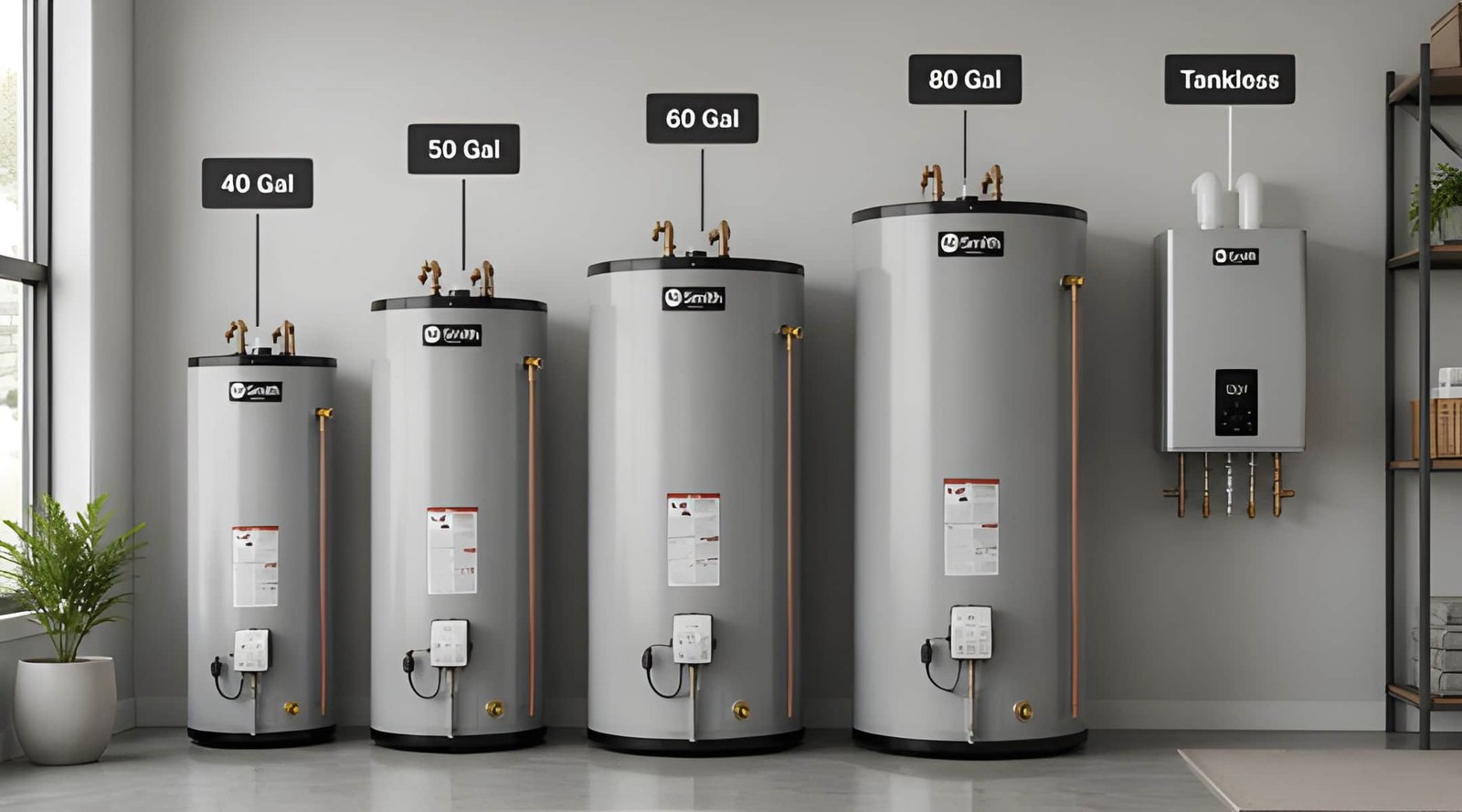
40 vs 50 vs 60 vs 80 Gallon Water Heater
Tank size is only one part of choosing a water heater, but storage capacity is an important consideration when comparing traditional tank-style water heaters. Capacities of 40 gallons, 50 gallons, 60 gallons, and 80 gallons represent different storage volumes. The right size depends on hot-water demand, household usage patterns, peak-hour demand, recovery capability, and the specific water heater model.
Overview of Water Heater Sizes
Comparing these four standard storage options helps clarify how each tier fits typical residential requirements without relying on oversimplified rules.
40-Gallon Water Heater
A standard storage option suited for homes with moderate-to-lower hot water consumption and minimal overlapping peak periods.
- Position: Entry-level standard storage size
- Advantage: Takes up less physical installation space
- Limitation: Less stored hot water during heavy simultaneous use
50-Gallon Water Heater
The most common residential capacity, offering a balanced middle-ground for everyday family routines and standard demand.
- Position: Standard residential baseline
- Advantage: Common middle-ground option with broad availability
- Limitation: May be insufficient for higher peak-hour demand
60-Gallon Water Heater
An extended-capacity choice designed to provide additional storage buffer for homes with active hot-water schedules.
- Position: Mid-to-large capacity option
- Advantage: Provides more stored hot water for overlapping tasks
- Limitation: Larger capacity may not be necessary for lower demand
80-Gallon Water Heater
A heavy-duty storage solution engineered for large hot-water demands and intense peak usage periods.
- Position: Maximum standard storage category
- Advantage: Highest storage capacity among these options
- Limitation: More space and structural support may be needed
Quick Comparison Table
| Water Heater Size | Relative Storage Capacity | General Use Case | Main Advantage | Main Consideration |
|---|---|---|---|---|
| 40 gallon | Smaller | Lower hot-water demand | Lower storage footprint | Less stored hot water |
| 50 gallon | Medium | Moderate residential demand | Common middle-ground option | May be insufficient for higher peak demand |
| 60 gallon | Larger | Higher demand & overlap | More stored hot water | Larger capacity may not be necessary |
| 80 gallon | Large | High hot-water demand | Highest storage capacity of these options | More space/capacity may not be needed |
Tank Capacity vs. First Hour Rating (FHR)
A 50-gallon water heater does NOT automatically provide exactly the same usable hot-water output as every other 50-gallon water heater. Performance can also depend on:
- First Hour Rating (FHR): Measures how much hot water the heater can supply during a high-demand period, considering stored hot water and recovery.
- Recovery Rate & Energy Source: Heating elements or burner performance determine how fast cold inlet water is reheated.
- Operating Settings: Incoming water temperature, thermostat settings, and daily usage patterns directly impact real-world delivery.
Size-to-Size Practical Comparisons
40 Gallons vs. 50 Gallons
When might 40 gallons make sense? When hot-water demand is relatively lower and expected peak demand can be comfortably handled. When might 50 gallons make more sense? When a moderate residential demand makes a middle-ground storage capacity appropriate to avoid running short during busy periods.
50 Gallons vs. 60 Gallons
When might 50 gallons be enough? For standard daily routines with moderate peak loads. When might 60 gallons provide useful additional capacity? When the household has higher hot-water demand or overlapping usage patterns that benefit from extra stored volume.
60 Gallons vs. 80 Gallons
When might 60 gallons be sufficient? When peak usage is high but manageable within standard extended limits. When might 80 gallons be worth considering? When peak hot-water demand is high enough that an 80-gallon tank is useful, though an 80-gallon tank is not automatically the right choice simply because it is larger.
Why Bigger Is Not Always Better
Choosing the largest tank available is not necessarily the best approach. A larger tank can mean greater physical size, additional installation considerations, potentially higher standby losses depending on the equipment, and unnecessary capacity if demand is low.
"Which Size Is Right for Me?" Guidance
To determine the ideal capacity, evaluate your actual hot-water demand rather than relying on rigid rules:
Consider 40 Gallons When:
Hot-water demand is relatively lower and the expected peak demand can be comfortably handled by the heater.
Consider 50 Gallons When:
A moderate residential hot-water demand makes a middle-ground storage capacity appropriate.
Consider 60 Gallons When:
The household has higher hot-water demand or would benefit from additional storage.
Consider 80 Gallons When:
Peak hot-water demand is high enough that a larger storage capacity may be useful, assuming the specific heater's performance and installation requirements support it.
Key Takeaway
40, 50, 60, and 80 gallons represent different storage capacities. Larger is not automatically better; actual hot-water demand matters, peak-hour demand matters, recovery capability matters, and FHR is important when comparing water heater performance. The correct choice should be based on the home's actual hot-water requirements and the specifications of the water heater.
Find Your Ideal Water Heater Size
Determine your required water heater size based on your actual hot-water demand using our sizing tool.
Water Heater Sizing CalculatorHow Water Heater Sizing Is Calculated
Proper water heater sizing is about matching the water heater's ability to supply hot water with the household's expected demand. Sizing is not simply a rigid formula such as "number of people × gallons per person." Instead, a reliable water heater sizing calculation evaluates hot-water usage, peak-hour demand, fixture types, usage timing, tank capacity, recovery capability, and the First Hour Rating (FHR).
The Core Sizing Stages
To understand how sizing works behind the scenes, the process breaks down into several key evaluation steps:
Estimate Hot-Water Usage
Assess overall daily hot-water consumption across active home sources including showers, baths, sinks, dishwashers, and laundry appliances.
Determine Peak-Hour Demand
Identify the busiest 60-minute window of the day when multiple hot-water activities overlap, creating the highest instantaneous demand.
Consider Storage & Recovery
Examine how much water the tank holds alongside the heater's ability to reheat incoming cold water during ongoing use.
Compare First Hour Rating
Match the calculated peak demand against the water heater's First Hour Rating (FHR) to verify continuous delivery capability.
Tank Capacity vs. Water Heater Performance
A common misconception is that tank capacity tells the whole story. In reality, a storage water heater's real-world delivery depends on more than nominal tank volume:
- Storage Capacity: Indicates how much water the tank holds statically.
- Recovery Rate: Measures how quickly the unit reheats incoming cold water.
- First Hour Rating (FHR): Combines stored volume and recovery capability into a single rating for peak-demand evaluation.
What Factors Change the Required Size?
A variety of household and equipment factors influence the final sizing outcome, meaning simple occupant counts are never enough on their own:
Usage & Routine Factors
Shower frequency, shower duration, bathtub capacity, simultaneous fixture operation, and daily household schedules heavily shift peak-hour demand requirements.
Equipment & Environmental Factors
Fixture flow rates, incoming groundwater temperatures, thermostat settings, and the specific energy source or recovery capability of the unit.
Common Water Heater Sizing Mistakes
Avoiding common pitfalls ensures you select a system that genuinely meets your home's needs without unnecessary adjustments:
Sizing by Tank Size Alone
Assuming gallon capacity equals output without checking recovery rates or FHR specifications.
Relying Solely on Occupant Count
Ignoring real usage patterns and peak-hour overlap in favor of rigid per-person rules.
Assuming Bigger Is Always Better
Oversizing unnecessarily can increase physical footprint and standby energy losses.
Sizing vs. Selection
It is helpful to distinguish between sizing and selection. Sizing is the analytical process of determining the required hot-water supply capability (such as peak-hour demand and FHR requirements). Selection is the subsequent step of choosing a specific water heater model that matches those calculated parameters.
Key Takeaway
Water heater sizing starts with hot-water demand, peak-hour demand is critical, tank capacity is only one part of the picture, recovery capability matters, and FHR is an essential specification for storage water heaters. The ultimate goal is to match the water heater's supply capability with the home's expected demand.
Find Your Ideal Water Heater Size
Use our interactive calculator to determine your required water heater size based on your actual hot-water demand.
Water Heater Sizing CalculatorHow to Calculate Peak-Hour Hot Water Demand
When performing a water heater sizing calculation, average daily usage only tells part of the story. Proper residential water heater sizing depends heavily on establishing your peak-hour hot water demand—the estimated volume of hot water a household requires during its absolute busiest 60-minute window of the day.
The 4-Step Calculation Process
To determine your household's peak hot water usage clearly, follow these structured steps:
Identify Hot-Water Fixtures & Appliances
List all active hot-water sources operating during your busiest period, including showers, bathtubs, sinks, dishwashers, and clothes washers.
Estimate Hot-Water Use
Calculate the actual hot water volume consumed by each fixture based on flow rate, duration, and the proportion of hot water blended into the mix.
Identify the Busiest Hour
Pinpoint the specific 60-minute interval when simultaneous usage peaks, such as back-to-back morning showers or overlapping evening chores.
Add Peak-Period Usage
Combine the hot-water requirements occurring during that busiest hour to establish your core peak demand benchmark.
Example: Calculating Peak-Hour Hot Water Demand
Consider a hypothetical family of four experiencing a high-demand morning routine. The table below outlines illustrative estimated usage values during their busiest 60-minute window:
| Hot-Water Activity | Illustrative Usage Detail | Illustrative Peak-Hour Use |
|---|---|---|
| Shower 1 | 10-minute morning shower | 20 Gallons |
| Shower 2 | 10-minute back-to-back shower | 20 Gallons |
| Bathroom Sink | Hand washing & dental hygiene | 4 Gallons |
| Kitchen Faucet | Breakfast prep & food rinse | 5 Gallons |
| Dishwasher | Single high-efficiency cycle | 6 Gallons |
| Estimated Peak-Hour Demand | 55 Gallons | |
Note: These figures serve as an illustrative example and do not represent universal standards for every household.
Tank Capacity vs. Peak-Hour Demand & First Hour Rating (FHR)
A common misconception is that peak-hour demand equals tank size. In reality, storage water heaters continue heating incoming cold water while supplying fixtures. Sizing compares your calculated peak-hour demand against the unit's First Hour Rating (FHR):
- Continuous Recovery: A storage water heater can supply more hot water than its nominal tank volume during an hour because of continuous heating recovery.
- FHR Match: If your peak-hour demand calculation results in 55 gallons, you require a water heater with an FHR of 55 or higher, even if the tank storage volume is 50 gallons.
Factors That Increase Demand
- Multiple showers occurring close together
- Long showers or luxury high-flow showerheads
- Filling deep soaking bathtubs
- Simultaneous fixture and appliance operation
- Running dishwashers and laundry concurrently
- Hosting overnight guests
Factors That Reduce Demand
- Staggered family member schedules
- Shifting appliance cycles to off-peak periods
- Installing low-flow, water-saving fixtures
- Evenly distributing hot water usage across the day
- Smaller overall household occupancy
Temperature Mixing and Hot-Water Fraction
A fixture's total water flow is not equivalent to its hot-water demand. Shower water is typically a blend of hot and cold water. Actual hot-water demand depends on fixture flow duration, desired outlet temperature, and incoming cold-water temperature.
Key Takeaway
Calculating peak-hour hot water demand involves identifying your household's busiest 60-minute window, estimating individual fixture hot-water consumption, summing those values, and comparing the result against a water heater's First Hour Rating (FHR) to ensure reliable performance during high-use periods.
Ready to Calculate Your Requirements?
Use our automated sizing tool to find the right water heater capacity for your home.
Water Heater Sizing CalculatorWhat Is First Hour Rating (FHR)?
When evaluating storage-tank water heaters, you will often encounter a specification known as the First Hour Rating (FHR). Understanding what First Hour Rating FHR represents is essential for proper water heater sizing and ensuring your household has enough hot water during busy periods.
Understanding FHR vs. Tank Capacity
A common misconception is that a water heater's tank capacity tells you everything about its hot-water delivery. In reality, tank capacity and First Hour Rating (FHR) measure two different things.
| Specification | What It Measures | Typical Unit | Key Detail |
|---|---|---|---|
| Tank Capacity | Physical storage volume | Gallons | Describes how much water the tank holds statically at one time. |
| First Hour Rating (FHR) | First-hour delivery capability | Gallons | Accounts for stored hot water plus recovery capability during heavy use. |
Why Tank Size and FHR Differ
Because FHR incorporates recovery capability, a water heater's FHR can be significantly higher than its physical tank capacity (especially common in high-recovery gas units). Conversely, a larger tank with a slow recovery rate might have a lower FHR than expected. This makes water heater FHR a much more reliable metric for peak-demand performance than tank size alone.
Practical Example of FHR
Consider a water heater listed with a 50-gallon tank capacity and a 70-gallon First Hour Rating. What does this mean in practical terms?
Not Physical Volume
The 70-gallon FHR does not mean the tank physically holds 70 gallons of water at once.
Delivery Potential
It means the unit can deliver approximately 70 gallons of hot water over the course of the first hour under standardized test conditions.
Real-World Variance
Actual performance can vary based on incoming water temperature, thermostat settings, and daily household usage patterns.
How FHR Relates to Peak-Hour Demand
When determining the appropriate water heater size, FHR serves as the primary benchmark against your household's busiest usage period.
What Factors Affect a Water Heater's FHR?
A water heater's first hour rating is determined by multiple engineering and environmental factors:
Tank & Element Specifications
Tank volume, heating input strength (burner size or electrical wattage), and recovery rate directly influence how quickly the unit can reheat water.
Operating Conditions
Incoming groundwater temperature, thermostat calibration, and overall heater design impact how much usable hot water is supplied during heavy use.
Why FHR Can Be Confusing
Homeowners often run into confusion when shopping for a water heater capacity upgrade because specifications look deceptively simple. Remembering that FHR measures active delivery over 60 minutes—rather than static storage—helps prevent under-sizing your equipment.
Where to Find Your Water Heater's FHR
You can locate the FHR rating on several official product documents:
- Manufacturer specification sheets and product brochures
- The EnergyGuide label (when applicable to the specific model)
- The manufacturer's online product page
- The rating plate or specification sticker affixed directly to the water heater tank
Key Takeaway
First Hour Rating (FHR) is the most useful specification for evaluating a storage water heater's performance during peak demand. By combining stored volume and recovery capability into a single metric, FHR helps ensure your chosen water heater can keep up with your household's busiest hot-water routines.
Ready to Find the Right Water Heater Size?
Use our interactive calculator to determine your required water heater specification based on your home's actual hot-water demand.
Water Heater Sizing CalculatorFHR vs Tank Capacity vs Recovery Rate
When evaluating water heater specifications, homeowners often encounter three primary metrics: tank capacity, First Hour Rating (FHR), and recovery rate. While they are related, each measurement answers a completely different question regarding water heater performance and hot-water capacity.
Comparing the Three Key Metrics
Examining each specification individually clarifies how they interact during daily residential routines and peak-demand periods.
Tank Capacity
Describes the physical volume of water the storage tank can hold at rest.
- Common Sizes: 40, 50, 60, or 80 gallons
- Primary Focus: Static storage volume
- Limitation: Doesn't account for reheating during use
First Hour Rating (FHR)
Measures how much hot water the unit can deliver during the first hour of heavy use.
- Composition: Stored water + recovery during the hour
- Primary Focus: Peak-demand readiness
- Key Benefit: Better indicator than tank size alone
Recovery Rate
Describes how quickly the water heater can replace and reheat incoming cold water.
- Common Metric: Gallons per hour (GPH) at a given temperature rise
- Primary Focus: Sustained output
- Key Benefit: Helps prevent running out during prolonged routines
Side-by-Side Comparison Table
| Feature | Tank Capacity | First Hour Rating (FHR) | Recovery Rate |
|---|---|---|---|
| What it describes | Stored water volume | First-hour hot-water delivery | How quickly water is reheated |
| Typical unit | Gallons | Gallons | Gallons per hour (GPH) |
| Main question answered | How much does the tank hold? | How much hot water can it deliver in the first hour? | How quickly can it make more hot water? |
| Affected by | Physical tank size | Tank size + recovery capability + test conditions | Heating input, energy source, incoming water temperature |
| Useful for | Understanding physical footprint & base storage | Evaluating peak-hour demand performance | Understanding sustained hot-water recovery over time |
FHR vs. Recovery Rate: Don't Confuse Them
A common misconception is that FHR and recovery rate are identical. They are closely linked but measure distinct characteristics:
- FHR is a comprehensive test rating for active delivery over the entire first hour of heavy demand.
- Recovery rate measures the speed of thermal replenishment (how many gallons per hour the burner or elements can heat).
- While a strong recovery rate boosts FHR, FHR also factors in the initial water already stored in the tank.
Practical Example
Consider a water heater with a 50-gallon tank capacity, a 70-gallon FHR, and a robust recovery specification:
What the 50 Gallons Mean
The tank physically holds 50 gallons of water at any given moment when fully heated.
What the 70-Gallon FHR Means
Due to active recovery during use, the unit can supply approximately 70 gallons of hot water over the course of the first busy hour.
Which Number Should You Look At?
Depending on what you need to evaluate for your household:
For Storage & Space
Look at Tank Capacity to ensure the physical unit fits your available installation space.
For Peak Demand
Look at First Hour Rating (FHR) to match against your household's busiest 60-minute window.
For Continuous Use
Look at Recovery Rate if your home experiences long overlapping showers or heavy back-to-back appliance usage.
Common Misconceptions
"Tank Capacity Equals FHR"
Many assume a 50-gallon tank always has a 50-gallon FHR. In practice, recovery capabilities often push FHR well above the tank volume.
"Bigger Tank Always Wins"
A smaller tank with exceptional recovery and a high FHR can easily outperform a larger, slower tank during peak-demand hours.
Key Takeaway
Tank capacity, First Hour Rating, and recovery rate serve different purposes in water heater sizing. While tank size tells you physical storage volume, FHR measures peak-hour delivery, and recovery rate tracks reheating speed. Reviewing all three metrics together provides a complete picture of overall water heater performance.
Ready to Find the Right Water Heater Size?
Use our interactive calculator to determine your required water heater specification based on your home's actual hot-water demand.
Water Heater Sizing CalculatorHot Water Usage by Fixture
Understanding hot water usage by fixture is crucial for accurate water heater sizing. Household hot-water demand is not determined by the number of occupants alone; different plumbing fixtures and appliances consume varying volumes of hot water based on usage frequency, duration, and flow rates.
Hot Water vs. Total Water Usage
A key distinction in residential plumbing is the difference between total water used and hot water consumed:
- Total Water Volume: The complete amount of water discharged by a fixture during use.
- Hot Water Portion: Because users typically mix hot and cold water supplies together, only a fraction of that total volume is drawn directly from the water heater tank.
Major Hot-Water Fixtures & Appliances
Household hot-water demand is typically driven by a combination of personal hygiene fixtures and cleaning appliances:
Showers
Often the single largest contributor to daily hot-water consumption in typical households.
- Key Drivers: Shower duration, showerhead flow rate, and frequency.
- Sizing Role: Back-to-back morning showers heavily dictate peak-hour demand.
Bathtubs
Filling a bathtub draws a substantial volume of hot water all at once compared to brief sink uses.
- Key Drivers: Tub size, fill level, and temperature settings.
- Sizing Role: Can create an immediate high-demand draw on storage capacity.
Bathroom Sinks
Used repeatedly throughout the day for handwashing, shaving, and basic grooming.
- Key Drivers: Short, frequent draws with mixed temperatures.
- Sizing Role: Contributes steadily to daily usage rather than extreme peak spikes.
Kitchen Sinks
Utilized for food preparation, dish rinsing, and kitchen cleanup.
- Key Drivers: Duration of running water and cleaning habits.
- Sizing Role: Often overlaps with evening routines and appliance cycles.
Dishwashers
Modern dishwashers heat their own water or draw from the home supply during wash and rinse cycles.
- Key Drivers: Cycle selection, operating temperature, and frequency.
- Sizing Role: Can overlap with evening sink and shower use.
Clothes Washers
Washing machine hot-water demand depends heavily on the selected wash temperature settings.
- Key Drivers: Wash temperature (hot vs. warm vs. cold) and number of loads.
- Sizing Role: Multiple back-to-back warm or hot loads increase overall daily demand.
What Drives Fixture Hot-Water Usage?
The amount of hot water drawn from your system is governed by several core operating factors:
Flow & Duration
Fixture flow rates (measured in gallons per minute) combined with how long the water runs directly determine the volume extracted per use.
Timing & Overlap
Simultaneous fixture usage (such as a shower running while the dishwasher operates) magnifies instantaneous demand.
Fixture Comparison Overview
| Fixture / Appliance | What Drives Hot-Water Use | Typical Usage Pattern | Why It Matters for Sizing |
|---|---|---|---|
| Shower | Flow rate and duration | Continuous draw over 5–15 minutes | Major contributor to peak-hour demand blocks. |
| Bathtub | Tub capacity and fill depth | Large single-batch withdrawal | Can exhaust a significant portion of tank storage at once. |
| Bathroom Sink | Short bursts of handwashing/grooming | Short, frequent draws | Adds to daily baseline consumption rather than peak spikes. |
| Kitchen Sink | Food prep, rinsing, and cleanup | Intermittent use throughout the day | Frequently overlaps with evening household routines. |
| Dishwasher | Cycle type and incoming temperature | Scheduled multi-stage cycles | Adds thermal load when running alongside other fixtures. |
| Clothes Washer | Selected wash water temperature | Batch loads | Hot-water cycles increase daily consumption volume. |
Daily Use vs. Peak Use
A home's daily hot-water usage measures total consumption across 24 hours, whereas peak hot-water usage focuses on the busiest hour of the day. A fixture with high daily water usage may not cause issues if spread out, but multiple fixtures operating during the same hour define whether your water heater can keep up.
Common Fixture-Based Sizing Mistakes
Assuming Uniform Usage
Treating every household as though they have identical shower lengths and appliance routines.
Ignoring Fixture Timing
Failing to account for overlapping hot-water activities during morning or evening rush hours.
Key Takeaway
Hot water demand is driven by specific fixture types, flow rates, durations, and usage timing. Recognizing how showers, baths, appliances, and sinks contribute to your home's total hot-water consumption helps ensure you select a water heater with the appropriate capacity and performance rating.
See How Your Household's Hot-Water Usage Affects Water Heater Sizing
Use our interactive calculator to determine your required water heater specification based on your home's actual demand.
Water Heater Sizing CalculatorWater Heater Sizing Example
Walking through a practical water heater sizing example helps demonstrate how individual factors connect into a final equipment decision. This worked scenario illustrates how a homeowner evaluates household hot-water demand, peak-hour concentration, and First Hour Rating requirements.
Hypothetical Example Household Profile
Identify Household Usage Patterns
The evaluation starts by looking beyond headcount to understand active daily habits. This hypothetical household utilizes morning showers, routine sink washing, an evening dishwasher cycle, and occasional mid-week laundry loads. Sizing relies on understanding when these fixtures draw hot water.
Identify the Peak-Use Period
Next, we pinpoint the busiest 60-minute window of the day. For this family, the peak demand occurs between 6:30 AM and 7:30 AM, when multiple occupants prepare for work and school simultaneously.
Estimate Peak-Hour Hot-Water Demand
Using illustrative example values, we aggregate the hot-water volume demanded during that busy morning hour:
| Activity / Fixture | Illustrative Demand |
|---|---|
| Morning Showers (3 occupants) | ~45 gallons |
| Bathroom Sinks & Grooming | ~5 gallons |
| Kitchen Sink Quick Use | ~10 gallons |
| Estimated Peak-Hour Total | ~60 gallons |
Note: These numerical figures are general illustrative estimates for this example and do not represent universal standards for every household.
Compare Demand With First Hour Rating (FHR)
To ensure the equipment can keep up without running cold, the estimated peak-hour demand is compared directly against the water heater's First Hour Rating specification:
A storage water heater with an FHR rating matching or exceeding this peak window is generally appropriate for this scenario.
Evaluate Tank Capacity & Recovery Capability
The evaluation confirms that tank capacity alone does not tell the whole story. A 50-gallon storage tank with strong burner or element recovery can easily achieve a 65-gallon FHR, bridging the gap between stored volume and total hourly delivery.
Arrive at a Working Recommendation
Based on this worked scenario, a 50-gallon storage water heater with a matching First Hour Rating serves as a reasonable baseline recommendation for this 4-person household under normal operating habits.
"What If?" Scenario Variations
To see how sensitive sizing is to habits, consider how shifting usage patterns alters the evaluation:
Scenario A: Staggered Schedules
If household members shower at different times throughout the day, peak-hour concentration drops, potentially allowing for a slightly lower FHR requirement.
Scenario B: Heavy Overlapping Use
If back-to-back showers coincide with running the dishwasher or laundry during the same hour, peak demand rises, pointing toward a higher FHR requirement.
Key Takeaway
Water heater sizing is not just about counting people or looking at tank volume. The goal of residential water heater sizing is to match a household's estimated peak-hour hot-water demand with a unit's storage capacity, FHR, and recovery performance under actual operating conditions.
Want to Calculate Your Own Water Heater Needs?
Use our interactive calculator to determine your required water heater specification based on your home's actual hot-water demand.
Water Heater Sizing CalculatorHow to Size a Tankless Water Heater
Learning how to size a tankless water heater requires a completely different approach than traditional storage-tank units. Rather than relying on storage capacity or First Hour Rating, tankless systems are sized primarily by evaluating maximum simultaneous flow rate (GPM) and temperature rise.
Storage-Tank Water Heater
- Primary Focus: Tank storage capacity
- Key Metrics: First Hour Rating (FHR) & recovery rate
- Operation: Relies on a pre-heated reservoir of water
Tankless Water Heater
- Primary Focus: Maximum simultaneous flow rate (GPM)
- Key Metrics: Required temperature rise & heater input capacity
- Operation: Heats water instantly as it flows through the unit
Step-by-Step Tankless Sizing Process
To determine the correct tankless capacity for a home, follow a systematic flow and temperature evaluation:
Determine Simultaneous Hot-Water Flow
Identify which fixtures and appliances may operate at the exact same time during peak household routines. Tankless sizing is governed by concurrent demand, not total occupant headcount.
Estimate Total Flow Rate (GPM)
Add up the flow rates of all fixtures expected to run simultaneously. Consider this illustrative breakdown:
| Fixture / Appliance | Illustrative Flow Rate |
|---|---|
| Shower | 2.0 GPM |
| Kitchen Sink | 1.0 GPM |
| Bathroom Sink | 0.5 GPM |
| Total Simultaneous Flow | 3.5 GPM |
Note: Actual fixture flow rates depend on installed hardware and household usage patterns.
Determine Required Temperature Rise
A tankless unit must heat incoming groundwater to your target hot-water temperature. Calculate the required rise using this standard relationship:
Incoming groundwater temperature varies significantly by geographic location, climate, and seasonal changes.
Understand the Heater's Heating Capacity & Specs
Tankless water heaters deliver varying flow rates depending on the required temperature rise. A unit can output a higher GPM at a lower temperature rise, but its delivery drops when a steep temperature rise is demanded.
Match Flow and Temperature Rise to Ratings
Compare your required simultaneous flow (e.g., 3.5 GPM) at your required temperature rise (e.g., 70°F) directly against manufacturer performance specifications to select an appropriately sized unit.
Important Warning: Max GPM Can Be Misleading
Never size a tankless water heater using the headline maximum GPM number alone. A manufacturer's maximum advertised flow rate is often measured under ideal conditions that may not match your home's actual incoming groundwater temperature. Always check the manufacturer's rated flow at the specific temperature rise your climate and household require.
What Factors Change Tankless Sizing?
Simultaneous Fixtures
Running multiple high-flow showers and appliances together increases required GPM capacity.
Incoming Water Temp
Colder winter groundwater requires a larger temperature rise, reducing available GPM output.
Desired Outlet Temperature
Higher target storage or delivery temperatures increase thermal load on the heating elements or burners.
Manufacturer Performance
Different models handle high temperature-rise curves differently; specifications must be verified.
Flow Rate vs. Temperature Rise Relationship
Tankless performance operates on an inverse relationship:
Lower Temperature Rise = Greater Flow Capacity (GPM)
Common Tankless Sizing Mistakes
Mistake 1: Sizing by Headcount
Assuming occupant count alone dictates tankless requirements without checking concurrent fixture use.
Mistake 2: Using Max GPM Blindly
Relying on advertised maximum flow rates without factoring in local incoming water temperatures.
Key Takeaway
Tankless water heater sizing is all about matching maximum simultaneous flow rate and temperature rise. By evaluating concurrent fixture usage and verifying manufacturer ratings against your local incoming water temperature, you can select an on-demand unit capable of meeting your household's peak demands.
Ready to Estimate Your Water Heater Needs?
Use our interactive calculator to determine your required water heater specification based on your home's actual hot-water demand.
Water Heater Sizing CalculatorTankless Water Heater GPM Requirements
Understanding tankless water heater GPM requirements is essential for selecting a system that can reliably supply on-demand hot water. Unlike traditional storage tanks, tankless heaters rely heavily on flow rate capacity to keep up with household demands.
What is GPM?
GPM stands for gallons per minute and measures the volume of water moving through your plumbing system. For a tankless water heater, GPM defines how much water the unit can instantly heat at any given moment.
Why GPM Matters for Tankless
Storage tanks draw from a pre-heated reservoir of water. Tankless units have no major storage reserve; they heat water dynamically as it flows. Therefore, a unit's flow rate capacity must match your concurrent water usage.
Simultaneous Hot-Water Demand
The core factor driving a home's tankless water heater GPM requirements is simultaneous fixture usage rather than simple head count. When multiple fixtures run concurrently, their individual flow rates combine.
Typical Fixture Flow Rates (Illustrative Examples)
| Fixture / Appliance | Typical Flow Rate Range |
|---|---|
| Standard Shower | 1.5 – 2.5 GPM |
| Bathroom Faucet | 0.5 – 1.0 GPM |
| Kitchen Faucet | 1.0 – 2.2 GPM |
| Bathtub Faucet | 2.5 – 4.0 GPM |
| Dishwasher | 1.0 – 2.0 GPM |
| Clothes Washer | 1.5 – 3.0 GPM |
Common GPM Demand Scenarios
Single Fixture Use
~2.0 GPM: Running one standalone shower or a single appliance typically requires minimal peak capacity.
Overlapping Family Use
~4.0 to 5.5 GPM: Running two showers simultaneously, or a shower plus kitchen faucet and appliance, requires a much higher GPM delivery capability.
Why Maximum GPM Ratings Can Be Misleading
A tankless water heater advertised with a high maximum GPM rating does not necessarily deliver that exact flow under every operating condition. Effective output depends heavily on incoming water temperature and the required temperature rise. Colder groundwater demands more heating effort, which can reduce available GPM delivery.
Connecting GPM to Temperature Rise
Tankless sizing ties flow rate directly to thermal performance. The required temperature rise is calculated as:
How to Determine Your Required GPM
Step 1: Identify Concurrent Fixtures
Determine which water-using fixtures realistically operate at the same time during peak routines.
Step 2: Add Flow Rates
Sum up the approximate GPM requirements of those specific simultaneous fixtures.
Step 3: Evaluate Temperature Rise
Factor in your local incoming groundwater temperature and target outlet temperature.
Step 4: Check Manufacturer Specs
Review manufacturer performance curves at your specific temperature rise to select the proper unit.
Common Tankless GPM Mistakes
Mistake 1: Relying Solely on Head Count
Assuming occupant count dictates GPM without accounting for simultaneous fixture habits.
Mistake 2: Ignoring Inlet Temperature
Using headline maximum GPM ratings without checking performance drop under cold incoming water conditions.
Key Takeaway
Tankless water heater GPM requirements are defined by peak simultaneous flow and temperature rise. Accurately assessing concurrent fixture usage ensures you choose an on-demand system that avoids cold-water sandwich effects or flow limitations.
Ready to Estimate Your Water Heater Needs?
Use our interactive calculator to determine your required water heater specification based on your home's actual hot-water demand.
Water Heater Sizing CalculatorTemperature Rise for Water Heater Sizing
Evaluating water heater temperature rise is crucial for understanding how much heating capacity your system needs. A clear grasp of temperature rise helps homeowners assess equipment performance across different seasons and supply conditions.
What Temperature Rise Means
Temperature rise is the difference between your desired hot-water temperature and the incoming cold water temperature. It tells you exactly how many degrees the water heater must elevate the water.
Why It Drives Performance
Whether using a tankless or a storage-tank system, a larger temperature gap means the heater must transfer more thermal energy to the water supply per minute or per recovery cycle.
The Temperature Rise Formula
Incoming Water vs. Desired Temperature
Incoming Cold-Water Supply
Incoming water temperature varies based on geographic location, groundwater conditions, plumbing depth, and seasonal weather shifts. Colder supply water creates a higher temperature-rise requirement.
Desired Outlet Temperature
The target temperature is what you want the fixture to deliver. An illustrative target of 120°F is commonly referenced, though actual settings depend on equipment specs and household preferences.
Illustrative Temperature-Rise Examples
| Incoming Water | Desired Water | Temperature Rise | General Meaning |
|---|---|---|---|
| 60°F | 120°F | 60°F | Lower temperature rise (warmer supply) |
| 50°F | 120°F | 70°F | Moderate illustrative rise |
| 40°F | 120°F | 80°F | Higher temperature rise (colder supply/winter) |
How Temperature Rise Affects Tankless & Storage Systems
Tankless Water Heaters
Because tankless units heat water dynamically on demand, higher temperature rise combined with high flow rates creates greater heating demand. Checking manufacturer specs for your specific rise ensures adequate flow.
Storage-Tank Water Heaters
Storage systems are also impacted during recovery. When cold replacement water enters a tank, a larger temperature gap requires more burner or element energy to reheat the stored volume.
Why Does My Water Heater Need a Higher Temperature Rise?
A higher temperature rise simply reflects a wider gap between your supply water and target temperature. This commonly occurs during winter months when groundwater temperatures drop significantly, requiring your water heater to work harder to hit the same output temperature.
Common Temperature-Rise Mistakes
Mistake 1: Confusing Setting with Rise
Treating your thermostat's target temperature setting as the temperature rise without subtracting the incoming water temperature.
Mistake 2: Ignoring Seasonal Shifts
Assuming incoming water temperature remains constant year-round, which can lead to unexpected capacity shortfalls in winter.
Ready to Estimate Your Water Heater Needs?
Use our interactive calculator to determine your required water heater specification using household and usage information.
Water Heater Sizing CalculatorTank vs Tankless Water Heater Sizing
Comparing tank vs tankless water heater sizing reveals a fundamental difference in how hot-water capacity is evaluated. While a traditional storage tank focuses on stored volume and recovery, a tankless system relies strictly on flow rate and temperature rise.
Storage-Tank Water Heater Sizing
- Primary Focus: Stored hot-water volume
- Key Metrics: First Hour Rating (FHR) & recovery capability
- Operation: Meets peak-hour demand from a pre-heated reservoir
Tankless Water Heater Sizing
- Primary Focus: Maximum simultaneous flow rate (GPM)
- Key Metrics: Required temperature rise & heater input capacity
- Operation: Heats water instantly as it flows through the unit
Sizing Factors Comparison Table
| Sizing Factor | Storage-Tank System | Tankless System |
|---|---|---|
| Main Capacity Focus | Stored water volume + recovery | Flow rate (GPM) + heating input |
| Physical Capacity | Expressed in Gallons (e.g., 50 gal) | Expressed in Flow Rate (e.g., 5 GPM) |
| Peak-Hour Demand | Critical metric (First Hour Rating) | Managed via simultaneous fixture usage |
| Temperature Rise | Secondary factor for recovery speed | Essential factor restricting output GPM |
| Manufacturer Ratings | FHR and recovery rate | Rated flow at specific temperature rise |
How Each System Evaluates Demand
Storage Tank Approach
A storage-tank water heater needs enough stored hot water and recovery capability to supply peak-hour demand periods without running cold. The evaluation centers on tank capacity and First Hour Rating.
Tankless Approach
A tankless water heater needs to provide enough flow at the required temperature rise. Sizing focuses on identifying fixtures that run simultaneously and summing their combined GPM requirements.
Why "Same Size" Means Different Things
Comparing a 50-gallon tank directly to a 5 GPM tankless unit is not an apples-to-apples comparison. A gallon rating measures stored reservoir capacity, whereas GPM measures continuous flow capacity. Tankless heaters do not maintain a large stored volume of hot water.
Common Sizing Misconception
Assuming household size translates identically across both systems is a major mistake. While occupancy shapes general routines, storage tanks require volume calculations (FHR), whereas tankless heaters require simultaneous fixture flow and temperature-rise evaluations.
What Should I Look At?
If Choosing a Storage Tank:
- Tank capacity (gallons)
- First Hour Rating (FHR)
- Recovery capability
- Peak-hour hot water demand
If Choosing a Tankless Unit:
- Simultaneous fixture flow (GPM)
- Required temperature rise
- Manufacturer performance specs
- Peak concurrent usage patterns
Key Takeaway
Sizing storage-tank and tankless water heaters requires completely different metrics. Knowing whether your home relies on stored volume or peak simultaneous flow ensures you choose the correct equipment specification.
Ready to Estimate Your Water Heater Needs?
Use our interactive calculator to determine your required water heater specification based on your household and usage information.
Water Heater Sizing CalculatorHeat Pump Water Heater Sizing
Proper heat pump water heater sizing involves evaluating hybrid storage systems that combine heat pump technology with traditional tank storage. Because these systems draw heat from surrounding air while maintaining stored water capacity, sizing requires evaluating storage volume, peak demand, recovery characteristics, and operating conditions.
Core Sizing Factors
Household Demand
Assessing total daily hot-water usage patterns across occupants and household fixtures.
Peak-Period Demand
Identifying the heaviest block of hot-water usage during morning or evening routines.
Tank Capacity
The amount of pre-heated water available in storage before a recovery cycle is triggered.
Recovery Capability
How quickly the system restores hot-water volume following heavy continuous usage.
Operating Conditions
Ambient air temperature and installation location which influence heat pump efficiency.
Manufacturer Specs
Official performance ratings providing precise output validation for specific models.
Bigger Is Not Automatically Better
Selecting the largest available hybrid storage tank is not always ideal. Excessively large tanks can involve different spatial, installation, and operating considerations, while undersized units can struggle during peak usage. The primary objective is to match storage capacity and recovery performance appropriately to your household's actual hot-water demand profile.
Tank Capacity vs. Recovery Performance
Heat pump water heaters rely on a storage tank, meaning tank capacity matters when accommodating hot water volume. However, tank capacity alone does not tell the full story. Recovery characteristics, heating input, selected operating modes, and surrounding ambient conditions all affect how a hybrid unit handles continuous draw and recovery.
Step-by-Step Heat Pump Water Heater Sizing Framework
Evaluate occupants and overall typical daily hot-water consumption.
Determine when simultaneous showers, laundry, or appliance use occurs.
Select an appropriate tank capacity matching peak household patterns.
Examine manufacturer published first hour ratings and recovery data.
Ensure installation environment meets ambient temperature requirements.
Compare final specifications across suitable hybrid water heater models.
Illustrative Household Scenario
Consider an illustrative household of four people with regular morning shower routines, daily dishwashing, and laundry requirements. When determining what size heat pump water heater is needed, the homeowner would not choose a unit based solely on the four-person head count. Instead, they would examine peak-hour demand, appropriate storage volume, First Hour Rating (FHR) specifications, and ambient installation conditions.
Conventional Storage Tank vs. Heat Pump Water Heater Sizing
| Sizing Factor | Conventional Storage Tank | Heat Pump Water Heater |
|---|---|---|
| Hot-Water Storage | Yes (Stored Volume) | Yes (Hybrid Storage Tank) |
| Tank Capacity | Important sizing metric | Important sizing metric |
| Peak Demand & FHR | Critical metric | Important where applicable |
| Recovery Performance | Based on burner/element input | Based on heat pump & backup modes |
| Operating Environment | Standard indoor installation | Sensitive to ambient air conditions |
| Final Selection | Tank volume & recovery specs | Critical review of manufacturer specs |
Why Manufacturer Specifications Matter
Hybrid heat pump water heaters vary significantly in tank volume, First Hour Rating, heating input capacity, and backup electric resistance behavior. Evaluating official manufacturer performance data ensures the selected model can support your home's unique demand patterns without unexpected performance bottlenecks.
Common Heat Pump Water Heater Sizing Mistakes
Mistake 1: Relying Solely on Occupants
Choosing a tank size based exclusively on the number of people without analyzing peak concurrent usage patterns.
Mistake 2: Ignoring Ambient Conditions
Failing to account for the installation space's temperature range, which directly impacts heat-pump efficiency and recovery.
Ready to Estimate Your Water Heater Needs?
Use our interactive calculator to determine your required water heater specification based on your household and usage information.
Water Heater Sizing CalculatorGas vs Electric Water Heater Sizing
Evaluating gas vs electric water heater sizing involves understanding that while both storage systems use a tank to hold hot water, their heating inputs and recovery characteristics can vary. Fuel type alone does not dictate tank capacity, but it influences how the equipment restores hot-water supply during heavy use.
Gas Water Heater Sizing
- Storage: Utilizes a tank to hold heated water volume
- Heating Input: Gas burner assembly and flue design
- Evaluation: Focused on peak demand, tank capacity, FHR, and recovery
Electric Water Heater Sizing
- Storage: Utilizes a tank to hold heated water volume
- Heating Input: Upper and lower electrical resistance elements
- Evaluation: Focused on peak demand, tank capacity, FHR, and recovery
Gas vs. Electric Sizing Comparison Table
| Sizing Factor | Gas Storage Water Heater | Electric Storage Water Heater |
|---|---|---|
| Stores Hot Water | Yes | Yes |
| Tank Capacity | Important sizing metric | Important sizing metric |
| Peak Demand & FHR | Critical metric | Critical metric |
| Recovery Capability | Model-dependent heating performance | Model-dependent heating performance |
| Heating Input Source | Gas burner input | Electrical resistance elements |
| Manufacturer Specs | Essential for final selection | Essential for final selection |
Does Gas or Electric Need a Different Tank Size?
Homeowners often wonder whether a gas water heater needs to be a different size than an electric water heater for the same household. Not necessarily. The appropriate tank capacity is determined primarily by your household's peak hot-water demand rather than the fuel source alone.
However, because individual models feature different heating inputs and recovery characteristics, checking the First Hour Rating (FHR) and manufacturer specifications is crucial rather than assuming that identical gallon ratings deliver identical performance.
The "Same Size" Misconception
Comparing a 50-gallon gas water heater directly to a 50-gallon electric water heater assuming they will perform identically is a mistake. Nominal tank capacity measures volume, but recovery capabilities and FHR vary between specific units depending on their design and heating inputs.
What Homeowners Should Compare Before Choosing
Demand & Peak Usage
Estimate overall household hot-water consumption and identify periods of heavy concurrent usage such as morning routines or back-to-back showers.
FHR & Recovery Performance
Review the First Hour Rating and manufacturer specifications to confirm how effectively the specific gas or electric model handles continuous draw.
Key Takeaway
Fuel type influences how a water heater heats water, but household demand and peak-hour usage drive the required sizing calculation. Always evaluate the specific manufacturer ratings rather than relying solely on fuel type or tank gallon capacity.
Ready to Estimate Your Water Heater Needs?
Use our interactive calculator to determine your required water heater specification based on your household and usage information.
Water Heater Sizing CalculatorHow to Tell If Your Water Heater Is Too Small or Too Large
A properly matched water heater balances actual household hot-water demand against system storage capacity and recovery performance. Recognizing whether your system is undersized or oversized helps you identify performance bottlenecks without jumping to premature replacement conclusions.
How to Tell If Your Water Heater Is Too Small
- Hot water runs out frequently during standard showers
- Water turns lukewarm when multiple fixtures operate simultaneously
- Household members must wait extended periods between showers
- Peak-hour hot-water demand consistently exceeds available supply
How to Tell If Your Water Heater Is Too Large
- Available storage capacity is substantially above normal daily demand
- The household rarely uses a significant portion of the stored volume
- The system was installed with an unnecessarily wide safety margin
- Normal demand falls far below the system's maximum delivery capacity
Too Small vs. Too Large Comparison
| Indicator | Water Heater Too Small | Water Heater Too Large |
|---|---|---|
| Hot Water Availability | Runs out frequently during peak use | Large capacity rarely fully utilized |
| Recovery Performance | May struggle to keep up with demand | Recovery easily handles light demand |
| User Experience | Multiple users experience shortages | Ample supply with zero constraints |
| System Sizing | Peak demand exceeds available supply | Capacity exceeds normal household usage |
Does Your Water Heater Actually Need to Be Replaced?
Running out of hot water does not automatically mean your storage tank is undersized or needs replacement. Similar symptoms can stem from changed usage patterns, increased household occupancy, incorrect temperature settings, sediment buildup, or equipment maintenance issues. Always inspect operating conditions and maintenance history before diagnosing a sizing failure.
Connecting Capacity, FHR, and Peak Demand
Evaluating whether a storage water heater is correctly sized involves comparing your Peak-Hour Hot Water Demand against the unit's First Hour Rating (FHR). If peak demand consistently exceeds the FHR, the system may be undersized for your usage pattern. Conversely, if available performance far exceeds normal requirements, the system may be larger than necessary.
Remember that nominal tank capacity alone does not tell the whole story. Two tanks with the same gallon rating can feature completely different recovery rates, heating inputs, and FHR specifications.
Practical Next Steps
If your system seems too small: Review your peak usage periods, check the unit's FHR specifications, and rule out maintenance issues before selecting a higher-capacity model.
If your system seems too large: Consider standby heat losses and operating efficiency, but avoid replacing a fully functional system solely because it provides extra capacity.
Check Your Water Heater Sizing
Use our interactive calculator to determine your precise hot-water requirements based on your household and fixture usage.
Check My Water Heater SizeCommon Water Heater Sizing Mistakes
Choosing or sizing a water heater requires careful evaluation of household demand, system capabilities, and performance ratings. Avoiding common missteps helps ensure your equipment matches your actual hot-water usage patterns without unnecessary compromises.
Sizing Solely by Number of People
- The Issue: Relying on rigid headcount rules (e.g., 4 people = 50 gallons) ignores individual lifestyle habits.
- Better Approach: Factor in shower frequency, fixture flow rates, concurrent use, and peak-hour demand.
Ignoring First Hour Rating (FHR)
- The Issue: Equating physical tank volume directly with actual hot-water delivery capability.
- Better Approach: Review FHR and manufacturer specifications to understand recovery and storage performance combined.
Assuming Bigger Is Always Better
- The Issue: Selecting the largest available tank under the assumption that more capacity is always superior.
- Better Approach: Match capacity to actual demand while considering standby heat losses and operating efficiency.
Overlooking Peak-Hour Demand & Recovery
- The Issue: Looking only at average daily usage rather than high-demand concurrent usage periods.
- Better Approach: Evaluate peak-hour requirements and recovery capability to ensure the system keeps pace with heavy use.
Common Mistakes & Better Approaches Summary
| Common Mistake | Better Approach |
|---|---|
| Size only by number of people | Consider actual hot-water usage and lifestyle patterns |
| Look only at tank gallons | Check FHR, recovery performance, and manufacturer specs |
| Choose the biggest tank | Match capacity to actual demand and consider standby losses |
| Ignore peak periods | Evaluate peak-hour hot water demand and concurrent fixture use |
| Ignore recovery capability | Consider how quickly the system replenishes hot water |
| Use maximum tankless GPM blindly | Check GPM at the required temperature rise |
| Assume every problem is sizing | Diagnose maintenance, sediment, or equipment faults first |
| Use one rule for every system | Consider specific system types (storage, tankless, heat pump) |
Mistaking Equipment Faults for Sizing Errors
Running out of hot water or experiencing lukewarm temperatures does not automatically mean your water heater is undersized. Always check for sediment buildup, incorrect temperature settings, faulty heating elements, or maintenance issues before assuming a replacement or capacity change is required.
Key Questions for Better Sizing
To avoid selection errors, evaluate your project using these foundational questions:
Demand & Timing
How much hot water does the household actually use, and when do peak-hour demand clusters occur?
Performance Specs
What are the unit's FHR, recovery rates, incoming water temperature, and temperature-rise requirements?
Professional Takeaway
Proper water heater sizing avoids both the frustration of undersized supply and the inefficiency of mismatched capacity. Use comprehensive performance metrics rather than simple rules of thumb.
Ready to Calculate Your Water Heater Size?
Use our interactive calculator to determine your precise hot-water requirements based on your household and usage information.
Check My Water Heater SizeDoes House Size Determine Water Heater Size?
No. House size by square footage does not directly determine water heater size. While square footage is vital for HVAC calculations, water heater sizing is driven primarily by actual hot-water demand and fixture usage patterns rather than floor area.
What House Size Tells You
- Total floor space and building layout
- Potential general context for property scale
- Relevance for heating and cooling (HVAC) equipment sizing
What Water Heater Sizing Depends On
- Number of occupants and lifestyle habits
- Shower frequency, duration, and flow rates
- Peak-hour demand and concurrent fixture use
- First Hour Rating (FHR) and recovery capability
House Size vs. Hot-Water Demand Scenarios
Large House, Modest Demand
A spacious 2,500 sq. ft. home occupied by two adults with low daily hot-water consumption may require only standard water heating capacity despite its large floor plan.
Smaller House, High Demand
A compact 1,500 sq. ft. home accommodating five active family members with overlapping showers, daily laundry, and dishwasher cycles can demand significantly higher water heating capacity.
Factors Sizing Fact Check Table
| Evaluation Factor | Importance for Water Heater Sizing |
|---|---|
| House Square Footage | Low / indirect context only |
| Number of Occupants | Important baseline indicator |
| Shower & Fixture Usage | High importance |
| Peak-Hour Demand | Critical metric for storage systems |
| First Hour Rating (FHR) | Essential for storage tank selection |
| Recovery Capability | Key for handling continuous usage |
| Simultaneous Fixture Use | Critical for tankless and peak sizing |
Avoid the "Gallons per Square Foot" Myth
There is no reliable universal formula such as assigning gallons of water heater capacity per 1,000 square feet. Basing equipment selection on square footage rather than actual hot-water usage frequently results in mismatched capacity.
Does Bathroom Count Determine Water Heater Size?
The number of bathrooms provides useful context regarding potential fixture capacity, but it does not dictate the exact required water heater size. A home with three bathrooms does not mean three showers operate simultaneously; actual household behavior and peak-hour habits determine the real hot-water load.
What to Use Instead of House Size
To accurately determine your required water heater capacity, evaluate your household size, peak usage timing, fixture flow rates, simultaneous demand, and manufacturer performance specifications rather than relying on house square footage.
Calculate Your Water Heater Size
Use our interactive calculator to determine your precise hot-water requirements based on actual household demand.
Calculate My Water Heater SizeWhat Size Water Heater for a Family of 4?
A four-person household typically falls into a mid-size residential water-heating range. However, four people alone do not dictate an exact tank size; actual hot-water usage patterns, peak-hour demand, and equipment performance ratings determine the appropriate solution.
The 50-Gallon Starting Point
For a household of 4 with regular daily showers, routine dishwasher cycles, and normal laundry loads, a 50-gallon storage water heater is frequently a practical baseline choice, provided its FHR and recovery match peak demand.
Why Families Differ
- Higher Demand: Four long, back-to-back showers or simultaneous laundry and dishwasher use may require more capacity or higher FHR.
- Lower Demand: Efficient fixtures and staggered shower times can allow a smaller storage system to perform adequately.
Storage Size Classes for a Family of 4
40-Gallon Class
May be suitable for four-person households with lower-volume usage, shorter showers, and minimal concurrent fixture operation. First Hour Rating (FHR) should be verified carefully.
50-Gallon Class & Above
Frequently used as a practical starting point for standard family usage. High-demand households with heavy concurrent fixture use may look toward 60-gallon models or higher.
Comparing Two Families of 4
Family A: Moderate Usage
4 occupants, short-to-moderate showers, staggered schedules, and low simultaneous appliance use. A standard mid-size unit handles this demand easily.
Family B: High Demand
4 occupants, longer showers, overlapping morning routines, frequent laundry, and simultaneous dishwasher operation. Requires higher FHR and recovery capability.
Family of 4 Sizing Considerations Table
| Family of 4 Situation | General Consideration |
|---|---|
| Lower hot-water use | A smaller storage system may be sufficient |
| Typical / moderate use | A mid-size storage system is a practical starting point |
| High peak demand | More capacity or higher FHR/recovery may be needed |
| Heavy simultaneous use | Evaluate peak demand and concurrent fixture flow carefully |
| Tankless system | Size by simultaneous GPM and required temperature rise |
| Heat pump water heater | Evaluate tank capacity, FHR, and recovery characteristics |
Checklist for a Family of 4
Before selecting a unit, evaluate your occupant count alongside shower frequency, duration, fixture flow rates, appliance habits, simultaneous usage, peak-hour demand, and manufacturer performance ratings.
Calculate Your Water Heater Size
Use our interactive calculator to determine your precise hot-water requirements based on your family's actual usage.
Calculate My Water Heater SizeWhat Size Water Heater for a Family of 5?
A family of 5 will generally require more water-heating capacity than a smaller household, but there is no single tank size that is correct for every five-person home. The appropriate choice depends entirely on your actual hot-water usage, peak-hour demand, simultaneous fixture use, and the specific performance ratings of the water heater.
The 50- to 60-Gallon Starting Point
For an illustrative household of 5 people with regular daily showers, normal dishwasher use, regular clothes washing, and moderate bathtub use, a 50- to 60-gallon-class storage system is frequently considered as a practical starting point. However, this is general guidance—if multiple showers overlap during the morning rush, a unit with a higher First Hour Rating (FHR) or faster recovery capability may be necessary.
When a Family of 5 May Need More (or Less) Capacity
When You May Need More Capacity
Higher demand situations may require a larger tank, a unit with faster recovery, or a higher-performance model. Consider upgrading if your household has:
- Five long showers taken close together
- Multiple showers operating simultaneously
- Frequent, deep bathtub use
- High-flow shower fixtures (e.g., body sprays, rain heads)
- Frequent dishwasher or heavy laundry use during peak periods
- A desire for substantial reserve capacity
When You May Need Less Capacity
Five occupants do not automatically mean you need the largest residential tank on the market. A smaller or moderate system may be adequate if your household has:
- Shorter, staggered shower routines
- Highly efficient, low-flow plumbing fixtures
- Limited to no bathtub usage
- Laundry and dishwasher cycles run outside of peak showering hours
- Little to no simultaneous hot-water usage
Storage Tank Capacity for a Family of 5
If you are considering a conventional storage tank, here is how common size classes generally align with a five-person household:
40-Gallon Class
Often limiting for five people unless demand is unusually low and staggered. Actual usage and FHR should be evaluated carefully before assuming it will suffice.
50-Gallon Class
Can serve as a practical starting point for some five-person households, provided the unit's First Hour Rating and recovery rate match your peak usage.
60-Gallon Class
Provides a helpful buffer of additional storage. Often chosen by families of 5 experiencing higher demand or overlapping schedules.
80-Gallon Class
May be appropriate for unusually high-demand homes (e.g., large soaking tubs, high-flow showers), but shouldn't be selected just because of the headcount.
Peak-Hour Demand & First Hour Rating
The key to sizing is Peak-Hour Demand: The most critical factor isn't just that five people live in the home, but how much hot water they use during the busiest hour of the day (e.g., multiple showers plus a dishwasher running simultaneously).
First Hour Rating (FHR): For storage tanks, gallons tell you the physical size, but FHR tells you approximately how much hot water the unit can deliver in the first hour of heavy use (factoring in recovery capability). For a family of 5, matching the FHR to your peak-hour demand is crucial.
Sizing by Water Heater Type
Conventional Storage Tank
Sizing focuses heavily on Tank Capacity, Peak-Hour Demand, and First Hour Rating (FHR). The unit must store and replenish enough hot water to handle the morning rush.
Tankless System
Sizing is completely different. It relies on Simultaneous Flow Rate (GPM) and the required Temperature Rise. You must ensure the unit can handle five people potentially running multiple hot-water fixtures at the same exact time.
Heat Pump Water Heater
Sizing considers Tank Capacity and FHR, but also accounts for Recovery Characteristics, as heat pumps often recover heat more slowly than gas units in standard operating modes.
Illustrative Example: Two Families of 5
Family A: Moderate Usage
- 5 people in the home
- Short-to-moderate showers
- Staggered schedules (limited simultaneous usage)
- Normal appliance use during off-peak hours
Outcome: A 50-gallon class or moderate FHR system may easily handle this household's demand without issue.
Family B: High Usage
- 5 people in the home
- Longer showers, often back-to-back
- Multiple showers running at once
- Frequent laundry/dishwasher use during morning prep
Outcome: Despite having the same number of people, Family B may require a 60+ gallon tank, a high-FHR model, or a high-capacity tankless system.
Quick Reference: Family of 5 Considerations
| Household Usage Situation | General Sizing Consideration |
|---|---|
| Lower hot-water use / Staggered routines | A moderate-capacity system may be sufficient if FHR meets peak needs. |
| Typical / Moderate daily use | A 50- to 60-gallon-class storage system may be considered as a baseline starting point. |
| High peak demand / Frequent baths | More storage capacity (e.g., 60+ gallons) or a higher FHR/recovery rate may be needed. |
| Heavy simultaneous fixture use | Evaluate peak-hour demand and overlapping flow rates very carefully. |
| Considering a Tankless system | Size strictly by simultaneous GPM and required temperature rise, not by the number of people. |
| Considering a Heat Pump system | Evaluate tank capacity alongside FHR, recovery characteristics, and operating modes. |
What Information Should You Use to Size Your System?
Before selecting a water heater, a family of 5 should move beyond the headcount and evaluate these practical factors:
- Number of occupants
- Shower frequency & duration
- Fixture flow rates (GPM)
- Bathtub usage frequency
- Dishwasher & clothes washer usage
- Simultaneous hot-water use
- Total peak-hour demand
- FHR and recovery (for storage) or GPM (for tankless)
Ready to Calculate Your Exact Requirements?
Don't guess based on household size alone. Use our interactive calculator to determine the actual water heater capacity and performance your family of 5 needs.
Calculate My Water Heater SizeWater Heater Sizing Chart
A water heater sizing chart can provide a useful starting point for evaluating residential hot-water capacity, but the correct equipment size depends on more than just the number of people in a home. Proper sizing requires examining actual hot-water usage, peak-hour demand, First Hour Rating (FHR), recovery capability, water heater type, and simultaneous fixture use.
Main Water Heater Sizing Reference Table
| Household Size | Typical Hot-Water Demand | Common Storage Tank Range | Important Sizing Check |
|---|---|---|---|
| 1–2 People | Lower usage / Staggered routines | Smaller storage capacity may be sufficient | Verify FHR and physical installation constraints. |
| 2–3 People | Moderate daily usage | 40–50 gallon class may be considered | Check peak-hour habits and shower duration. |
| 3–4 People | Standard family routines | 50-gallon class is a common starting point | Assess overlapping morning shower schedules. |
| 4–5 People | Active family with high peak demand | 50–60 gallon class may be considered | Evaluate FHR, recovery rate, and appliance use. |
| 5–6 People | High-volume or multi-bath household | 60–80 gallon class may be considered | Examine simultaneous fixture flow and peak demand. |
| 6+ People | Unusually high or continuous demand | Larger capacity or higher-performance systems | Consider high-FHR models, multiple tanks, or tankless. |
Household-Size Examples
Family of 2
A lower-demand two-person household with efficient fixtures may use relatively little hot water, whereas a high-use two-person home with extended showers or soaking tubs can require greater capacity.
Family of 4
A 50-gallon-class storage system serves as a common baseline starting point for many four-person homes, but actual peak demand and First Hour Rating (FHR) must always be verified.
Family of 5 & 6+
Larger households frequently encounter overlapping routines. Sizing depends heavily on whether hot-water use is staggered or concentrated during peak morning and evening hours.
Storage Tank vs. Tankless Sizing Approach
Conventional Storage Tank
Gallons + First Hour Rating (FHR) + Recovery Rate
Evaluated primarily by stored capacity and how quickly the unit can replenish hot water during peak usage windows.
Tankless Water Heater
Simultaneous Flow Rate (GPM) + Temperature Rise
Evaluated by how many gallons per minute (GPM) of hot water the unit can deliver simultaneously across multiple active fixtures.
Important FHR & Recovery Note: Tank capacity alone does not determine performance. Two water heaters with identical gallon capacities can feature vastly different First Hour Ratings, recovery capabilities, heating inputs, and overall efficiency.
When You May Need More (or Less) Than the Chart Suggests
When You May Need More Capacity
You may require higher performance or capacity than a basic household-size chart indicates if your home experiences:
- Long showers or multiple showers close together
- Several fixtures operating simultaneously
- Frequent bathtub or large soaking tub use
- Heavy laundry or dishwasher cycles during peak periods
- High-flow plumbing fixtures
When You May Need Less Capacity
Your household might get by with a smaller system than expected if you have:
- Short, staggered shower schedules
- Highly efficient, low-flow fixtures
- Minimal bathtub utilization
- Appliances run outside of peak usage hours
- Low overall daily hot-water consumption
How to Use This Chart
Find Your Size
Locate the household-size range closest to your current living situation.
Assess Usage
Consider whether your household has low, moderate, or high hot-water habits.
Check FHR
For storage tanks, compare expected peak demand with FHR and recovery.
Evaluate GPM
For tankless systems, evaluate simultaneous GPM and required temperature rise.
Calculate
Use our interactive tool below for a personalized capacity estimate.
Important Sizing Disclaimer
Sizing charts provide general reference guidance rather than a guaranteed equipment specification. Actual equipment selection depends on household usage patterns, peak-hour demand, First Hour Rating, recovery characteristics, water heater type, manufacturer specifications, and local installation conditions.
Ready for an Individualized Sizing Estimate?
Move beyond general charts. Use our interactive calculator to determine the precise water heater specifications required for your home.
Calculate My Water Heater SizeWater Heater Sizing Methodology
Determining the correct water heater size requires more than relying on basic rules of thumb or counting the number of occupants in a home. A rigorous water heater sizing calculation evaluates household usage habits, peak-hour demand, incoming water temperature, and equipment performance specifications to match appliances accurately to real-world demands.
What Goes Into Water Heater Sizing?
Household Size
Provides initial context on potential occupancy, but does not dictate exact heating requirements on its own.
Hot-Water Usage
Examines daily consumption volumes generated by showers, baths, laundry cycles, and dishwashing habits.
Peak Demand
Focuses on the busiest hour of the day when multiple fixtures and appliances operate simultaneously.
Incoming Water Temperature
Factors in groundwater temperature to determine how much thermal energy is needed to reach target heat.
Water Heater Type
Distinguishes between conventional storage tanks, tankless systems, and heat pump technologies.
Capacity & Performance
Evaluates tank volume, First Hour Rating (FHR), recovery capability, and simultaneous flow rates (GPM).
Step-by-Step Sizing Flow
Review baseline factors such as occupant count, bathroom count, fixture flow rates, and typical usage frequency. Household size establishes a starting point, but actual habits drive real requirements.
Analyze periods when hot-water usage concentrates into tight windows (e.g., overlapping morning showers combined with a dishwasher cycle). Peak-hour demand is distinct from total daily water consumption.
Compare peak demand against equipment delivery capacity. For storage heaters, this centers on tank volume and First Hour Rating; for tankless units, it relies on continuous flow rate capacity.
Incorporate groundwater temperature to determine required temperature rise. Formula relationship: $\text{Temperature Rise} = \text{Desired Hot-Water Temperature} - \text{Incoming Water Temperature}$ (e.g., $120^\circ\text{F} - 50^\circ\text{F} = 70^\circ\text{F}$).
Examine how efficiently a storage tank replenishes hot water or how rapidly a tankless system transfers heat. Two tanks with identical gallon capacity can exhibit vastly different recovery rates.
Cross-reference calculated demand profiles against manufacturer performance specifications to identify capable equipment configurations.
Confirm that local code requirements, fuel or electrical availability, venting limitations, and physical installation constraints align with the selected equipment.
Storage Tank vs. Tankless Methodology
Conventional Storage Tank Methodology
Focused on storing and supplying hot water during peak intervals. The core evaluation path follows:
Peak-Hour Demand $\rightarrow$ First Hour Rating (FHR) $\rightarrow$ Tank Capacity $\rightarrow$ Recovery Capability
Tankless Water Heater Methodology
Focused on continuous on-demand heating without storage reserves. The core evaluation path follows:
Simultaneous Flow Rate (GPM) $\rightarrow$ Temperature Rise $\rightarrow$ Rated Heating Capacity $\rightarrow$ Manufacturer Output
Conceptual Sizing Relationships
Storage: Required Performance $\approx$ Peak-Hour Hot-Water Demand evaluated via FHR & Recovery
Tankless: Required Flow (GPM) + Temperature Rise ($\Delta$T) $\rightarrow$ Required Heating Capacity
Illustrative Methodology Example
Putting the Process into Action
Imagine a household with multiple occupants running morning showers and a dishwasher concurrently. The sizing methodology first inventories these simultaneous fixture demands to calculate peak-hour volume. For a storage unit, it verifies whether the FHR and recovery rate can sustain that volume without running cold. For a tankless unit, it totals the maximum GPM required across those active fixtures at the designated temperature rise to ensure the burner or elements can handle the load seamlessly.
Why Structured Methodology Matters
Relying on oversimplified rules—such as choosing equipment based solely on square footage, head counts, or nominal tank gallons—frequently results in sizing errors. A structured calculation framework ensures that usage patterns, peak loading, and recovery constraints are fully accounted for before investment.
Important Limitations & Qualifications
Water heater sizing calculations provide professional estimates derived from expected demand models and equipment specifications. Actual performance varies based on installation specifics, operating conditions, and maintenance. Always review official manufacturer ratings and local building codes prior to final equipment procurement.
Ready to Estimate Your Water Heater Size?
Use the Calculante Water Heater Sizing Calculator to estimate your recommended size based on your household and usage factors.
Calculate My Water Heater SizeWater Heater Sizing FAQs
Explore detailed answers regarding water heater dimensions, capacity calculations, First Hour Ratings, and tankless requirements to help you make an informed decision.
No matching questions found. Try searching for another term or browse all categories above.
The appropriate water heater size depends primarily on your peak hot-water demand, daily household usage patterns, and the type of system (storage vs. tankless) rather than just the number of occupants.
- Evaluate the total number of people living in the residence.
- Identify overlapping schedules (e.g., morning showers + dishwasher).
- Compare storage First Hour Ratings or tankless GPM requirements.
Household size establishes a baseline starting point for potential hot-water consumption. However, active lifestyle habits, simultaneous fixture use, and shower lengths dictate whether you need a standard or higher-capacity unit.
A 50-gallon storage water heater is widely considered a reliable baseline starting point for a four-person household with moderate usage habits and staggered shower schedules.
- Common choice: 50-gallon conventional electric or gas storage tank.
- High-demand alternative: High FHR 50-gallon unit or 7+ GPM tankless system.
A family of five often requires a 50- to 80-gallon storage system or an appropriately sized tankless system, depending heavily on peak-hour overlapping demand and simultaneous bathroom use.
A 40-gallon unit can be sufficient for 1 to 3 people or lower-demand households, but it frequently runs short during peak morning hours in homes with three or more occupants.
Yes, for many standard four-person homes a 50-gallon unit works well, provided the First Hour Rating (FHR) aligns with peak-hour demands and simultaneous appliance use.
First Hour Rating measures the amount of hot water a storage tank can supply during an hour of heavy use, combining stored volume and burner recovery capability.
- FHR is stated directly on the EnergyGuide label of every certified residential storage water heater.
Tank capacity measures the standing volume of water inside the tank, while FHR measures overall delivery performance under heavy usage conditions over a 60-minute window.
Recovery rate determines how quickly a water heater can reheat incoming cold water after a heavy draw. High-recovery models can replenish hot water fast enough to support larger households with smaller tanks.
Tankless water heaters are sized by calculating total simultaneous flow rate in gallons per minute (GPM) across all active fixtures and evaluating the required temperature rise.
- Sum the GPM of fixtures running at the same time (e.g., shower + washing machine).
- Determine local groundwater temperature and required outlet temp ($120^\circ\text{F}$).
Running multiple showers and appliances simultaneously usually requires a tankless unit rated between 7 to 10+ GPM, depending on your geographic groundwater temperature.
Colder inlet water temperatures require a larger temperature rise ($\Delta$T), which reduces the maximum GPM output for tankless units or increases recovery times for storage tanks.
Frequent hot-water exhaustion can result from an undersized unit, sediment buildup on heating elements, failing thermostats, or an increase in peak-hour household demand.
Yes. Oversizing a storage tank can lead to unnecessary standby heat loss and increased energy costs, while excessively large tankless systems may short-cycle or require expensive electrical upgrades.
Using an interactive sizing calculator ensures you account for peak demand, fixture flow rates, and FHR accurately before purchasing equipment or investing in professional installation.
Ready to Calculate Your Exact Requirements?
Use our interactive water heater sizing tool above to determine the ideal gallon capacity, First Hour Rating, or tankless GPM tailored to your household.
Back to CalculatorTrusted Industry & Government Sources
Our water heater sizing guidelines, storage capacity models, and energy metrics are built upon verified insights from leading federal agencies, independent standards institutions, and top manufacturers.
Accurate water heater sizing relies heavily on standardized metrics like the First Hour Rating (FHR) and gallons per minute (GPM) flow rates. By aligning our calculator's algorithms with U.S. Department of Energy (DOE) testing guidelines and AHRI-certified performance standards, we ensure that the storage capacity and flow recommendations provided on Calculante match real-world household demands and equipment performance ratings.
Related Calculators
Compare alternative water heating options, estimate plumbing upgrade costs, and plan your energy efficiency improvements with our suite of specialized tools.
Water Heater Replacement Cost Calculator
Estimate equipment pricing, contractor labor rates, and installation expenses for replacing your residential water heater.
Launch Calculator →Heat Pump Savings Calculator
Calculate your estimated annual utility bill reductions and efficiency gains by switching to a modern heat pump system.
Launch Calculator →Heat Pump Sizing Calculator
Determine the proper tonnage, capacity, and specifications required for heating and cooling your home efficiently.
Launch Calculator →HVAC Replacement Cost Calculator
Calculate complete system replacement expenses, including furnaces, air conditioners, ductwork adjustments, and labor.
Launch Calculator →