
Water Heater Replacement Cost Calculator
Calculate your exact cost to replace a water heater instantly. Compare tank vs. tankless options, and factor in up-to-date labor rates, local permits, and equipment pricing.
Adjust the options below in the Water Heater Replacement Cost Calculator to match your home setup.
Replacement Cost Analysis & Summary
Loading analysis...
- Existing Water Heater
- Standard Electric Tank (40 Gal)
- New Water Heater
- Standard Electric Tank
- New Capacity
- 50 Gallons
- Installation Type
- Same Location — Straight Replacement
- Estimated Cost Range
- $2,100–$3,400
- Market Cost Level
- Average-Cost Market
Water Heater Replacement Cost Breakdown
Shows how your estimated project cost is divided among equipment, labor, permits, disposal, and upgrades.
Water Heater Replacement Cost by Type
Compares baseline estimated replacement costs across major water heater technologies.
Replacement Cost vs. Installation Upgrades
Breaks down costs from a straightforward swap to full modification and accessory additions.
FREE LOCAL HVAC QUOTES
Enter your ZIP code to compare Licensed HVAC contractors near you.
How Our Calculator Works
The Calculante Water Heater Replacement Cost Calculator estimates a potential project cost by combining your selected water heater characteristics with installation and project-related cost factors. This guide explains how the water heater replacement cost calculator processes your inputs to generate a planning estimate. Please note that the result is an approximate planning tool, not a guaranteed contractor quote.
The 4-Step Calculation Process
How the calculator turns your selections into a clear planning estimate.
Choose Your Water Heater
Select the relevant water heater system type, such as a conventional storage tank, tankless unit, heat pump, or other available options. Equipment type forms the core baseline of the estimate.
Enter Size or Capacity
Provide the tank capacity (such as 40 gallons or 50 gallons) or relevant sizing metric. The calculator uses these dimensions to adjust equipment baseline projections where applicable.
Add Project Costs
Account for standard installation labor, removal and old unit disposal, permits, or necessary project adjustments to align the calculator with your expected scope of work.
Review Estimated Total
The calculator combines your chosen inputs and applicable cost components into a cohesive estimated replacement cost, giving you a reliable planning benchmark for evaluating options.
What Information Contributes to the Estimate?
Overview of the key data categories utilized by the water heater replacement estimate calculator.
1. Water Heater Type
The selected system category directly influences the baseline equipment and specialized installation requirements factored into the calculation.
2. Capacity or Size
Tank volume or heating output specifications help scale the equipment portion of the estimate to match your household demand.
3. Installation Scope
Standard labor and setup components contribute to the total by accounting for professional connection work and testing.
4. Removal & Project Costs
Inclusion of old unit haul-away, disposal fees, and local permit estimates ensure a comprehensive, rounded project picture.
5. Market & Regional Realities
While the calculator compiles general baseline ranges, it accounts for the fact that actual contractor prices fluctuate depending on local labor rates, material availability, and regional code compliance.
How the Calculation Concept Is Structured
The water heater replacement calculator functions by accumulating modular cost categories based on user inputs. The conceptual framework follows a transparent structure:
By adjusting individual parameters in the calculator, you can instantly see how transitioning from a standard tank to a tankless or heat pump system alters the final estimated planning range.
Example: How Input Changes Affect Your Result
Example A — Straightforward Tank Swap
Selecting a standard 40-gallon electric tank with standard installation and basic disposal yields an estimate reflecting a low-complexity, like-for-like project.
Result: Lower-tier planning range
Example B — High-Complexity System Upgrade
Switching inputs to a gas tankless unit requiring specialized wall venting, gas line adjustments, and local permits scales the calculator output upward to reflect the added labor and material requirements.
Result: Upper-tier planning range
Calculator Estimate
- Provides fast, accessible planning information
- Calculates an approximate project cost range
- Allows easy comparison across different replacement scenarios
- Serves as an informed starting point before contacting professionals
Contractor Quote
- Accounts for precise equipment brand selection and availability
- Evaluates physical site conditions and access constraints in person
- Prices exact labor hours and required plumbing or electrical modifications
- Reflects exact local code mandates and contractor-specific business overhead
Takeaway: Use the water heater replacement calculator to plan your budget; use formal contractor quotes to confirm your exact project cost.
Why Your Result May Differ from a Contractor Quote
An online calculation is built on generalized parameters and cannot independently account for every on-site nuance. Discrepancies between an estimate and a formal quote often stem from local labor variations, specific equipment model markups, unexpected plumbing or wiring code updates, difficult installation access (such as tight attics or crawlspaces), and individual contractor pricing structures. A calculator provides a planning estimate; a contractor provides a site-specific project quote.
What the Calculator Cannot Assess
Because calculators rely strictly on user-selected inputs rather than physical inspection, they cannot independently evaluate:
- The physical condition and wear of your existing plumbing pipes and shut-off valves
- Actual room clearances, tight crawlspace access, or attic height restrictions
- The current condition of your electrical panel, wiring gauge, or dedicated breakers
- Existing gas line sizing, regulator status, and wall venting integrity
- Hidden water damage, floor rot, or localized code compliance mandates
For these reasons, treat the calculator result as a structured planning foundation rather than a final binding price.
Checklist for Getting the Most Useful Estimate
- ☐ Select the correct water heater type matching your current or desired system
- ☐ Enter the appropriate tank capacity or flow requirement accurately
- ☐ Review installation-related selections carefully to reflect project complexity
- ☐ Include applicable removal, disposal, and permit project costs
- ☐ Check the core assumptions and parameters behind the estimate
- ☐ Compare the resulting baseline with written local contractor quotes
- ☐ Account for unique property-specific site conditions
- ☐ Treat the calculator output as a reliable upfront planning estimate
How Does the Water Heater Replacement Cost Calculator Work?
The calculator works by synthesizing your system type, tank capacity, and project selections into an organized cost model designed to help you understand potential expenses before obtaining contractor bids. The more accurately your selections reflect your actual project scope, the more useful the resulting planning estimate will be—keeping in mind that final contractor pricing always depends on local rates and physical site inspections.
Ready to calculate your estimated replacement cost based on your specific project inputs?
Open the CalculatorHow Much Does It Cost to Replace a Water Heater?
For most homeowners, the average cost to replace a water heater ranges from $1,200 to $3,500, including both the equipment and professional installation. However, the total water heater replacement cost can vary significantly depending on the water heater type, tank capacity, equipment pricing, labor rates, disposal fees, permits, and whether the project requires complex plumbing, electrical, gas, or venting modifications. Because every home's infrastructure is unique, there is no single universal replacement price.
Lower-Cost Replacement
Typically applies to a straightforward swap of a standard electric tank water heater located in an easily accessible area. This level assumes existing connections are up to code, in good condition, and require minimal to no infrastructure modifications.
- Standard electric tank unit
- Existing installation location
- Easy accessibility & simple hookups
Typical Replacement
The most common scenario for standard gas or electric tank replacements. It accounts for normal labor conditions, professional removal and disposal of the old unit, standard connection materials, and routine permit or code requirements.
- Standard tank replacement
- Removal & haul-away of old unit
- Standard installation materials & permits
Higher-Cost Replacement
Reflects complex projects such as switching to a tankless system, upgrading electrical service, modifying gas lines or venting, difficult access conditions, unit relocation, or extensive code compliance upgrades.
- Tankless conversions or heat pumps
- Gas-line, electrical, or venting upgrades
- Difficult access or unit relocation
What Is Included in Water Heater Replacement Cost?
When reviewing a water heater replacement estimate, it helps to understand what standard contractor pricing usually covers. While quotes vary, a comprehensive installation price generally encompasses:
- New Water Heater Unit: The physical equipment, whether standard tank, tankless, or high-efficiency.
- Labor and Installation: Professional mounting, water connections, and safety checks by a licensed plumber.
- Removal of Old Unit: Disconnecting and draining the failing water heater.
- Disposal or Haul-Away: Transporting and recycling the old tank responsibly.
- Standard Connection Materials: New connectors, fittings, and thermal expansion tanks if required.
- Basic Testing and Startup: Verifying proper temperature, pressure relief valve operation, and leak-free performance.
- Permits and Code Fees: Local regulatory filings where mandated by jurisdiction.
Note: Not every contractor includes every item in their initial quoted price. Always verify whether permits, haul-away fees, or expansion tanks are factored into your water heater replacement price.
Why Does Water Heater Replacement Cost So Much?
The cost of replacing a water heater depends heavily on a combination of equipment specifications and home-specific installation variables:
Straight Replacement vs. Complex Installation
Two homeowners can purchase similarly priced water heaters and receive vastly different installation quotes. Understanding the difference between these two project scopes clarifies why estimates vary:
Straight Replacement
An existing water heater is replaced in approximately the same location using compatible existing infrastructure. This requires fewer labor hours, utilizes existing utility hookups, and results in fewer additional costs.
Complex Installation
The project may require unit relocation, new electrical circuits, gas-line sizing modifications, updated venting configurations, extensive plumbing adjustments, code compliance upgrades, or difficult access handling.
Want a More Personalized Estimate?
Use the Calculante Water Heater Replacement & Installation Cost Calculator to adjust water heater types, tank sizes, installation conditions, labor complexity, optional upgrades, and market cost levels for a tailored projection.
Calculate Your Replacement CostDisclaimer: Figures provided are broad national planning estimates for reference purposes only. Actual contractor prices, labor rates, and equipment costs vary by region, brand, and specific home requirements. Always consult a licensed professional for an accurate on-site quote.
Cost by Water Heater Type
When calculating the total water heater replacement cost, the choice of unit is the single most significant factor. Understanding the differences in equipment pricing, installation complexity, energy efficiency, and operational savings helps you determine the true value of various water heater types before starting your project.
Traditional Tank Water Heater
The most common system in homes, storing and continuously heating a pre-set volume of water in an insulated tank. Ideal for standard replacements where existing utility and plumbing connections are already in place.
- Upfront Affordability: Generally lower initial purchase and installation price.
- Simple Swap: Straightforward replacement when replacing an existing tank.
- Consideration: Standby heat loss means slightly higher long-term energy use.
Tankless Water Heater
Heats water on demand as it flows through the unit, eliminating storage tanks and providing endless hot water while saving valuable floor space and energy.
- Higher Installation Complexity: Often requires gas line resizing, electrical upgrades, or specialized venting.
- Energy Efficiency: Eliminates standby losses for long-term utility savings.
- Consideration: Higher initial tankless water heater replacement cost offset by durability and efficiency.
Heat Pump Water Heater
Extracts heat from the surrounding air and transfers it into the water tank, providing exceptional energy efficiency and significant utility bill reductions in suitable climates.
- High Efficiency: Outstanding heat pump water heater cost savings over time through low electricity consumption.
- Space Requirements: Needs adequate surrounding airflow (at least 1,000 cubic feet of unconditioned space).
- Consideration: Higher upfront price tag mitigated by local rebates and energy tax credits.
Solar Water Heater
Utilizes roof-mounted solar collectors and a specialized storage tank to harness solar thermal energy, drastically cutting water heating bills in sunny regions.
- Maximum Sustainability: Renewable energy source with the lowest ongoing operational expenses.
- Complex Setup: Roof structural work, specialized collectors, and backup heating integration.
- Consideration: Highest initial solar water heater cost, highly dependent on geographic climate and sunlight.
Condensing Water Heater
High-efficiency gas-fired tank water heaters that capture and reuse exhaust gases to heat water, offering superior performance for high-demand households.
- High Output: Excellent recovery rates for larger homes with high hot water consumption.
- Specialized Venting: Requires PVC or CPVC venting and a condensate drain line.
- Consideration: Requires professional evaluation of existing utility clearances and gas supply.
Cost Comparison by Water Heater Type At-a-Glance
Review a side-by-side comparison of estimated equipment pricing, professional installation rates, and typical total project costs to help guide your decision.
| Water Heater Type | Equipment Cost | Installation Cost | Typical Total Cost |
|---|---|---|---|
| Traditional Tank | $600 – $1,500 | $400 – $900 | $1,000 – $2,400 |
| Tankless System | $1,200 – $3,500 | $800 – $2,500+ | $2,000 – $5,500+ |
| Heat Pump (Hybrid) | $1,500 – $3,000 | $700 – $1,800 | $2,200 – $4,800 |
| Solar Water Heater | $2,500 – $5,500 | $1,500 – $3,500 | $4,000 – $9,000+ |
| Condensing Model | $1,800 – $3,200 | $800 – $1,600 | $2,600 – $4,800 |
Ready to find a precise projection for your home? Return to the Water Heater Replacement Cost Calculator to customize tank size, fuel type, and installation variables for your exact project.
Installation Cost Breakdown
When reviewing a water heater replacement installation cost, it helps to look beyond a single lump-sum figure. The final price depends heavily on your existing home setup, unit accessibility, local codes, and whether specific upgrades are necessary. A comprehensive water heater installation cost breakdown separates these distinct components so you understand exactly what you are paying for.
1. Installation Labor
Professional water heater installation labor is the core of the service charge. It covers disconnecting the old system, positioning the new unit, leveling, connecting utilities, system testing, and basic startup inspection.
- Variability: Varies based on regional contractor rates and job complexity.
- Scope: Straightforward swaps require fewer hours than complex conversions.
2. Removal & Disposal
Safely draining, disconnecting, and hauling away a heavy, failing tank is standard practice. Some quotes bundle this fee, while others list water heater removal cost and disposal separately.
- Disposal Fees: Includes recycling and eco-friendly drop-off fees.
- Accessibility: Tight spaces, stairs, or attics can increase handling effort.
3. Plumbing Connections
Your plumbing installation cost covers water supply lines, shutoff valves, flexible connectors, drain fittings, and thermal expansion tanks mandated by modern plumbing codes.
- Conditional: Standard swaps need minimal work; relocations require pipe extensions.
- Safety: Expansion tanks prevent pressure damage in closed-loop systems.
4. Electrical Work
Water heater replacement labor for electric models may involve upgrading circuits, wiring, breakers, or disconnect boxes to safely handle high-draw heating elements or hybrid systems.
- When Needed: Required when switching fuel types or upgrading to high-draw units.
- Code Compliance: Ensures breakers and wiring meet current electrical codes.
5. Gas Line Work
Gas-fired units require secure gas connections, shutoff valves, and occasionally pipe diameter modifications to deliver the adequate volume required by modern high-demand or tankless burners.
- Project-Specific: Only applies if gas piping must be resized or rerouted.
- Safety First: Must be performed by certified professionals to prevent gas leaks.
6. Venting Systems
Proper exhaust venting is critical for gas and high-efficiency condensing units. Water heater venting cost varies based on whether your existing flue is compatible or requires modification.
- Condensing Units: Require specialized PVC, CPVC, or stainless-steel vent pipes.
- Upgrades: Necessary if older metal flues are corroded or improperly sized.
7. Permits & Inspections
Many local municipalities mandate official filings. The water heater permit cost covers local government fees and mandatory safety inspections to ensure code compliance.
- Jurisdiction Dependent: Fees and requirements vary strictly by city and county.
- Protection: Protects your home warranty and resale value through official sign-off.
8. Code & Safety Upgrades
Older installations often lack modern safety features. Technicians may need to add seismic strapping, drain pans, pressure relief components, or secure mounting brackets to meet current safety standards.
- Conditional: Only applied if your current setup falls short of local building codes.
- Long-term Value: Enhances home safety and prevents catastrophic water damage.
What Makes Installation Cost More?
Not every homeowner incurs every fee listed above. A standard tank-for-tank swap usually involves basic labor, removal, standard connections, and a permit. However, several conditional factors can significantly increase your cost to install a water heater:
Important Note: Avoid assuming all individual cost components accumulate into a single mandatory total. Many line items are entirely conditional based on your home's unique infrastructure.
Want to calculate your exact projected expenses? Return to the Water Heater Replacement Cost Calculator to tailor labor complexity, permits, and installation variables for your project.
Cost by Gallon Size
When planning a water heater replacement cost by size, tank capacity plays a direct role in overall pricing. Generally, larger storage tanks require more raw materials, heavier equipment, and occasionally extra handling during installation. However, selecting a unit should never rely on price alone; the correct capacity must match your household's daily hot-water demand, peak usage patterns, recovery rate, and the unit's First Hour Rating.
30-Gallon Water Heater
Best suited for smaller living spaces, studio apartments, or 1-to-2-person households with minimal hot-water usage.
- Equipment Advantage: Smaller physical footprint and lower initial 30 gallon water heater replacement cost.
- Limitation: Easily depleted during simultaneous demands like running a dishwasher and taking a shower.
40-Gallon Water Heater
The most common residential standard size across North American homes, ideal for small to medium households.
- Balanced Choice: Balances affordability with adequate capacity for standard daily routines.
- Market Pricing: Widespread availability helps keep the average cost to replace a 40 gallon water heater predictable.
50-Gallon Water Heater
Designed for medium-to-large family homes supporting multiple occupants and simultaneous hot-water appliances.
- Family Standard: A popular choice for households with 3 to 4 residents needing reliable capacity.
- Cost Factor: Slightly higher equipment pricing and weight compared to 40-gallon units.
75-Gallon Water Heater
Engineered for larger households, multi-bath homes, or properties with high-volume hot-water requirements.
- High Capacity: Reduces the risk of running out of hot water during peak morning routines.
- Consideration: Requires significantly more floor space, structural clearance, and a higher 75 gallon water heater replacement cost.
80-Gallon Water Heater
Heavy-duty commercial-grade residential units for massive luxury homes, large multi-generational families, or extensive fixture counts.
- Maximum Storage: Maximizes continuous volume for sprawling homes.
- Evaluation Needed: Less common than 40- or 50-gallon tanks; verify whether a high-efficiency tankless setup is more economical than an 80 gallon water heater replacement cost.
Cost Comparison by Tank Size At-a-Glance
Review estimated U.S. national averages matching common residential tank capacities against typical household configurations.
| Tank Size | Typical Household Use | Typical Installed Replacement Cost |
|---|---|---|
| 30 Gallon | Small household / lower demand | $900 – $1,600 |
| 40 Gallon | Small to medium household | $1,100 – $2,100 |
| 50 Gallon | Medium household / family | $1,300 – $2,600 |
| 75 Gallon | Larger household / higher demand | $2,200 – $4,200 |
| 80 Gallon | High-demand household / luxury home | $2,800 – $5,000+ |
What Size Water Heater Do I Need?
Choosing the correct water heater capacity goes beyond counting occupants. Two homes with identical family sizes can have vastly different hot-water needs depending on lifestyle, appliance usage schedules, and plumbing fixtures.
Understanding First Hour Rating (FHR)
The First Hour Rating represents the amount of hot water a storage tank can supply during a busy one-hour period starting with a full tank. Found on the Energy Guide label, FHR is a more precise measure than gallon capacity alone. Matching your household's peak hour usage to a unit's FHR prevents running out of hot water without unnecessarily paying for an oversized tank.
Want to calculate your exact project estimate? Return to the Water Heater Replacement Cost Calculator to customize tank size, fuel type, and regional variables for your home.
What Factors Affect Replacement Cost?
When calculating your total water heater replacement cost, final prices can vary substantially from one home to another, even when purchasing similar equipment. The final price depends on a combination of the equipment selected and the unique site conditions of your installation. While an online tool provides a helpful baseline estimate, an actual contractor quote may differ based on your home's specific requirements.
1. Water Heater Type
Different technologies have distinct purchase prices and installation requirements. Conventional tanks, tankless systems, heat pumps, solar units, and condensing models all impact the overall water heater installation cost differently.
2. Tank Capacity
Storage tanks ranging from 30 gallons to 80 gallons have varying equipment expenses. Larger tanks require more materials, increased physical footprint, and additional handling during transport and placement.
3. Fuel Source
Your home's existing utility setup—whether natural gas, propane, or electricity—shapes project complexity. Transitioning between fuel sources requires extensive retrofitting, which elevates the total cost to replace a water heater.
4. Labor Rates
Contractor water heater labor cost varies by geographic location, local market demand, licensing requirements, and technician experience. Metropolitan areas typically command higher hourly labor fees than rural regions.
5. Installation Location & Access
Units positioned in tight closets, attics, crawlspaces, or basements with narrow stairwells increase labor time. Difficult physical access or complicated extraction of the old unit adds to overall project effort.
6. Plumbing Modifications
Straightforward swaps often reuse existing plumbing, but older homes may require updated supply lines, new shutoff valves, new drain connections, or thermal expansion tanks to meet safety standards.
7. Electrical Requirements
Electric and heat-pump water heaters often demand specialized electrical work, such as running new high-voltage wiring, installing a dedicated circuit breaker, or upgrading the main electrical panel.
8. Gas Line & Venting
Gas-fired heaters require secure gas connections and compliant venting. Upgrading to a high-efficiency system or changing technologies frequently necessitates new venting configurations or larger gas piping.
9. Permits & Local Codes
Municipalities often mandate building permits and safety inspections for water heater replacements. Local plumbing, electrical, and gas codes vary by jurisdiction and affect overall project compliance expenses.
10. Removal & Disposal
Decommissioning, safely draining, transporting, and properly recycling or disposing of the old water heater tank contributes to total project overhead, especially in multi-story or hard-to-reach areas.
11. Water Heater Relocation
Moving a water heater to a completely new room is vastly different from a like-for-like swap. Relocation involves running entirely new plumbing, electrical lines, gas piping, venting, and drainage systems.
12. Efficiency & Features
High-efficiency models, hybrid heat pump technology, and smart Wi-Fi controls increase upfront equipment prices while significantly reducing long-term utility expenses over the product lifespan.
Why Water Heater Replacement Quotes Vary
Two local contractors can provide noticeably different estimates for what appears to be the same job. These variations typically stem from differences in labor pricing, brand tiers offered, equipment warranties, included disposal services, permit handling, code upgrades, and thoroughness of installation craftsmanship. When evaluating bids, homeowners should carefully review what is included in each quote rather than comparing bottom-line numbers alone.
Typical Cost Impact Scenarios
Understanding how site conditions shift a project toward the lower or higher end of the pricing spectrum.
Lower-Cost Replacement
- Same installation location
- Same fuel source (no conversion)
- Fully compatible existing plumbing/venting
- Straightforward, unobstructed access
- Minimal code modifications required
- Standard residential equipment tier
Higher-Cost Replacement
- Switching water heater type or capacity
- Relocating the unit to a new area
- New electrical wiring or panel work
- Gas-line upgrades or new venting systems
- Difficult access (attics, tight crawlspaces)
- Extensive plumbing and code corrections
Ready to evaluate your project parameters? Return to the Water Heater Replacement Cost Calculator to estimate your customized replacement cost based on your home's unique variables.
Water Heater Labor Cost
When calculating your total project expenses, professional water heater labor cost represents a major portion of the overall budget. While a straightforward swap may only take a few hours of professional work, more complicated installations can demand additional time, specialized expertise, or secondary trades. Understanding typical plumber charges helps clarify how much it costs to install a water heater in your home.
Typical Water Heater Replacement Labor Cost
Approximate U.S. national estimates for professional labor only (excluding equipment and materials):
Important Distinction: Labor covers professional installation work only. The total replacement cost combines equipment, labor, materials, permits, and any project-specific upgrades. Actual pricing varies by geographic market and site complexity.
Basic Tank Replacement
A straightforward installation where the new unit stays in the same location, retains the existing fuel source, and utilizes fully compatible plumbing, gas, and electrical connections with minimal modifications.
Tankless Water Heater Installation
Involves more extensive labor than a standard tank, including plumbing rerouting, gas-line sizing upgrades, electrical wiring, specialized venting, and wall-mounting. Requirements vary depending on existing home infrastructure.
Heat Pump Water Heater Installation
Hybrid water heaters can involve added labor considerations such as running dedicated 240V electrical circuits, installing condensate drainage lines, verifying adequate room airflow, and careful equipment handling.
Difficult-Access Replacement
Labor requirements increase when existing units are located in cramped closets, attics, tight crawlspaces, or basements with narrow stairwells, requiring extra time for extraction and maneuvering.
Water Heater Relocation
Moving a water heater to a completely new area of the home is significantly more labor-intensive, requiring extended plumbing runs, electrical or gas-line relocation, new venting, and specialized structural support.
What Does Water Heater Replacement Labor Include?
While exact scopes vary by contractor and project, standard professional water heater installation labor typically includes:
- Disconnecting power, gas supplies, and water lines from the old unit
- Safely draining and removing the existing water heater from the property
- Positioning and leveling the replacement water heater unit
- Connecting supply water lines, shutoff valves, and thermal expansion tanks where applicable
- Securing gas or electrical supply connections in compliance with local safety standards
- Connecting discharge pipes, temperature/pressure relief valves, and drainage components
- Filling, starting up, and testing the system for proper operation and thermostat calibration
- Checking all fittings, joints, and connections thoroughly for leaks
- Cleaning up the immediate workspace and removing debris
What Can Increase Water Heater Labor Cost?
Certain conditions and upgrades can require additional labor or specialized trade work, which may increase labor costs:
- Difficult access, tight spaces, or multi-story transport hurdles
- Complete water heater relocation to a different room
- Switching fuel sources (e.g., electric to gas conversion)
- Changing water heater technology (e.g., standard tank to tankless or hybrid)
- Running a new electrical circuit or upgrading panel capacity
- Modifying or upsizing gas piping to meet appliance specifications
- Installing new or specialized venting systems
- Updating outdated plumbing lines or non-compliant valves
- Code-required upgrades such as seismic strapping or drain pans
- Permit acquisition and coordination of municipal safety inspections
Labor vs. Total Replacement Cost
To understand project estimates, it helps to break down where your money goes:
Labor is only one component of the total water heater replacement cost. Recognizing this distinction helps homeowners properly evaluate plumber bids and installation estimates.
How Do Plumbers Charge for Water Heater Replacement?
Contractors generally structure their pricing using one of three common models:
- Flat-Rate Pricing: A single bundled price covering labor and standard installation materials, giving homeowners upfront cost certainty.
- Hourly Labor Rates: Billed by the hour plus materials, commonly used for complex or diagnostic troubleshooting scenarios.
- Turnkey Replacement Pricing: An all-inclusive quote covering equipment, labor, permits, disposal, and standard fittings.
Always request a written breakdown of what is included in a quote before comparing prices across different plumbing companies.
Labor Cost Comparison by Installation Scenario
Approximate U.S. national estimates for professional labor only.
| Installation Scenario | Typical Labor Cost (Estimate) | Relative Complexity |
|---|---|---|
| Basic tank replacement | $300 – $600 | Low |
| Difficult-access replacement | $500 – $1,000 | Moderate |
| Tankless installation | $800 – $2,500+ | Moderate – High |
| Heat pump installation | $600 – $1,500 | Moderate |
| Water heater relocation | $1,000 – $3,000+ | High |
Disclaimer: Labor costs vary significantly by geographic market, local contractor rates, equipment specifications, accessibility, and installation complexity. These estimates are intended for planning purposes and do not constitute a binding quote.
Ready to evaluate your project? Return to the Water Heater Replacement Cost Calculator to estimate your overall replacement cost, keeping in mind that actual labor charges depend on your specific installation requirements.
Removal & Disposal Cost
When planning a water heater replacement cost, taking out the old system and clearing it from your property is a vital step. While professional water heater removal and water heater disposal are frequently bundled into a contractor's overall installation price, they can also appear as separate line items. The final expense depends heavily on unit size, weight, property layout, accessibility, and local disposal requirements.
Typical Water Heater Removal & Disposal Cost
Approximate U.S. national estimates for professional removal and disposal services:
Cost Distinction: Removal covers the labor required to disconnect and carry out the old unit, while disposal covers transportation and recycling or facility fees. Many contractors bundle these into their total quote, so homeowners should always verify what is included.
1. Disconnecting the Old Unit
Before any physical extraction can occur, a technician must safely shut off incoming utility lines. Depending on the system, this involves shutting off the water supply, decoupling plumbing lines, cutting or detaching gas pipes, and powering down electrical connections.
2. Draining and Preparation
Storage-tank water heaters hold significant amounts of water and must be completely drained before transport. Tank age, sediment buildup, and awkward drain valve access can add valuable preparation labor time to the cost to remove a water heater.
3. Transporting Out of the Home
Maneuvering a heavy, bulky tank out of its installation spot requires careful labor. Navigating narrow doorways, tight hallways, staircases, basements, or multi-story attics increases the physical effort involved in water heater removal.
4. Disposal & Facility Fees
Old equipment must be hauled away and processed according to local environmental regulations. Old water heater disposal fees vary by municipality, and recycling availability depends on local scrap-metal processing facilities.
5. Special or Complex Removals
Certain projects feature unique removal hurdles, such as severely corroded tanks that require dismantling, oversized commercial-grade residential units, or extremely confined mechanical closets that demand extra technician time.
Water Heater Removal vs. Disposal
When reviewing contractor estimates, it helps to understand how these two components differ:
Many professional plumbers bundle both services into a single turnkey replacement price. Always check if water heater disposal cost is covered in your initial quote.
What May Be Included in a Replacement Quote?
Depending on the company, a comprehensive installation quote may encompass old unit disconnection, safe hauling, recycling fees, and basic workspace cleanup. Because practices vary widely, clarifying these details ensures you avoid unexpected surprises on your final project invoice.
What Can Increase Removal & Disposal Cost?
Certain site conditions and logistical challenges can increase the water heater removal and disposal cost:
- Larger-capacity tanks (75 or 80 gallons) that are heavy and cumbersome
- Basement or attic locations involving stairs or long carrying distances
- Tight utility closets or restricted working clearances
- Severe equipment deterioration or complex plumbing ties requiring extra work
- High local municipal disposal or environmental dump fees
- Specialized transport requirements for unique locations
Note: These factors are conditional and do not automatically apply to every standard residential replacement project.
Project Scenario Examples
Illustrating how site conditions can shift removal and disposal requirements:
Straightforward Replacement
- Ground-floor utility room or garage
- Standard 40- or 50-gallon tank
- Clear, unobstructed exit path
- Removal/Disposal: Lower end of cost range (often bundled)
Difficult-Access Replacement
- Upper-floor attic or tight basement stairs
- Oversized 75-gallon tank or heavy commercial model
- Extended carrying distance to the service vehicle
- Removal/Disposal: Higher end of cost range due to extra labor
Planning your budget? Return to the Water Heater Replacement Cost Calculator to estimate your full project price, keeping in mind that removal and disposal expenses may factor into your final installation total.
Permit & Code Costs
Water heater replacement permit requirements and fees vary by city, county, state, and the scope of work being performed. A straightforward replacement may have different requirements from a project involving plumbing modifications, electrical work, gas-line changes, venting updates, equipment relocation, or a different equipment type. There is no single nationwide water heater permit fee.
Typical Water Heater Permit Cost Range
Approximate U.S. national estimates for basic replacement permits and inspections:
Important Note: Some jurisdictions charge relatively modest permit fees, while other locations feature higher combined permit and inspection costs. Fees depend on local rules, project value, and equipment scope. Always confirm current fees with your local building authority or contractor.
Plumbing Permit
Typically applies when plumbing connections, water lines, or shutoff valves are modified or installed during a water heater replacement project.
Electrical Permit
May apply when dedicated electrical work is performed, such as wiring changes for certain electric models, heat pumps, or panel connections.
Gas Permit
Local regulations may require a separate gas permit when gas piping, connectors, or related fuel-supply lines are modified or inspected.
Inspection Fees
Municipal safety inspections verify code compliance. An inspection may be included in the base permit fee or billed as a separate charge.
Administrative / Reinspection Fees
Some jurisdictions charge additional processing, plan-review, or reinspection fees if work requires follow-up review or corrections.
Does Replacing a Water Heater Require a Permit?
Whether replacing a water heater requires a permit depends entirely on your local jurisdiction and the scope of the replacement. Requirements can differ significantly between a straightforward like-for-like replacement versus an installation involving plumbing modifications, electrical updates, gas-line work, venting changes, relocation, or equipment-type conversions.
Homeowners should verify permit requirements directly with their local building or plumbing department, or ensure their licensed contractor handles the verification and application process.
What Code Requirements Can Add to the Cost?
Permit fees are only part of the equation. Modern building, plumbing, electrical, and gas codes often require updates to bring older installations into compliance. While not every item applies to every home, common code-related requirements include:
- Thermal expansion tanks where required by local plumbing codes
- Proper temperature and pressure (T&P) relief valve discharge piping
- Drain pans and appropriate drainage provisions where applicable
- Seismic restraints or earthquake bracing in designated geographic zones
- Venting updates for gas-fired appliances to meet current safety standards
- Combustion-air supply improvements for gas or propane equipment
- Electrical disconnect switches, bonding, or GFCI protection where applicable
- Upgraded gas shutoff valves or sediment traps
- Code-compliant clearances and accessible workspace around the unit
Expansion Tank
Many modern plumbing codes require thermal expansion tanks on closed-loop systems to absorb pressure spikes, adding hardware and installation labor.
Seismic Restraints
Certain regional building codes require water heaters to be securely braced against movement or seismic activity using approved strapping.
Venting Updates
Switching fuel types or equipment technology (such as high-efficiency or tankless units) often requires specialized venting materials or chimney liners.
Electrical Updates
Certain replacements may require electrical panel updates, new wire gauges, dedicated circuits, or weatherproof disconnect boxes.
Drainage / Drain Pan
Local plumbing codes may mandate a properly drained safety pan beneath indoor tank installations to protect living areas from leaks.
Gas-Line / Connection Updates
Upgrading gas piping size or replacing corroded shutoff valves to satisfy current gas safety codes can involve extra parts and labor.
Permit & Code Cost Overview
Summary of permit types, applicability, and typical cost impact.
| Cost Item | When It May Apply | Typical Cost Impact |
|---|---|---|
| Plumbing permit | Plumbing work/replacement | Low to moderate |
| Electrical permit | Electrical work is performed | Low to moderate |
| Gas permit | Gas piping/work is modified | Low to moderate |
| Inspection | Required by local authority | Low or included |
| Code upgrades | Existing installation requires updates | Varies significantly |
| Reinspection / administrative fees | Additional review is required | Usually additional |
Why Permit Costs Vary
There is no single nationwide water heater permit cost. Fees and code compliance requirements differ based on multiple factors:
- City, county, or municipal building department fee schedules
- State-level plumbing, electrical, and mechanical regulations
- Project scope and total valuation formulas
- Local code amendments (such as energy efficiency mandates or seismic zones)
- Required municipal inspections and local administrative overhead
Who Pays for the Permit?
Permit and inspection expenses can appear in a contractor quote in several ways: as a separate line item, bundled into an all-inclusive installation price, included with labor, paid directly by the homeowner to the local authority, or passed through as part of project costs.
Homeowners should always confirm whether a quoted price covers the permit fee, the inspection, and any potential code-compliance upgrades.
Contractor Checklist
Use these key questions when discussing permits and code compliance with plumbing professionals:
- “Is a permit required for this replacement?”
- “Is the permit included in the quote?”
- “Is the inspection included?”
- “Will you handle the permit process?”
- “Are code upgrades expected for this installation?”
- “Could electrical, gas, plumbing, or venting changes increase the price?”
- “Are reinspection fees included if needed?”
Practical Cost Example
To illustrate how permits and code requirements affect overall project budgeting, consider two scenarios:
Basic Replacement Scenario
Standard like-for-like tank replacement with existing connections fully up to code. Includes equipment, standard installation labor, and a standard municipal permit and inspection fee.
More Involved Replacement Scenario
Replacement requiring an added thermal expansion tank, updated venting components, electrical adjustments, and a combined plumbing/gas permit with specialized inspection requirements.
Note: These scenarios are illustrative examples for planning purposes and do not represent guaranteed pricing.
Use the Water Heater Replacement Cost Calculator above to estimate your overall replacement cost, then check your local permit and code requirements to refine your budget.
Tank vs Tankless Cost
Comparing a traditional storage water heater to a tankless system involves evaluating more than just the initial price tag. While traditional tank water heaters generally feature lower upfront purchase and installation expenses, tankless water heater cost dynamics include higher initial investments balanced by potential long-term energy efficiency and extended service life. The most cost-effective choice depends heavily on household hot-water demand, fuel types, installation requirements, and how long you plan to stay in your home.
Which Option Is Cheaper?
A traditional tank water heater is usually cheaper to purchase and install, whereas a tankless water heater generally costs more upfront but may offer longer service life and lower standby energy losses.
Traditional Tank Water Heater
Stores and continually heats a large volume of water in an insulated tank, providing reliable performance with lower upfront investment requirements.
- Equipment Cost: Generally lower purchase price
- Installation Cost: Usually simpler and less expensive
- Total Installed Cost: Approximately $900 – $2,500 installed
- Typical Lifespan: Around 8 to 12 years
- Operating Factor: Continuous standby energy losses
- Maintenance: Periodic flushing and anode rod inspection
Tankless Water Heater
Heats water on demand as it flows through the unit, eliminating standby heat loss and offering endless hot water with a compact footprint.
- Equipment Cost: Generally higher purchase price
- Installation Cost: Often higher due to venting/gas lines
- Total Installed Cost: Approximately $2,000 – $5,000 installed
- Typical Lifespan: Often 15 to 20+ years
- Operating Factor: Reduced standby energy waste
- Maintenance: Annual descaling/flushing recommended
Upfront Cost & Total Installed Cost Comparison
When examining water heater replacement cost, initial pricing represents the most immediate difference between systems. Traditional tank models benefit from straightforward swap-outs that require fewer specialized modifications. Conversely, tankless water heater installation cost is often higher because units may require upgraded gas lines, larger electrical circuits, specialized venting materials, or modifications to existing water supply configurations.
National planning estimates suggest total installed costs typically run between $900 and $2,500 for traditional tank systems, compared to $2,000 to $5,000 for tankless systems. Actual project expenses vary substantially based on location, contractor rates, and specific site conditions.
Operating Cost & Standby Energy Losses
Purchase price represents only part of the equation. Traditional tank water heaters continually store and reheat water around the clock, creating standby heat loss even when no hot water is being consumed. Tankless water heaters activate only upon demand, cutting out standby losses.
However, actual operating savings depend heavily on local utility rates (electricity, natural gas, or propane) and household hot-water consumption habits. High-demand households may see different relative efficiency gains than smaller households with minimal daily water usage.
Lifespan and Replacement Value
Service life plays a major role in a comprehensive tank vs tankless water heater cost evaluation. Conventional tank systems generally last 8 to 12 years, whereas tankless systems often achieve 15 to 20 years or more with regular maintenance.
Because tankless units have a longer expected operating life, their higher initial investment is distributed across many more years of service. For homeowners planning to stay in their property long-term, this extended lifespan can significantly improve long-term value.
Tank vs Tankless Cost Comparison Table
Key financial and operational differences at a glance.
| Cost Factor | Tank Water Heater | Tankless Water Heater |
|---|---|---|
| Equipment cost | Generally lower | Generally higher |
| Installation cost | Usually lower | Often higher |
| Total installed cost | Generally lower ($900–$2,500) | Generally higher ($2,000–$5,000) |
| Operating cost | Includes standby losses | Can reduce standby losses |
| Lifespan | Typically shorter (8–12 yrs) | Typically longer (15–20+ yrs) |
| Maintenance | Generally simpler | May require periodic maintenance |
| Long-term value | Strong low-upfront-cost option | May offer long-term efficiency/value |
Break-Even Considerations & Payback Period
Many homeowners look at a tankless water heater payback period to determine if the added upfront expense makes financial sense. Conceptually, break-even is calculated by dividing the additional upfront installation cost by the estimated annual energy savings:
Payback Period = Additional Upfront Cost ÷ Estimated Annual Savings
In practice, exact payback timelines vary widely. Actual savings depend on utility prices, baseline energy efficiency, hot-water usage volume, maintenance frequency, and potential repair costs over time.
Lowest Upfront Cost Priority
If minimizing immediate out-of-pocket expenses is the primary goal, a traditional tank water heater replacement cost makes it the most attractive financial option.
Long-Term Efficiency Priority
If you prioritize energy efficiency, lower standby waste, and extended equipment lifespan, a tankless water heater worth it evaluation leans in favor of the upgrade.
Short-Term Ownership
For rental properties or homeowners planning to move soon, lower initial replacement costs often carry more weight than long-term efficiency benefits.
Practical Cost Example
To see how these choices affect project budgeting, consider two contrasting replacement scenarios:
Traditional Tank Scenario
Lower initial equipment investment, straightforward swap installation labor, and conventional operating costs. Best suited for immediate budget-conscious replacements.
Tankless System Scenario
Higher initial equipment and specialized installation investment, offset by potential operating-efficiency benefits and a significantly longer service lifespan.
Note: These scenarios are illustrative planning examples and do not constitute guaranteed pricing or savings promises.
Use the Water Heater Replacement Cost Calculator above to estimate the replacement cost for your project and compare how different equipment choices can affect your budget.
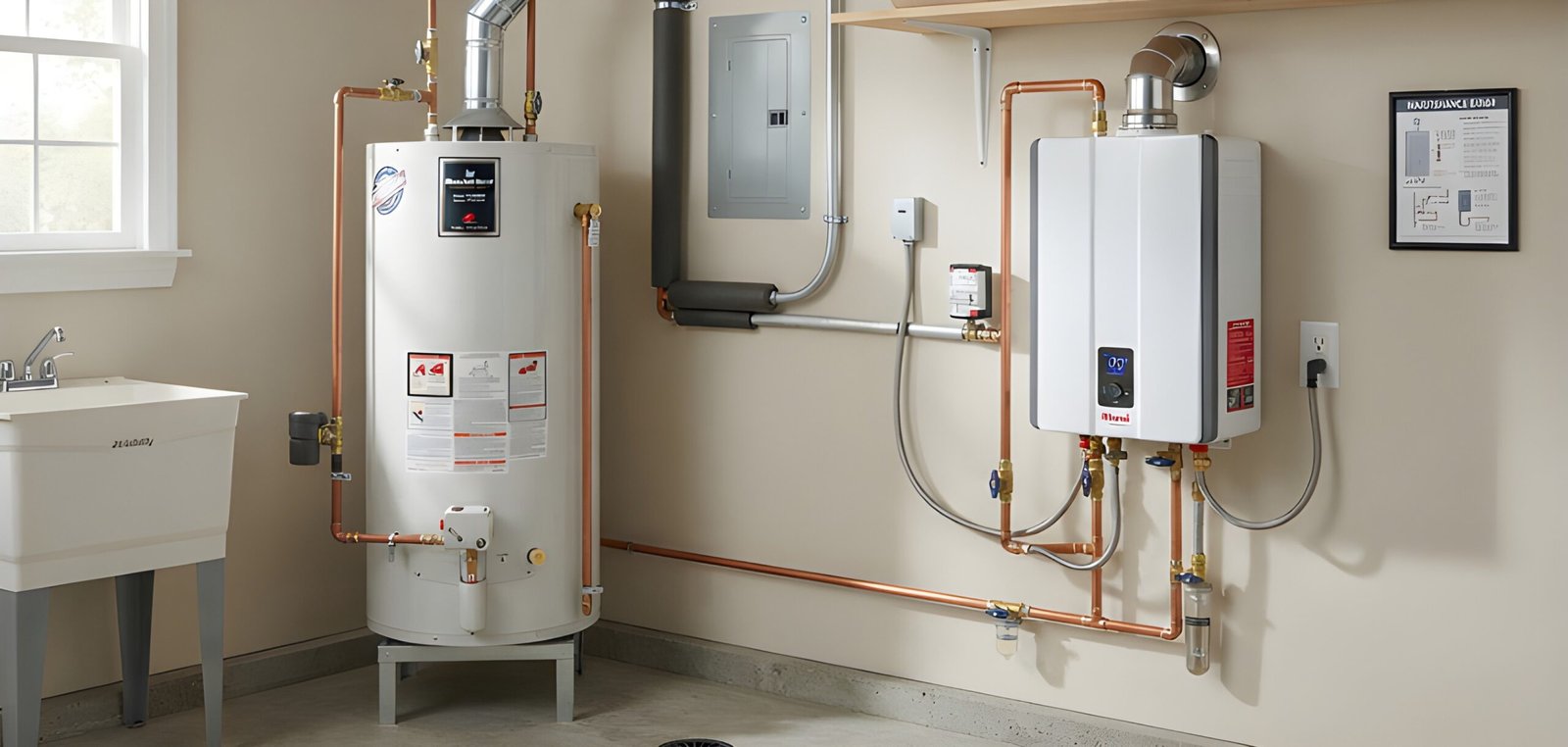
Electric vs Gas Cost
Evaluating an electric vs gas water heater requires examining more than just the initial purchase price. Upfront equipment and installation expenses differ from long-term operating expenses, which are heavily influenced by local utility rates, equipment efficiency, and your home's existing infrastructure. Neither fuel type is universally cheaper to own over time.
Which Option Is Cheaper?
Neither electric nor gas is always cheaper. Electric water heaters can have lower upfront costs, while gas water heaters may have lower operating costs in areas where natural gas is relatively inexpensive. The best choice depends on local energy prices, equipment efficiency, usage, and existing home infrastructure.
Electric Water Heater
Utilizes electrical heating elements to warm water. Conventional models often feature lower initial purchase costs and relatively straightforward installations when suitable electrical service is present.
- Equipment Cost: Often lower for conventional models
- Installation Cost: Often simpler when electrical service exists
- Typical Installed Cost: Generally ranges from $800 to $2,500
- Operating Factor: Depends on regional electricity rates
- Maintenance: Generally straightforward upkeep
Gas Water Heater
Burns natural gas or propane to heat water via a burner assembly. Often favored for faster recovery rates and potentially lower operating costs where natural gas rates are favorable.
- Equipment Cost: Varies by model and efficiency
- Installation Cost: Can be higher if gas/venting work is needed
- Typical Installed Cost: Generally ranges from $1,000 to $3,000
- Operating Factor: Depends on regional gas rates
- Maintenance: May involve combustion and venting components
Equipment, Installation, and Total Installed Cost Comparison
When assessing an electric water heater cost versus a gas water heater cost, equipment pricing is only part of the equation. Conventional electric tank models frequently have lower base purchase prices. However, installation expenses vary based on what infrastructure is already in place.
An electric water heater installation cost may be economical if adequate circuit capacity and wiring exist, but upgrading electrical service can add expense. Conversely, a gas water heater installation cost may reflect the labor required for proper gas piping connections, sediment traps, and code-compliant venting or combustion air solutions.
Broad U.S. national estimates suggest total installed costs typically run between $800 and $2,500 for standard electric units, and between $1,000 and $3,000 for standard gas units, though complex configurations can exceed these ranges.
Operating Costs and Energy Price Impact
An electric vs gas water heater operating cost comparison depends primarily on local utility rates and equipment efficiency. Because electricity and natural gas prices vary substantially across different regions of the United States, the more economical fuel source changes by location.
Homeowners should compare estimated annual energy costs rather than focusing solely on upfront pricing. In regions with low electricity rates, electric models can be very cost-effective to run. In areas where natural gas is inexpensive relative to electricity, gas models often hold an operating advantage.
Role of Existing Home Infrastructure
Your home's existing utility infrastructure plays a critical financial role when replacing a water heater:
- Switching or Staying Electric: Requires compatible electrical supply, voltage, amperage, and dedicated breaker capacity. Upgrading panels or running new heavy-duty wiring can significantly increase project expenses.
- Switching or Staying Gas: Requires a reliable natural gas line (or propane setup) and proper venting channels. Installing new gas lines or modifying chimneys/flues adds material and labor costs.
Electric vs Gas Cost Comparison Table
Key financial and operational factors for electric and gas water heaters.
| Cost Factor | Electric Water Heater | Gas Water Heater |
|---|---|---|
| Equipment cost | Often lower for conventional models | Varies by model |
| Installation cost | Often simpler when electrical service exists | Can be higher when gas/venting work is needed |
| Total installed cost | Varies by project ($800–$2,500 typical) | Varies by project ($1,000–$3,000 typical) |
| Energy cost | Depends on electricity rates and efficiency | Depends on gas rates and efficiency |
| Maintenance | Generally straightforward | May involve additional combustion/venting components |
| Infrastructure | Requires suitable electrical service | Requires suitable gas/venting infrastructure |
| Long-term cost | Depends on local electricity prices and usage | Depends on local gas prices and usage |
Electric May Make Sense When...
Suitable electrical service is already in place, local electricity prices are favorable, natural gas is unavailable on the property, or avoiding combustion venting requirements is preferred.
Gas May Make Sense When...
Suitable gas infrastructure already exists, natural gas rates are economical, the home features appropriate venting paths, or faster recovery rates are desired.
Practical Cost Example
To understand how fuel choice affects budgeting, consider two illustrative replacement paths:
Electric Replacement Scenario
Lower equipment purchase investment and straightforward electrical hookup utilizing existing wiring, balanced against regional electricity operating rates.
Gas Replacement Scenario
Standard equipment investment with localized gas line and venting verification, paired with natural gas operating rates which may offset initial setup expenses over time.
Note: These scenarios are illustrative examples for planning and do not represent guaranteed pricing.
Use the Water Heater Replacement Cost Calculator above to estimate your replacement budget, then compare your local electricity and natural gas costs to understand which option may be more economical over time.
Heat Pump Water Heater Cost
A heat pump water heater typically requires a higher upfront purchase price than a conventional electric storage tank, but it can use substantially less electricity by extracting heat from the surrounding air. Evaluating the true heat pump water heater replacement cost involves balancing equipment expenses, installation requirements, local labor rates, and potential energy incentives.
Unit Price
The standalone equipment-only price range for residential heat pump water heaters, varying by tank capacity and efficiency ratings.
Installation Cost
Includes professional plumbing connection, electrical verification, condensate line routing, and airflow setup considerations.
Total Installed Cost
The typical total installed cost combining both the heat pump water heater price and necessary installation labor for standard setups.
Rebates & Incentives
Federal tax credits, state programs, and local utility rebates that can significantly offset the initial purchase and installation investment.
How Much Does a Heat Pump Water Heater Cost?
A standard residential heat pump water heater installation cost generally spans between $2,000 and $4,500 total, depending on project complexity and regional contractor rates. While traditional electric resistance tanks often have lower upfront purchase tags, hybrid heat pump units introduce greater initial equipment and labor costs due to specialized components, control boards, and condensate management requirements.
| Cost Component | Typical Planning Range | Primary Cost Driver |
|---|---|---|
| Heat Pump Unit | $1,200 – $2,800+ | Tank capacity, efficiency rating, and brand tier |
| Standard Installation | $800 – $1,500 | Direct swap utilizing existing plumbing/electrical |
| Complex Installation | $1,500 – $2,500+ | Electrical circuit upgrades, new drainage, or tight spaces |
| Total Installed Project | $2,000 – $4,500+ | Combined equipment, labor, permits, and modifications |
Note: Figures represent broad U.S. residential planning averages. Actual pricing depends heavily on geographic location, contractor rates, and specific home configurations.
What Affects Heat Pump Water Heater Cost?
Several technical and physical factors influence the final cost to install a heat pump water heater in a residential property:
Tank Capacity & Dimensions
Larger households typically require 50-gallon, 65-gallon, or 80-gallon models. Increased storage capacity and physical dimensions directly raise equipment pricing and handling requirements.
Installation Location & Airflow
Hybrid units require adequate surrounding volume (typically 400 to 1,000 cubic feet of unconditioned space) to extract heat effectively. Basements, garages, or utility rooms work best; tight closets may need louvered doors.
Existing Electrical Setup
While most units operate on standard 240V circuits like conventional electric tanks, changing location or electrical panel proximity can require wiring adjustments or dedicated breaker verification.
Condensate Management & Drainage
Because heat pumps extract moisture from the air during operation, continuous condensate removal is required. Installing drain lines, gravity slopes, or condensate pumps adds to project complexity.
Upfront Cost vs. Operating Cost
Evaluating a heat pump water heater replacement cost requires comparing immediate expenses against long-term operational savings. Because heat pump technology moves heat rather than generating it via direct resistance, these units can use up to 70% less electricity than standard electric models.
Households with high daily hot-water consumption and high local electricity rates often experience faster payback periods, where cumulative utility savings offset the higher initial equipment purchase price over time.
Heat Pump Water Heater Payback
The financial return on investment depends on your baseline energy use, local utility pricing, and available incentives.
- Energy Efficiency: High Uniform Energy Factors (UEF) lower annual electricity consumption.
- Utility Rates: Higher per-kilowatt-hour rates increase dollar savings from efficiency gains.
- Incentives: Federal tax credits and local utility rebates reduce net upfront costs.
Replacing Aging Electric Tank
Ideal when transitioning an existing electric storage water heater in a garage or basement with ready electrical service and adequate room volume.
New Installation or Relocation
Moving or installing a unit in tight or finished living spaces may incur extra expenses for ducting, specialized clearance, drainage lines, or circuit modifications.
Incentive-Eligible Upgrade
Combining manufacturer promotions, regional energy efficiency rebates, and federal tax credits can dramatically lower the effective net project expense.
Heat Pump Cost Factors: Lower vs. Higher Expense Situations
| Cost Factor | Lower-Cost Situation | Higher-Cost Situation |
|---|---|---|
| Unit Selection | Standard capacity / basic model | Large capacity / premium smart features |
| Installation Setup | Direct swap in open utility room or garage | Tight or finished interior space requiring tight clearances |
| Electrical Requirements | Existing 240V circuit ready and accessible | Electrical panel upgrades or rewiring required |
| Plumbing & Drainage | Straightforward water lines with gravity drain nearby | Rerouting pipes or installing condensate pump |
| Incentives & Rebates | Full qualification for federal credits and utility cash-back | Ineligible for local rebate programs |
Is a Heat Pump Water Heater Worth the Higher Upfront Cost?
For most households with moderate to high hot-water demand living in homes with suitable space and electrical infrastructure, a heat pump water heater is well worth the investment. Lower monthly energy consumption often offsets the higher purchase and installation price over the equipment's lifespan, especially when combined with available tax credits and utility rebates.
Ready to estimate your complete water heater replacement project?
Calculate Replacement CostTankless Installation Cost
Installing a tankless water heater can cost more than simply swapping out a conventional storage tank. On-demand systems often require specialized adjustments to gas supply lines, electrical circuits, venting configurations, plumbing layouts, and condensate drainage. Understanding what drives the tankless water heater installation price helps homeowners budget accurately for their replacement project.
How Much Does It Cost to Install a Tankless Water Heater?
A typical tankless water heater installation cost generally ranges from $1,500 to $3,500+ for total installed projects (equipment and labor combined). Straightforward replacements where compatible infrastructure already exists trend lower, while complex tank-to-tankless conversions involving gas line upgrades, new venting, or electrical work sit at the higher end of the range.
Direct Replacement
Swapping an existing tankless unit with a similar model where all primary infrastructure is already compatible.
Gas Tankless Setup
Requires verifying gas supply line sizing, combustion intake, and installing specialized stainless steel or PVC venting.
Electric Tankless Setup
High-amperage electric models frequently require significant electrical panel capacity and heavy-duty wiring upgrades.
Tank-to-Tankless
Transitioning from a traditional storage tank to an on-demand system, requiring extensive retrofit labor and material adjustments.
What Is Included in Tankless Water Heater Installation?
Professional tankless water heater installation labor covers much more than simply mounting the unit to a wall. A comprehensive installation estimate typically incorporates several core technical steps:
Equipment Removal & Disposal
Disconnecting and safely hauling away the old water heater tank or legacy equipment.
Plumbing & Water Connections
Rerouting or modifying water inlet and outlet lines, plus installing required isolation valves.
Gas Line / Electrical Adjustments
Ensuring the fuel source or electrical circuit can deliver the high peak output demanded by tankless units.
Venting & Condensate Drainage
Running code-compliant exhaust venting and setting up proper condensate drainage for high-efficiency models.
Why Tank-to-Tankless Conversion Costs More
Replacing a conventional storage tank with a tankless water heater is rarely a direct drop-in replacement. Because on-demand units require massive thermal output in a short burst, they frequently trigger the need for infrastructure upgrades:
- Gas Supply Sizing: Standard storage tanks use smaller gas lines (often 1/2 inch). Gas tankless units commonly require larger 3/4 inch gas lines to ensure adequate fuel flow.
- Specialized Venting: Traditional draft hoods use metal chimney flues. Tankless systems require dedicated, sealed-combustion venting materials that must be routed safely through walls or roofs.
- Electrical Requirements: Even gas tankless water heaters need an electrical connection for internal computers and electronic ignition, while electric tankless units require heavy electrical service adjustments.
- Configuration & Mounting: Transitioning from floor-standing vertical tanks to wall-hung tankless units requires secure structural mounting and custom water line realignment.
Gas vs. Electric Tankless Installation Requirements
Comparing structural installation factors between fuel types.
| Installation Factor | Gas Tankless Installation | Electric Tankless Installation |
|---|---|---|
| Gas supply | May require upgrading pipe diameter (e.g., to 3/4") | Not required |
| Venting | Required for combustion exhaust (dedicated PVC/stainless steel) | Not required for combustion |
| Electrical requirements | Standard 120V outlet for internal controls | Can require significant electrical panel capacity (multiple 240V breakers) |
| Plumbing connection | Required (with service valve kits) | Required |
| Condensate management | May apply to high-efficiency condensing units | Typically not a combustion condensate issue |
| Installation complexity | Varies by gas line and venting layout | Varies heavily by available electrical service |
Tankless Installation Cost Breakdown by Project Type
General planning ranges for various residential tankless scenarios.
| Project Type | Installation Complexity | Typical Total Project Cost Range |
|---|---|---|
| Straightforward tankless replacement | Lower | $1,200 – $2,200 |
| Tank replacement with moderate modifications | Medium | $1,800 – $2,800 |
| Tank-to-tankless conversion | Higher | $2,500 – $4,500+ |
| Gas conversion requiring venting upgrades | High | $3,000 – $5,000+ |
| Electric installation requiring heavy electrical work | High | $2,800 – $4,800+ |
Existing Tankless Setup
Replacing an old tankless unit with a modern model in the same location is usually the most streamlined and cost-effective installation path.
Tank-to-Tankless Retrofit
Upgrading from a traditional storage tank involves multi-trade labor (plumbing, gas, venting, or electrical) which increases upfront installation pricing.
Relocating the Unit
Moving a water heater to an exterior wall or a different utility space increases labor time and material requirements for line extensions.
Equipment vs. Installation vs. Total Project Cost
When planning a budget, homeowners should separate the equipment purchase price from the labor and modification expenses.
Looking only at the base tankless water heater price can lead to unexpected budget shortfalls if infrastructure upgrades are overlooked.
Why Is Tankless Water Heater Installation So Expensive?
Tankless installation costs more than conventional tank replacements because it is a complex retrofit process rather than a simple parts swap. Upgrading gas lines, running specialized venting, configuring electrical capacity, managing condensate, and ensuring local code compliance require skilled professional labor. However, a straightforward replacement or compatible upgrade remains much more affordable than a full structural conversion.
Ready to estimate your complete water heater replacement project?
Use Replacement Cost CalculatorRepair vs Replacement
When a water heater malfunctions, deciding whether to repair or replace the unit is one of the most common dilemmas homeowners face. Evaluating water heater repair cost vs replacement cost requires looking beyond an immediate service bill to consider the age of the tank, the nature of the problem, and long-term operating reliability.
Repair May Make Sense
- Newer Unit: The water heater is well within its expected lifespan.
- Minor Issue: The problem is limited to a replaceable part like a thermostat, heating element, or anode rod.
- Sound Tank: The storage tank shows no signs of internal rust, structural leaks, or corrosion.
- Reliable History: The unit has otherwise been dependable with minimal service calls.
Replacement May Make More Sense
- Aging Equipment: The water heater is nearing or past its typical 8 to 12 year lifespan.
- Tank Failure: The storage tank itself is actively leaking or structurally compromised.
- Frequent Repairs: Service calls are becoming a recurring, expensive habit.
- Outdated Efficiency: Upgrading can improve energy performance and match household demand changes.
How to Decide: Repair or Replace Water Heater?
A structured decision framework helps homeowners determine whether a service call justifies another fix or if it's time to invest in a replacement unit.
1. Unit Age
Conventional tanks last roughly 8–12 years. Spending heavily on a unit past its prime rarely yields long-term value.
2. Nature of Problem
Component failures (valves, igniters) are fixable. Structural failures indicate systemic breakdown.
3. Tank Integrity
A leaking tank shell cannot be patched permanently; replacement is virtually always required.
4. Repair Cost vs Value
Comparing repair fees against the total cost of a new, warrantied installation guides smart spending.
5. Repair Frequency
One-off fixes are normal; paying for multiple repairs over a short span signals a failing system.
6. Remaining Service Life
Even if an older repair succeeds, consider how much longer the rest of the aging components will hold up.
Water Heater Repair Cost vs. Replacement Cost Matrix
Comparing typical situational indicators for repair versus replacement.
| Condition / Situation | Repair May Make Sense | Replacement May Make More Sense |
|---|---|---|
| Water Heater Age | Relatively new (under 5 years) | Older or near end-of-life (8+ years) |
| Nature of Failure | Minor component failure (thermostat, valve) | Major system breakdown or tank wall failure |
| Tank Condition | Clean, sound structure, no leaks | Active leaking, rust-colored water, heavy corrosion |
| Repair History | First service issue in years | Frequent, repeated service calls |
| Financial Impact | Low-cost repair relative to replacement | High repair cost approaching replacement value |
When Is It Not Worth Repairing?
A water heater is generally not worth repairing when the storage tank is leaking, multiple parts are failing simultaneously, or the unit has exceeded its expected service life. Pouring money into an obsolete system often results in throwing good money after bad when a new replacement provides a fresh warranty and reliable performance.
When Is Repair the Better Choice?
Repair is typically the smarter option when your water heater is relatively young and encounters a minor, isolated glitch. If a replacement valve or element restores full function for a modest price on a well-maintained unit, scheduling a professional repair preserves your capital until replacement becomes genuinely necessary.
Navigating the "50% Guideline"
A common rule of thumb suggests that if a repair cost reaches around 50% of the price of a brand-new unit—and the water heater is past its halfway lifespan—replacement is usually the wiser path. While not an absolute law, this guideline helps homeowners avoid sinking heavy funds into temporary fixes.
Newer Unit + Minor Problem
A 3-year-old water heater stops heating due to a faulty thermostat. Because the tank is sound and under warranty coverage, repairing is the logical, budget-friendly choice.
Older Unit + Expensive Repair
A 10-year-old unit requires a costly manifold or gas valve replacement. Given its age, investing in a new system provides better long-term reliability and peace of mind.
Leaking Storage Tank
Water pooling at the base of the tank indicates structural tank wall failure. Since internal leaks cannot be repaired, immediate replacement is required to prevent property damage.
Recurring Service Calls
A unit that required service twice last year and fails again now indicates a compounding decline. Accumulating repair bills quickly eclipse the upfront cost of a new replacement.
Illustrative Cost Comparison Example
Consider a typical scenario for a standard residential gas storage water heater facing a major component failure on an 8-year-old unit:
*Note: Figures shown are broad U.S. planning estimates. Actual quotes vary based on location, contractor rates, and specific installation requirements.
Quick Decision Checklist
Review this checklist to quickly align your current situation with the most cost-effective path forward:
Consider Repair If:
- Unit is relatively new (under 5 years)
- Tank structure is completely sound
- Problem is limited to a single part
- Repair cost is modest
- System has been historically reliable
Consider Replacement If:
- Storage tank is actively leaking
- Unit is 10+ years old
- Repairs are becoming frequent
- Repair cost approaches replacement value
- Advanced corrosion is visible
Is It Cheaper to Repair or Replace a Water Heater?
There is no single universal answer. Repair is typically more economical when the water heater is young and encounters a minor, isolated component failure. Conversely, replacement is cheaper in the long run when the unit is older, the tank is leaking, or recurring repair bills outweigh the value of investing in aging equipment.
Decided that replacement is the right choice for your home?
Estimate Replacement Cost NowWhen Should You Replace a Water Heater?
Water heaters do not necessarily need to be replaced simply because they reach a certain age, but age, condition, performance, reliability, and repair history can indicate when replacement should be considered. Replacing a water heater before an unexpected failure can also give homeowners more time to compare replacement options and costs.
How Long Does a Water Heater Last?
Typical service life can vary depending on water heater type, water quality, maintenance, usage, installation conditions, and equipment quality. Understanding general lifespan expectations helps homeowners plan ahead without viewing age as an automatic expiration date.
Conventional Tank Water Heaters
Typically range between 8 to 12 years of service life under standard operating conditions and routine maintenance.
Tankless Water Heaters
Often last 15 to 20 years or more, benefiting from replaceable components and lower internal tank stress.
Heat Pump Water Heaters
Generally provide 10 to 15 years of efficient operation when properly maintained and kept in suitable ambient spaces.
Top Signs You Need a New Water Heater
Recognizing the primary warning signs can help you address declining performance before a complete system breakdown occurs.
Water Around the Tank
Visible water pooling or moisture around the base of a storage tank can indicate a serious structural problem or internal leak.
Rust or Corrosion
Significant exterior rust or discolored hot water often points to internal tank deterioration and progressive metal breakdown.
Frequent Repairs
Repeated service problems and mounting repair expenses indicate that the system is losing long-term reliability.
Inconsistent Hot Water
Persistent problems maintaining adequate hot water temperature or volume show that the unit is struggling to meet household needs.
Unusual Noises
Loud rumbling, popping, or banging sounds inside a conventional tank frequently point to heavy sediment buildup and overheating.
Rising Energy Bills
A noticeable spike in energy use can reflect declining internal efficiency, though household utility changes should also be considered.
Water Heater Is Getting Old
Advanced age increases the probability of component failure, making proactive evaluation a wise strategy as units cross 8–10 years.
Frequent Shutdowns
Repeated pilot light outages, burner lockouts, or electrical trips signal that the unit is nearing the end of its useful lifespan.
Water Heater Age: When Should You Start Planning?
Age is a vital metric, but it is not an automatic replacement trigger. Reviewing system status by life stage keeps replacement timing manageable.
Newer Unit (0–4 Years)
Usually monitor performance and maintain the system as appropriate with routine flush cycles and anode rod inspections.
Mid-Life Unit (5–7 Years)
Pay attention to changes in performance, efficiency, minor leaks, and any emerging need for component service calls.
Older Unit (8–10 Years)
Begin thinking proactively about replacement options, especially if minor efficiency drops or unusual sounds appear.
End of Typical Life (10+ Years)
Replacement planning becomes increasingly important, particularly if reliability is declining or repair frequency increases.
7 Warning Signs It May Be Time to Replace Your Water Heater
If you are wondering how do I know when to replace my water heater, look for these seven primary indicators:
- 1. Active Tank Leaks: Pooling water around the base indicates tank wall failure.
- 2. Severe Corrosion: Heavy rust on fittings or the tank body shows deep degradation.
- 3. Frequent Repairs: Paying for multiple service visits turns into a bad investment.
- 4. Declining Performance: Running out of hot water much faster than before.
- 5. Advanced Age: Crossing past the standard 8 to 12 year benchmark.
- 6. Efficiency Drops: Unexplained increases in monthly utility bills.
- 7. Complete Unreliability: Systems that repeatedly shut down or fail to ignite.
Should You Replace a Water Heater Before It Fails?
Weighing proactive replacement against running a unit to total failure involves balancing convenience, cost, and peace of mind.
Potential Advantages of Proactive Replacement
- Less risk of sudden water damage from a ruptured tank.
- More time to compare equipment options and bids.
- Ability to schedule installation around your calendar.
- Opportunity to upgrade to higher-efficiency models.
Potential Drawbacks
- Investing in a replacement before capturing every final month of life.
- Current unit may still operate fine for a short period.
- Requires upfront capital deployment sooner.
Emergency Failure vs. Planned Replacement
Comparing what happens when you plan ahead versus dealing with an unexpected breakdown.
| Decision Metric | Emergency Replacement | Planned Replacement |
|---|---|---|
| Equipment Selection | Limited to whatever is in stock locally | Wide choice of brands, sizes, and efficiency tiers |
| Contractor Quotes | Rushed evaluation with fewer competitive bids | Time to secure multiple estimates and compare rates |
| Property Risk | High risk of secondary water damage from leaks | Controlled swapout prevents emergency water damage |
| Technology Upgrade | Difficult to research tankless or heat pump swaps | Ample time to evaluate modern energy-saving units |
Water Heater Warning Signs by Severity
Categorizing symptoms helps clarify whether you should keep an eye on the appliance, investigate further, or call for a replacement quote.
Monitor
- Increasing unit age (7+ years)
- Minor, intermittent temperature shifts
- Occasional light operational hum
Investigate
- Recurring performance drops
- Increasing repair frequency
- Inconsistent hot water delivery
Replacement Needed
- Active storage tank shell leak
- Extensive metal rust and corrosion
- Repeated major component failures
Quick Water Heater Replacement Checklist
Consider planning for replacement if your household checks multiple boxes below:
- ☐ The water heater is getting older (approaching or past 8–10 years)
- ☐ The unit has needed repeated repairs or service calls
- ☐ Hot water performance is declining during normal daily routines
- ☐ There are visible signs of external rust or pipe corrosion
- ☐ The system is becoming unreliable or shutting down unexpectedly
- ☐ Energy use appears to be increasing without other household changes
- ☐ The tank is leaking or moisture pooling is detected at the base
Older but Reliable
An older water heater that is still performing well does not automatically need immediate replacement, though keeping funds ready for a planned swap is sensible.
Older + Frequent Problems
Declining reliability combined with advanced age is a strong reason to evaluate replacement rather than continuing to sink money into temporary fixes.
Visible Tank Leak
A leaking storage tank is a critical warning sign indicating structural wall failure, making prompt replacement essential to avoid property damage.
When Should You Replace a Water Heater? (Takeaway)
Replacement should be considered when the unit is approaching the later part of its expected service life, reliability is declining, repairs are becoming frequent or costly, performance is deteriorating, or a serious problem such as a storage-tank leak develops. Age alone does not automatically mean replacement is required if the system is sound, well-maintained, and operating dependably.
Ready to evaluate your options? Estimate your potential project investment using our interactive calculator below.
Estimate Replacement Cost NowSigns You Need a New Water Heater
Water heaters often show warning signs before they fail completely. Changes in water temperature, water appearance, noise, leaks, reliability, and performance can indicate that the unit needs professional inspection or that replacement should be considered. One symptom does not automatically mean the entire water heater must be replaced, but recognizing early warning signs helps you address problems before an emergency occurs.
Top Signs You Need a New Water Heater
Review the primary physical, operational, and performance warning signs that signal a failing water heater.
1. The Tank Is Leaking
Water leaking from the storage tank itself can be a major sign that replacement is needed. A structural shell breach is fundamentally different from a minor fitting drip.
2. Rust or Significant Corrosion
Visible rust or substantial external corrosion can indicate deep metal deterioration and may be a reason to evaluate replacement.
3. Not Enough Hot Water
Persistent insufficient hot water can indicate declining performance, inadequate capacity, or internal sediment buildup blocking heat transfer.
4. Water Temperature Is Inconsistent
Repeated temperature fluctuations—such as water turning lukewarm unexpectedly—can indicate a problem with the water heater or its ability to maintain consistent heat.
5. Unusual or Increasing Noises
Persistent rumbling, popping, banging, or other unusual sounds from a storage water heater can be a warning sign of heavy sediment hardening inside the tank.
6. Water Looks Rusty or Discolored
Rusty or unusual-looking hot water can be a sign of internal corrosion or a deteriorating anode rod and should be evaluated by a professional.
7. Frequent Repairs or Breakdowns
Recurring problems can indicate declining reliability, especially when combined with an older unit that requires repeated component service.
8. Approaching End of Service Life
Advanced age makes the system more vulnerable to failure. When an older unit begins showing performance drops, replacement planning becomes sensible.
Water Heater Warning Signs by Severity
Evaluating symptoms by their severity helps you decide whether to monitor the system, seek a professional check, or plan for a replacement.
⚠️ Monitor
Examples: Occasional light operational hum, minor temporary temperature shifts, or increasing age without active performance loss.
These signs do not mean immediate replacement, but they warrant observation.
⚠️ Investigate
Examples: Inconsistent hot water, recurring performance drops, unusual water discoloration, or repeated minor repairs.
Professional evaluation is recommended to diagnose underlying issues.
⚠️ Serious Warning
Examples: Significant tank shell leakage, substantial rust corrosion, repeated major component failures, or total reliability loss.
Replacement should be actively considered and planned.
5 Clear Signs Your Water Heater May Be Failing
If you need a quick summary of when a water heater is going bad, look closely at these five strong indicators:
- 1. Visible Tank Leakage: Water escaping from the actual storage vessel walls.
- 2. Significant Corrosion: Severe rust accumulation on seams, tanks, or valves.
- 3. Persistent Lack of Hot Water: Inability to meet basic household daily volume needs.
- 4. Frequent Breakdowns: Needing continuous service visits within a short timeframe.
- 5. Major Reliability Drops: Sudden shutdowns, erratic heating, or complete operational failure.
Signs of a Failing Water Heater vs. Normal Operation
Comparing routine system behavior with symptoms that suggest a potential problem.
| Symptom Category | Could Be Normal / Minor | May Indicate a Problem |
|---|---|---|
| Noises | Minor temporary operational sounds | Persistent, loud rumbling or popping |
| Hot Water Delivery | Adequate supply for household routines | Persistent lack of hot water or quick depletion |
| Water Appearance | Clear water | Repeated rusty or discolored hot water |
| Unit Age & History | Older but reliably maintained | Older unit plus multiple warning signs |
| Service Needs | Occasional routine maintenance | Frequent or major component repairs |
| Tank Leakage | No visible moisture | Water pooling directly from the storage tank |
Water Heater Leak: When Is It Serious?
A water heater leaking is one of the most common concerns for homeowners. Understanding where the moisture originates helps determine the severity of the situation:
Water Around Connections or Fittings
Moisture near inlet/outlet pipes, temperature-pressure relief valves, or external plumbing joints may stem from loose piping or a gasket issue. This does not automatically mean the storage tank itself has failed.
Water Coming From the Storage Tank
Water pooling directly from the body of the tank or seeping through the insulated jacket indicates an internal tank wall breach. Because structural tank leaks cannot be permanently patched, replacement is typically required.
When Hot Water Performance Declines
Homeowners frequently notice symptoms like running out of hot water faster than before, water turning hot and then cooling unexpectedly, or longer recovery times between cycles. While these issues can sometimes stem from adjustable controls or sediment buildup, they can also point to a failing element, burner, or failing storage capacity. Professional evaluation helps pinpoint whether a service fix or replacement is appropriate.
Water Heater Making Noise
A water heater making noise—such as deep rumbling, popping, or sharp banging sounds—often occurs when heavy sediment layers harden at the bottom of a conventional tank and overheat. While occasional sounds can happen during normal heating cycles, persistent or worsening noises can signal advanced internal wear and stress on the appliance structure.
Age Combined With Warning Signs
Age alone does not automatically mean you need a new water heater. However, an older water heater combined with active leakage, severe corrosion, frequent repairs, declining performance, inconsistent hot water, or rising unreliability creates a much stronger reason to start planning for replacement.
Quick Checklist: Do I Need a New Water Heater?
Review the symptoms below against your current appliance condition:
- ☐ My water heater is leaking from the tank body
- ☐ I see significant rust or corrosion on the unit
- ☐ I frequently run out of hot water during normal use
- ☐ Water temperature has become unpredictable or inconsistent
- ☐ The unit is making unusual, loud rumbling or popping noises
- ☐ Hot water appears rusty, discolored, or muddy
- ☐ The water heater needs frequent repairs or service calls
- ☐ The unit is older and becoming increasingly unreliable
*Note: The more serious warning signs you observe—especially active tank leakage or major structural deterioration—the more important it is to have the system professionally evaluated and consider replacement options.
Older + Reliable
An older water heater with no major symptoms or leaks does not necessarily require immediate replacement, although keeping replacement options in mind is smart practice.
Older + Multiple Warning Signs
Age combined with recurring performance drops, unusual noises, or discolored water is a strong reason to evaluate replacement before total failure occurs.
Visible Tank Leak
A storage-tank leak is a serious warning sign indicating structural wall failure, making prompt replacement essential to prevent water damage to your home.
What Are the Biggest Signs You Need a New Water Heater?
The strongest warning signs include a leaking storage tank, significant corrosion, persistent lack of hot water, repeated major failures, and declining reliability. While age becomes more meaningful when combined with these symptoms, remember that some issues can have multiple causes and require professional evaluation to confirm whether replacement is necessary.
Noticing warning signs and considering an upgrade? Estimate your potential project investment using our interactive calculator below.
Estimate Replacement Cost NowEmergency Replacement Cost
Emergency water heater replacement can cost more than a planned replacement because homeowners may need immediate service, after-hours labor, expedited equipment, additional plumbing or electrical work, or other urgent services. The exact emergency water heater replacement cost varies by location, timing, heater type, installation requirements, and contractor availability. Understanding these pricing factors helps you navigate urgent upgrades without surprises.
Emergency Replacement Cost Overview
How different timing and urgency levels impact your total water heater replacement project investment.
1. Standard Replacement
A normally scheduled replacement during regular business hours generally incurs fewer emergency-related premiums, allowing for competitive contractor scheduling and standard equipment sourcing.
2. Same-Day Replacement
Same-day service may cost more because the plumbing contractor is rearranging existing schedules, delaying other projects, or prioritizing your urgent hot water needs.
3. After-Hours Replacement
Evenings, overnight service, weekends, and holidays can carry additional emergency dispatch charges, after-hours labor premiums, and higher urgent service rates.
4. Emergency With Upgrades
The final emergency hot water heater replacement cost can increase further when urgent timing coincides with necessary plumbing, electrical, venting, or building code modifications.
What Makes Emergency Replacement More Expensive?
Several operational and logistical factors drive up the total emergency water heater replacement cost:
After-Hours & Holiday Labor
Paying technicians for overnight, weekend, or holiday shifts increases hourly labor billing rates significantly.
Dispatch & Service Fees
Immediate emergency dispatch often incurs specialized urgent service call fees to mobilize a crew on short notice.
Expedited Equipment Sourcing
Sourcing a specific tank or tankless unit immediately can involve rushed delivery charges or limited inventory options.
Schedule Disruption
Contractors often reassign teams from scheduled jobs, creating overtime overhead that reflects in the final bill.
Unforeseen Site Conditions
Emergency tank failures often reveal rusted fittings, damaged drain pans, or water damage requiring immediate remediation.
Code & Modification Needs
Bringing an old setup up to current building codes during an emergency adds necessary materials and labor time.
After-Hours vs. Planned Replacement Comparison
A breakdown of how timing and urgency influence project pricing dynamics.
| Replacement Situation | Typical Cost Pressure | Why It May Cost More |
|---|---|---|
| Planned Weekday Replacement | Baseline / Standard | Standard scheduling; optimal equipment pricing and normal labor rates. |
| Same-Day Weekday Replacement | Moderate increase | Schedule adjustments and priority dispatch overhead. |
| Evening Replacement | Higher | After-hours labor premiums and urgent technician dispatch. |
| Weekend Replacement | Higher | Weekend technician availability and limited crew staffing. |
| Holiday / Overnight Emergency | Potentially significantly higher | Emergency callout rates, premium overtime pay, and urgent logistics. |
| Emergency + Installation Changes | Highest total investment | Combination of urgent labor rates plus extra plumbing, electrical, or venting work. |
What Does an Emergency Water Heater Replacement Bill Include?
When facing an urgent water heater replacement emergency, your invoice may itemize several distinct components. Understanding these line items helps clarify where your money goes:
- The Water Heater Unit: The selected tank, tankless, or heat pump model (subject to local distributor availability).
- Installation Labor: Standard technical setup time, adjusted for urgency or after-hours work.
- Emergency / After-Hours Service Fees: Surcharges for rapid dispatch outside standard operating windows.
- Removal & Disposal: Disconnecting, draining, and hauling away the failed tank.
- Plumbing & Electrical Materials: Replacement connectors, valves, thermal expansion tanks, or wiring updates.
- Gas, Venting, & Code Compliance: Essential safety updates required by local regulations during installation.
Why Emergency Replacement Costs More Than Planned Replacement
Emergency pricing is not necessarily because the water heater equipment itself is more expensive. Instead, the higher cost stems from contractor availability, urgent scheduling, after-hours labor premiums, expedited delivery, limited equipment choices, and the intensive work required to restore hot water quickly under stressful conditions. Planning ahead avoids these extra surcharges, but emergencies require immediate logistical mobilization.
Realistic Emergency Replacement Scenarios
Explore how different urgent situations can influence your actual replacement project cost:
Scenario 1 — Weekday Same-Day Replacement
A homeowner discovers a leaking tank mid-morning and needs hot water restored before evening. The contractor rearranges schedules, resulting in a moderate priority dispatch fee added to standard rates.
Scenario 2 — Weekend Emergency
A unit fails completely on Saturday morning. Because fewer technicians are on duty and weekend overtime applies, labor and dispatch charges increase the total bill compared to a Tuesday appointment.
Scenario 3 — Overnight Emergency
Water starts gushing from a ruptured tank at 10 PM. Emergency after-hours callout rates, late-night dispatch fees, and overnight labor premiums raise the overall replacement expense.
Scenario 4 — Emergency With Installation Changes
An urgent replacement reveals corroded gas lines or outdated electrical wiring that must be brought up to code before the new unit can be safely installed, increasing total material and labor costs.
How to Manage Emergency Costs
- Compare available local contractors if time permits.
- Ask upfront whether quotes include after-hours or emergency fees.
- Verify whether removal, disposal, and basic permits are included.
- Confirm equipment availability before committing to a contractor.
- Know your existing water heater tank size and fuel type to speed up quotes.
Emergency vs. Planned Checklist
- ☐ Is immediate replacement actually necessary today?
- ☐ Is the service being requested outside normal hours?
- ☐ Does the estimate include emergency service charges?
- ☐ Are the water heater and installation labor itemized?
- ☐ Are removal, disposal, and code fees accounted for?
Does Emergency Water Heater Replacement Cost More?
Yes, emergency replacement can cost more than planned replacement, especially for same-day, nighttime, weekend, or holiday service. However, the actual premium varies considerably depending on contractor availability, location, water heater type, installation requirements, and whether additional plumbing or code work is necessary.
Ready to estimate your potential replacement investment based on your specific heater type, size, and installation needs?
Calculate Replacement Cost NowWhat Is Included and Not Included in a Water Heater Replacement?
When reviewing a water heater replacement quote, what you see isn't always the complete picture. While a standard replacement quote typically covers the new unit and basic installation labor, the exact scope varies by contractor, property layout, heater type, and installation conditions. Understanding what is included in water heater replacement versus what might be charged separately helps homeowners avoid hidden costs of water heater replacement and compare estimates accurately.
What Is Typically Included?
Core items commonly found in a standard water heater installation quote.
1. New Water Heater
The replacement tank or tankless unit itself is typically included in the quoted price, though model specs, capacity, efficiency, and warranties should be confirmed.
2. Standard Installation Labor
Standard technician labor is commonly included when the new unit connects directly to existing plumbing and utility setups with minimal modification.
3. Basic Connection Materials
Standard fittings, flexible connectors, shut-off valves, or basic piping supplies needed to hook up the unit are often included in a standard quote.
4. Old Unit Removal
Some replacement quotes include disconnecting and removing the existing water heater from the closet or basement, while others may list haul-away separately.
5. Startup and Basic Testing
Contractors generally fill, ignite or power up, and test the new system to verify proper operation and hot water delivery before completing the job.
6. Basic Cleanup
Sweeping up or clearing away basic packaging materials and debris directly associated with the installation workspace is typically included.
What May Not Be Included?
Additional items or site conditions that often incur separate or extra charges.
1. Major Plumbing Modifications
Extensive pipe rerouting, corroded valve replacements, or upgrading undersized piping to code can be charged separately.
2. Electrical Upgrades
New breakers, heavy-duty wiring, dedicated circuits, or electrical panel updates required for electric or heat pump models are usually extra.
3. Gas & Venting Changes
Upgrading gas lines, modifying flue pipes, or installing specialized stainless steel venting for high-efficiency units often requires extra fees.
4. Relocation Expenses
Moving a water heater to a new room or floor introduces significant additional labor, pipe extensions, venting runs, and structural work.
5. Permits & Code Upgrades
Municipal permit fees, expansion tanks, drain pans, or anti-scald valves mandated by local building codes may be billed separately.
6. Difficult Access Charges
Tight crawlspaces, narrow attic stairwells, or awkward locations requiring specialized handling equipment can incur extra labor charges.
7. Property Repairs
Repairing drywall, flooring, or cabinets damaged by a leaking tank or altered during installation is generally not included in standard plumbing quotes.
8. Optional Accessories
Smart leak detectors, automatic shut-off valves, water softeners, or recirculation pumps are optional add-ons billed separately.
Included vs. Not Included Quick Comparison
Review what is typically bundled in a water heater installation estimate versus what frequently incurs additional costs.
| Item / Service | Often Included | May Cost Extra |
|---|---|---|
| Replacement water heater | ✓ (Standard models) | Upgraded capacity or tankless |
| Standard installation labor | ✓ (Straight swap) | Complex custom setups |
| Basic connection materials | ✓ (Fittings & lines) | Extensive custom piping |
| Removal of old unit | ✓ (Many contractors) | Depends on local policy |
| Disposal / Haul-away | Sometimes included | Often a separate fee |
| Startup & testing | ✓ (Standard procedure) | — |
| Major plumbing modifications | — | ✓ (Rerouting / valves) |
| Electrical upgrades | — | ✓ (Breakers / wiring) |
| Gas & venting modifications | — | ✓ (Flues / gas lines) |
| Relocation | — | ✓ (Moving rooms/floors) |
| Permits & code upgrades | Sometimes included | ✓ (Varies by locality) |
| Difficult-access charges | — | ✓ (Attics / tight spots) |
| Property repairs | — | ✓ (Drywall / flooring) |
| Optional accessories | — | ✓ (Leak detectors / pumps) |
Why Contractor Quotes Can Differ
When comparing multiple water heater replacement estimates, two quotes for the same property can vary significantly. Understanding why helps clarify pricing discrepancies:
- Equipment Quality & Warranties: One quote might feature a standard contractor-grade tank with a 6-year warranty, while another includes a premium high-efficiency model with a 10- or 12-year warranty and extended labor coverage.
- Bundled vs. Unbundled Scope: An apparently higher quote may be all-inclusive (covering disposal, permits, expansion tanks, and minor code updates), whereas a lower headline price could exclude those essentials as add-on fees.
- Contractor Overhead & Insurance: Fully licensed, bonded, and insured plumbing companies carry operational overhead that ensures accountability but may reflect slightly higher standard pricing than independent handymen.
- Site Assessment Assumptions: Contractors inspect installation requirements differently; one may anticipate code upgrades while another provides an estimate assuming a direct, unhindered swap.
Questions to Ask Before Accepting a Replacement Quote
Use these crucial questions during consultations to ensure complete cost transparency:
- Is the specific water heater brand, model, capacity, and efficiency rating clearly specified in writing?
- Is standard installation labor fully covered in the base quote?
- Is the removal and hauling away of the old water heater included?
- Does the price cover disposal fees or recycling costs?
- Are standard connection materials (flexible connectors, shut-off valves) included?
- Are municipal permits and required code inspections included or charged separately?
- Will any plumbing, electrical, gas, or venting modifications incur extra hourly or material fees?
- Are there any potential hidden or unexpected charges that could arise once work begins?
- What is the total expected price if no unforeseen structural or code issues are discovered?
Illustrative Sample Quote Breakdown
To help you understand how a transparent water heater replacement estimate is structured, here is an example of an itemized quote format:
Base Replacement Scope
- 50-Gallon Standard Gas Water Heater Unit: Included
- Standard Installation Labor & Basic Testing: Included
- Basic Water Supply & Gas Connectors: Included
- Old Unit Disconnection & Removal: Included
Potential Additional Charges (If Required)
- Old Unit Disposal & Recycling Fee: Varies ($50 – $150)
- Thermal Expansion Tank & Code Compliance Valve: Varies ($150 – $350)
- Municipal Plumbing & Building Permit: Varies ($75 – $250)
- Flue Venting or Gas Line Modification: Varies by site conditions
Note: This breakdown is illustrative only and does not represent fixed universal market prices or an actual contractor quote.
Included vs. Extra: What to Watch For
A lower initial quote is not automatically the better deal if critical components are excluded. One contractor might quote a low base price but charge separately for removal, disposal, permits, and connection materials—ultimately costing more than a competitor whose higher quote was all-inclusive. Always compare the total scope of work, not just the headline price.
Quick Quote-Check Checklist
- ☐ Water heater model and capacity confirmed
- ☐ Installation labor included
- ☐ Removal included
- ☐ Disposal clarified
- ☐ Standard materials included
- ☐ Permits clarified
- ☐ Required modifications clarified
- ☐ Optional upgrades identified
- ☐ Final expected price confirmed
What Is Normally Included in Water Heater Replacement?
A typical replacement quote normally includes the new water heater unit, standard installation labor, basic connection materials, startup testing, and sometimes old unit removal. However, major plumbing, electrical, gas, venting, relocation, permit, code upgrades, difficult-access fees, property repairs, and optional accessories are frequently separate. Always ask for a clear, itemized scope of work before comparing water heater replacement quotes.
Ready to estimate your baseline water heater replacement cost and use it as a starting point when reviewing contractor quotes?
Calculate Replacement Cost NowHow to Compare Replacement Quotes
The lowest water heater replacement quote is not always the best value. When evaluating multiple contractor estimates, you need a systematic approach to compare quotes fairly. True value depends on the equipment specifications, installation scope, included services, warranty coverage, required modifications, and final expected project cost. Always strive to compare like-for-like quotes to make an informed decision.
The 7 Things to Compare in a Replacement Quote
Key evaluation points to review before accepting any contractor proposal.
1. Water Heater Model
Compare the exact model, capacity, fuel type, energy efficiency ratings, and warranty specs rather than looking only at brand names or advertised tank sizes.
2. Total Installed Price
Evaluate the total expected project cost instead of base labor or equipment prices alone, checking closely for separately itemized fees.
3. Installation Scope
Ensure quotes account for identical installation requirements, including standard connections, plumbing adjustments, electrical, venting, or relocation work.
4. Removal & Disposal
Check whether old unit removal and disposal are fully bundled or listed as extra line items to ensure an accurate comparison.
5. Warranty Coverage
Compare tank/unit warranties against contractor workmanship guarantees, noting duration, coverage limits, and who handles service calls.
6. Permits & Codes
Verify if municipal permits, code-mandated expansion tanks, or safety valves are included in the quote or billed separately.
7. Contractor Qualifications
Consider licensing, insurance, professional standing, written guarantees, and responsiveness as part of the overall value equation.
Side-by-Side Quote Comparison Framework
An example layout showing how to structure a water heater replacement estimate comparison.
| Comparison Item | Quote A (Contractor 1) | Quote B (Contractor 2) | Quote C (Contractor 3) |
|---|---|---|---|
| Water heater type | Standard Tank (Gas) | Standard Tank (Gas) | High-Efficiency Tankless |
| Capacity / Specs | 50-Gallon (Standard) | 50-Gallon (Standard) | High-Flow Rate Unit |
| Equipment included | Included | Included | Included |
| Installation included | Included (Standard) | Included (Standard) | Included (Complex Vented) |
| Removal of old unit | Included | Included | Included |
| Disposal / Haul-away | Separate charge | Included | Included |
| Plumbing / Code items | Varies / Excluded | Expansion tank included | All code updates included |
| Permit handling | Homeowner responsibility | Included | Included |
| Warranty terms | 6-yr tank / 1-yr labor | 10-yr tank / 2-yr labor | 15-yr heat exchanger / 5-yr labor |
| Total expected price | Lowest headline price | Moderate all-inclusive price | Highest total investment |
Don't Compare Only the Headline Price
A common pitfall when reviewing a water heater replacement quote is focusing exclusively on the final bottom-line number. For instance, Quote A might feature a lower initial price because removal, disposal, permits, and connection materials are excluded as add-on fees. Meanwhile, Quote B might display a higher upfront figure but bundle all required installation components, permits, and haul-away services. Evaluating the final expected project cost and scope ensures you aren't caught by surprise fees later.
Watch for These Quote Red Flags
Warning signs that suggest you need to ask more questions before signing an agreement.
Vague Scope of Work
The estimate lacks detail on exactly what plumbing, electrical, or installation work will be performed.
Missing Equipment Details
The quote omits the specific water heater brand, model number, capacity, or energy efficiency rating.
Unclear Additional Charges
Language suggests substantial costs may be added mid-project without explaining when or why.
No Warranty Information
The paperwork provides zero details regarding equipment manufacturer coverage or workmanship guarantees.
Ambiguous Permit Responsibility
It remains unclear whether required municipal permits or code-mandated safety items are your responsibility.
Unexplained Price Gaps
Two quotes differ drastically in price without any corresponding difference in equipment or scope.
Price vs. Value
Lower Price: May look attractive initially, but check whether it excludes critical installation work, permits, or uses lower-grade specifications.
Better Value: May carry a higher initial investment but includes robust warranty protection, comprehensive installation scope, and professional code compliance.
Achieving a "Like-for-Like" Comparison
To compare quotes accurately, ensure each contractor is bidding on the same water heater type, capacity, fuel source, efficiency tier, and installation requirements. If one contractor quotes a standard tank and another quotes a high-efficiency tankless system, you are comparing entirely different projects. Request revised estimates if necessary to establish a true baseline.
Essential Questions to Ask Each Contractor
Use these targeted questions during consultations to clarify estimate details:
- What exact water heater brand, model number, and capacity are included in this quote?
- Does this represent the total installed price, or are certain materials billed separately?
- Is standard installation labor fully covered under this estimate?
- Are old unit removal and disposal included in the base price?
- Will any necessary plumbing, electrical, gas, or venting modifications incur extra fees?
- Are municipal permits and required code inspections included or charged separately?
- What specific equipment and workmanship warranties apply to this installation?
- Could any additional charges be added after work begins, and under what conditions?
Illustrative Quote Comparison Scenario
Imagine a homeowner receiving three replacement proposals: Quote A features the lowest headline price but excludes removal and permits. Quote B costs moderately more but includes complete installation, haul-away, and permit handling. Quote C features a premium tankless system with an extended warranty. By analyzing total project scope rather than picking Quote A purely on price, the homeowner realizes Quote B offers the best practical value for a standard replacement, while Quote C represents an intentional upgrade.
Note: This scenario is illustrative only and does not represent fixed market pricing or actual contractor quotes.
Final Quote-Comparison Checklist
- ☐ Exact water heater model and specifications confirmed
- ☐ Capacity and fuel type verified across all quotes
- ☐ Total installed price established
- ☐ Installation scope and required modifications clarified
- ☐ Removal and disposal policies checked
- ☐ Permit responsibility identified
- ☐ Equipment and workmanship warranties confirmed
- ☐ Potential additional charges documented
- ☐ Contractor qualifications verified
- ☐ Quotes compared on a strict like-for-like basis
What Is the Best Way to Compare Water Heater Replacement Quotes?
The best approach is to compare multiple written quotes using a standardized checklist. Look beyond the headline price and evaluate the exact equipment, installation scope, included services, warranties, potential additional charges, and final expected project cost. The best quote is not necessarily the cheapest quote — it is the proposal whose total scope, equipment, and cost are clearest and best suited to your home.
Ready to establish a reliable baseline cost estimate and use it as a benchmark when reviewing your contractor quotes?
Calculate Replacement Cost NowWater Heater Replacement Cost Examples
Replacement costs can vary significantly depending on the heater type, tank capacity, fuel source, installation conditions, and whether the project is a straightforward like-for-like replacement or requires additional modifications. The following scenarios illustrate how real-world replacement costs are constructed. Please note that these are illustrative planning examples for U.S. homeowners, not guaranteed contractor quotes.
Quick Scenario Overview
Illustrative 2026 U.S. planning ranges for common water heater replacement situations.
1. Basic 40-Gallon Electric Tank
Scenario: Replacing an existing standard electric tank in the same location with straightforward access.
Range: $1,200 – $2,200
Complexity: Low. Typically represents one of the simpler replacement projects.
2. 50-Gallon Gas Tank Replacement
Scenario: Exchanging a standard 50-gallon gas tank in its original closet or utility room.
Range: $1,500 – $2,800
Complexity: Low-Moderate. Can involve minor venting or gas line safety check considerations.
3. Larger 75-Gallon Tank Replacement
Scenario: Upgrading to a larger 75-gallon storage tank to support higher household hot-water demand.
Range: $2,200 – $4,000
Complexity: Moderate. Larger units increase equipment costs and require careful clearance check.
4. Heat Pump Water Heater
Scenario: Switching a standard electric tank to a hybrid heat pump system for energy savings.
Range: $2,500 – $4,500
Complexity: Moderate-High. Higher equipment cost and requires adequate room air volume or condensate drainage.
5. Gas Tankless Water Heater
Scenario: Upgrading from a storage tank to an on-demand gas tankless unit.
Range: $3,000 – $5,500+
Complexity: High. Often requires gas line resizing, dedicated electrical, and specialized stainless steel venting.
6. Complex Replacement
Scenario: Relocating a unit to a new area or working in a tight, difficult-access crawlspace or attic.
Range: $3,500 – $6,000+
Complexity: High. Site conditions and extensive plumbing modifications drive the price up.
Detailed Cost Breakdown by Scenario
How representative replacement project totals are constructed from individual cost components.
Scenario A — Simple Electric Tank Swap
- Water Heater Unit (40-Gal Electric): ~$600 – $900
- Standard Installation Labor: ~$500 – $800
- Basic Connectors & Materials: ~$100 – $200
- Old Unit Removal & Disposal: ~$75 – $150
- Permit / Code Inspection: ~$50 – $150
- Illustrative Total: $1,325 – $2,200
Reflects a straightforward like-for-like swap with existing wiring and plumbing connections unchanged.
Scenario B — Standard Gas Tank Replacement
- Water Heater Unit (50-Gal Gas): ~$800 – $1,200
- Standard Installation Labor: ~$600 – $900
- Fittings, Gas Flex & Vent Check: ~$150 – $300
- Old Unit Removal & Haul-Away: ~$100 – $200
- Permit & Safety Valve Upgrades: ~$100 – $250
- Illustrative Total: $1,750 – $2,850
Accounts for gas safety checks, minor flue verification, and standard code requirements.
Scenario C — Heat Pump Water Heater
- Hybrid Heat Pump Unit (50-Gal): ~$1,500 – $2,300
- Specialized Installation Labor: ~$800 – $1,200
- Condensate Line & Electrical Setup: ~$200 – $400
- Removal & Eco-Disposal: ~$100 – $200
- Permits & Code Compliance: ~$100 – $250
- Illustrative Total: $2,700 – $4,350
Higher equipment cost paired with condensate drainage installation and airflow considerations.
Scenario D — Tankless or Complex Upgrade
- Gas Tankless Unit & Isolation Kit: ~$1,200 – $2,200
- Complex Installation Labor: ~$1,200 – $2,000
- Stainless Steel Venting & Gas Line Upgrade: ~$400 – $900
- Removal, Disposal & Permits: ~$200 – $400
- Illustrative Total: $3,000 – $5,500+
Reflects major structural, gas line, and dedicated venting modifications required for tankless transitions.
Water Heater Replacement Cost Comparison Table
Overview of project scopes, planning ranges, and primary cost drivers across different scenarios.
| Replacement Scenario | Example Project | Illustrative Cost Range | Main Cost Drivers |
|---|---|---|---|
| 40-gallon electric tank | Standard electric swap | $1,200 – $2,200 | Tank unit size, straightforward labor |
| 50-gallon gas tank | Standard gas tank replacement | $1,500 – $2,800 | Gas safety check, venting inspection |
| 75-gallon tank | High-demand large storage tank | $2,200 – $4,000 | Heavier equipment weight, clearance space |
| Heat pump water heater | Hybrid electric energy upgrade | $2,500 – $4,500 | Higher unit cost, condensate management |
| Gas tankless | Tank-to-tankless conversion | $3,000 – $5,500+ | Gas line resizing, specialized venting |
| Complex replacement | Attic/crawlspace or relocation | $3,500 – $6,000+ | Difficult access, extensive plumbing rerouting |
Why Two Similar Water Heaters Can Have Different Costs
Homeowners frequently wonder why two neighbors purchasing identical water heater models can receive notably different replacement quotes. The water heater unit itself is only one part of the total project. Final pricing is heavily influenced by local labor rates, site accessibility, the condition of existing plumbing and electrical systems, gas or venting modifications, municipal permit requirements, code-mandated safety items (such as expansion tanks), and contractor scope.
Simple Replacement
Characterized by a direct like-for-like swap in the exact same location. The existing water supply lines, electrical connections, and venting align seamlessly with the new unit.
Access is unhindered, requiring minimal modification. These projects have shorter labor times and more predictable, lower-end pricing.
Complex Replacement
Involves difficult access areas (tight crawlspaces, awkward attics), transitioning between different fuel types or system categories (tank to tankless), or complete unit relocation.
Requires extensive pipe rerouting, electrical panel adjustments, or custom venting runs, resulting in wider price ranges and higher labor investments.
What If My Project Is Different?
These examples are designed to illustrate general cost structures and planning ranges rather than predict an exact quote for your home. Every property has unique installation variables. Homeowners should use these scenarios to understand the relative cost breakdown, identify where their own project fits, and then utilize the Calculante calculator to generate a personalized baseline estimate.
Illustrative Homeowner Scenarios
Scenario 1: Lowest Complexity
A homeowner replaces an existing electric storage tank with a matching model in an open garage utility room. Because connections match and access is open, labor is minimal and the project stays on the lower end of the cost spectrum.
Scenario 2: Moderate Complexity
A homeowner replaces an older gas tank. During inspection, the technician notes that local building codes now require a thermal expansion tank and updated shut-off valves, moderately increasing the total project investment.
Scenario 3: High Complexity Upgrade
A family transitions from a standard gas tank to a high-flow tankless unit. This requires upgrading the gas supply line diameter and running new stainless steel wall venting, elevating total costs above a standard tank swap.
Water Heater Cost Planning Checklist
- ☐ Water heater type identified (Tank vs. Tankless vs. Heat Pump)
- ☐ Tank capacity or tankless flow requirement confirmed
- ☐ Fuel source verified (Electric, Natural Gas, Propane)
- ☐ Existing installation location confirmed
- ☐ Access difficulty and physical clearances evaluated
- ☐ Necessary installation modifications identified
- ☐ Removal and haul-away policies clarified
- ☐ Permit and local code upgrade requirements noted
- ☐ Optional accessories separated from required core work
- ☐ Total estimated budget established using planning ranges
How Much Could a Water Heater Replacement Cost?
A straightforward standard tank replacement typically falls in the lower end of the overall market range, while larger tanks, hybrid heat-pump systems, gas tankless conversions, difficult access conditions, and code-mandated installation modifications can push total project costs considerably higher. The best way to understand your likely replacement cost is to match your project to the closest scenario and adjust for your specific equipment and site requirements.
Ready to move from a general example to a personalized estimate based on your home's unique project details?
Calculate Your Replacement CostFrequently Asked Questions
Find clear, expert-backed answers regarding water heater replacement costs, sizing, installation factors, and how our estimation calculator works to help you plan your project with confidence.
The average cost to replace a water heater ranges from $1,200 to $3,500 including professional installation and equipment.
- Standard Electric Tank: $1,200 – $2,200 (Lower end of market pricing)
- Standard Gas Tank: $1,500 – $2,800 (Includes basic venting check)
- Heat Pump / Hybrid: $2,500 – $4,500 (Higher efficiency, specialized setup)
- Tankless On-Demand: $3,000 – $5,500+ (Requires gas/electrical modifications)
Our calculator synthesizes your selected water heater characteristics with installation variables using a structured algorithmic pricing model:
- Step 1: Selects baseline equipment costs based on your chosen system type and capacity.
- Step 2: Adds standard labor brackets associated with professional installation.
- Step 3: Incorporates optional project components like old unit haul-away and local permits.
The result provides an instant, comprehensive planning estimate to help you benchmark contractor bids.
No. The output provided by the calculator is an informative planning estimate and should not be treated as a binding contractor bid.
Actual contractor pricing accounts for physical site inspection variables such as tight spatial access, corroded plumbing lines, unique electrical panel capacities, and specific local code mandates that automated web tools cannot independently inspect.
While traditional tank units offer lower initial equipment and replacement costs, tankless systems require a higher financial upfront investment due to complex installation requirements:
- Tank Water Heaters: Simpler drop-in replacement using existing water and vent lines. Lower labor investment.
- Tankless Systems: Requires upgrading gas lines for higher BTU demands, installing specialized stainless steel venting through walls or roofs, and occasionally upgrading electrical circuits.
For a straightforward like-for-like tank replacement where water lines, gas/electric connections, and venting align perfectly, a licensed technician typically completes the job in 2 to 4 hours.
Complex projects—such as converting from an electric storage tank to a gas tankless unit or relocating the water heater to an attic or tight crawlspace—can extend project timelines to a full working day due to extensive structural modifications.
When reviewing water heater replacement quotes, watch out for these commonly added line items required for code compliance and safety:
- Thermal Expansion Tank: Required by modern codes on closed plumbing systems to prevent pressure spikes.
- Permit & Inspection Fees: Local municipal fees ensuring the installation passes code inspection.
- Shut-Off Valves & Connectors: Replacing rusted or archaic gate valves with modern ball valves.
- Drain Pans & Condensate Pumps: Essential for attic or indoor installations to prevent flood damage.
Proactive replacement is strongly recommended if your water heater has exceeded its expected lifespan (typically 10 to 12 years for storage tanks), shows visible rust on the outer tank shell, or begins leaking around base seams.
Waiting for catastrophic tank rupture often results in severe water damage to flooring, drywall, and personal belongings—turning a planned replacement into an expensive emergency project.
Yes, hybrid heat pump water heaters involve higher initial equipment costs and can incur extra installation expenses. Because they extract heat from surrounding air, they require adequate room volume (typically 750+ cubic feet) or louvered doors, plus a dedicated condensate drain line.
However, their superior energy efficiency frequently offsets the higher upfront installation cost over time through lower utility bills.
DIY water heater installation is generally discouraged unless you have professional plumbing, electrical, and gas-fitting training.
Incorrectly installed gas lines risk fatal carbon monoxide leaks or explosions. Improper electrical wiring or pressure relief valve setups can cause severe water damage or electrical fires. Furthermore, most manufacturers void equipment warranties if installed by unlicensed individuals.
Proper sizing relies on your household occupancy and peak hour water demand:
- 1 to 2 Occupants: 30 to 40-gallon tank
- 3 to 4 Occupants: 50-gallon tank
- 5+ Occupants: 75+ gallon tank or high-flow tankless unit
If your household frequently runs multiple hot water appliances simultaneously (such as a dishwasher and shower), upgrading capacity ensures you don't run out of hot water.
Our calculator features configurable options allowing you to toggle removal and eco-disposal fees. Always confirm with your chosen contractor whether hauling away your expired heavy tank is included in their quoted flat-rate price or listed as an auxiliary disposal fee.
Contractor bids fluctuate due to differences in company overhead, insurance coverage, labor warranty protections, local licensing standards, and how comprehensively they scope the installation.
A lower-priced bid may omit crucial safety upgrades, building permits, or disposal fees, whereas a comprehensive quote covers full code compliance and workmanship guarantees.
No matching questions found
Try searching with different keywords or browse all categories above.
Ready to Calculate Your Exact Replacement Cost?
Use our interactive Water Heater Replacement Cost Calculator to input your home's specifications and get an instant, customized planning estimate.
Our Trusted Sources
Our water heater replacement cost models, tank vs. tankless efficiency comparisons, and installation guidelines are built upon verified insights from leading federal agencies, independent standards institutions, and top manufacturers.
Accurate water heater replacement and installation estimates rely heavily on standardized metrics like equipment efficiency, capacity ratings, and compliance requirements. By aligning our calculator's algorithms with U.S. Department of Energy (DOE) guidelines and AHRI-certified performance standards, we ensure that the cost projections and sizing recommendations provided on Calculante match real-world installation scenarios.
Related Calculators
Compare alternative heating systems, estimate overall replacement costs, and plan your home energy efficiency improvements with our suite of specialized tools.
AC & Heater Operating Cost Calculator
Estimate monthly and seasonal utility expenses to run your home's heating and cooling systems accurately.
Launch Calculator →Heat Pump Savings Calculator
Calculate your annual energy bill reduction and long-term utility savings for upgrading to an efficient hybrid system.
Launch Calculator →Heat Pump Sizing Calculator
Determine the correct capacity and tonnage requirements needed to properly condition and heat your home's layout.
Launch Calculator →HVAC Replacement Cost Calculator
Plan major home infrastructure investments with comprehensive pricing breakdowns for new heating and cooling setups.
Launch Calculator →