
EV Solar Charging Calculator
Calculate exactly how many solar panels you need to charge your electric vehicle or Tesla at home, estimate annual charging electricity demand, evaluate system costs, and optimize your clean energy savings.
Visual comparison of annual grid-only charging vs. solar-assisted EV charging.
How to Use Our EV Solar Charging Calculator
Our tool helps you estimate annual EV charging electricity demand, determine how many solar panels for EV charging cost and system sizing are required, check how much charging can be covered by solar, calculate remaining grid electricity costs, and explore potential savings.
Select Your Electric Vehicle
Select your vehicle make and model from the available list. The calculator will automatically populate the vehicle's energy efficiency. You can easily edit the efficiency value if you know a more precise figure for your driving conditions. If your specific vehicle is unavailable, use the manual or fallback option.
Enter Your Annual Driving Distance
Input your estimated annual mileage. You can also toggle between miles and kilometers depending on your preference. Driving distance heavily impacts annual electricity demand and determines how many solar panels to charge an EV efficiently.
Set Your Home-Charging Percentage
Estimate the percentage of your EV charging performed at home. For example, a homeowner who relies primarily on a home garage charger might choose 80%, while someone who frequently utilizes public charging stations may choose a lower percentage.
Add Your Solar and Electricity Details
Enter your existing solar system size, local electricity price, and optional location details. If you have no solar setup installed yet, simply select the no-existing-solar option. Local solar production estimates and utility rates help refine your output figures.
Adjust Advanced Options if Needed
Fine-tune your calculation using advanced settings such as charging system losses, regional solar production yield, the share of solar electricity available for EV charging, panel wattage, and grid export credits. You can keep the default assumptions if you are unsure.
Review Your Results and Cost Breakdown
Examine your annual charging electricity, estimated additional solar panels, solar coverage percentage, remaining grid power needs, and estimated monthly or annual charging expenses. Review how many solar panels do I need to charge a Tesla or other EVs, and use the detailed breakdown tables and charts to explore your calculations.
Tip: Use Your Most Accurate Numbers
Actual vehicle efficiency, annual driving mileage, utility rates, existing solar production, household electricity consumption, and local sunlight conditions can materially alter your estimate. Whenever possible, update default settings with verified figures from your vehicle metrics, electricity bills, and solar proposals.
Please note that this tool provides planning estimates rather than guaranteed utility bill reductions or professional solar system engineering blueprints.
Feel free to modify your inputs and test multiple scenarios—such as charging at home more frequently, leveraging existing solar production surplus, or expanding your array capacity—to see how clean energy integration impacts your household budget.

How Many Solar Panels Do You Need to Charge an EV?
Determining how many solar panels to charge an EV depends primarily on your annual driving distance, your vehicle’s electricity efficiency, local solar production conditions, charging system losses, and individual panel wattage. There is no universal panel count that fits every driver; two households driving similar electric cars can require substantially different solar capacities based on miles driven and regional climate differences.
1. Lower Annual Mileage
Drivers with lower annual driving distances—such as 6,000 miles per year—require significantly less annual battery energy. Consequently, they need fewer solar panels to cover their EV charging demand completely, minimizing upfront installation costs.
2. Typical Daily Driving
For a typical driving profile of 12,000 miles per year, standard mid-range efficiency requires a moderate amount of home solar capacity. This tier represents the baseline modeling used in standard residential clean energy evaluations.
3. Higher Annual Mileage
Long commutes or frequent road trips pushing upwards of 18,000 miles per year demand much higher annual electricity consumption. These higher-mileage scenarios require a larger array of solar panels to maintain high solar coverage for daily driving.
What Determines the Number of Solar Panels?
Annual Driving Distance
Total miles driven each year form the foundation of your charging energy requirements. More miles mean more kilowatt-hours consumed, which directly increases the total solar production needed to offset your driving footprint.
EV Energy Efficiency
Measured in miles per kWh (or kilometers per kWh), efficiency dictates how far your vehicle travels on a single unit of electricity. A highly efficient electric car needs less energy to cover the same distance than a larger, heavier electric vehicle or SUV.
Local Solar Production
Solar panels generate varying amounts of electricity depending on regional sunlight, weather patterns, geographic location, roof shading, orientation, and tilt angle. ZIP-code-based production estimates provide helpful modeling benchmarks rather than guaranteed generation outputs.
Solar Panel Wattage and Charging Losses
Individual panel wattage determines how much physical capacity each module contributes to your system. Furthermore, charging losses during AC-to-DC conversion mean that the electricity drawn from your home electrical supply slightly exceeds the actual energy delivered into the vehicle battery.
Simple Calculation Example for an Electric Car
To understand how requirements are computed for a typical electric car, consider the following baseline planning assumptions:
- Annual driving distance: 12,000 miles
- EV efficiency: 3.5 miles per kWh
- Charging losses: 10%
- Solar panel rating: 400 watts (0.4 kW DC per panel)
- Illustrative annual solar production: 1,200 kWh per installed kW
1. Annual Home Electricity Drawn: 12,000 miles ÷ 3.5 mi/kWh ÷ (1 − 0.10 losses) = 3,810 kWh/year.
2. Recommended Solar Capacity: 3,810 kWh ÷ 1,200 kWh/kW/yr = 3.18 kW DC.
3. Panel Count: 3.18 kW ÷ 0.4 kW per panel = 7.95, rounded up to 8 solar panels.
Note: This simplified arithmetic illustrates annual energy planning. It does not imply that your EV will always draw power directly from solar panels in real time, nor does it account for concurrent household appliance consumption or an existing solar array.
Existing Solar Panels: Do You Need More?
Drivers who have already installed residential solar panels may not need to build a brand-new system to power their EV. When evaluating an existing setup, consider:
- Existing system size and generation: Total capacity and estimated annual electricity production.
- Household consumption: How much power your home appliances and heating systems already draw from the array.
- Available solar share: The specific percentage of solar generation actually available to allocate toward EV charging.
- Remaining grid dependency: The amount of electricity that must still be purchased from your utility provider.
Keep in mind that total annual solar production is not automatically equal to surplus energy available for vehicle charging. If your current system is fully utilized by your home, adding supplementary solar capacity may be necessary to support your EV without raising your utility bills.
To find out exact figures tailored to your driving habits and local climate, use the interactive calculator above to estimate your annual EV electricity demand and additional panel requirements.
Want to Know How Many Solar Panels You Need for Your EV?
Use our EV Solar Charging Calculator to figure out your exact daily driving energy demand, how many solar panels it takes to power your electric car, and your estimated annual savings.
Calculate EV Solar Panels NowHow Many Solar Panels to Charge an Electric Car?
Understanding how many solar panels to charge electric car usage requires looking closely at practical driving scenarios. The total solar panel capacity needed depends primarily on how far the vehicle is driven annually, how efficiently it converts electricity, how much energy is lost during charging, and how much electricity your local solar panel array produces each year.
1. Short-Distance Driver
Covering an illustrative 6,000 miles per year, this driving profile cuts annual electricity demand in half compared to average commuting benchmarks. Lower energy consumption naturally translates to a smaller solar footprint and fewer panels required.
2. Average-Distance Driver
Driving an illustrative 12,000 miles per year aligns closely with standard U.S. annual mileage benchmarks. This balanced scenario requires moderate annual home charging electricity and a standard residential solar panel array size.
3. Long-Distance Driver
Reaching an illustrative 18,000 miles per year due to extensive commuting or regular road trips results in significantly higher annual electricity demand. Consequently, covering this mileage entirely through home solar requires a larger system capacity.
Driving Scenario Comparison
The following comparative table illustrates how changing annual driving distances alter estimated energy consumption and solar panel requirements. All calculations use uniform baseline assumptions: 3.5 mi/kWh efficiency, 10% charging losses, 400W panel rating (0.4 kW), and an illustrative solar production rate of 1,200 kWh per installed kW.
| Annual Driving Distance | Est. Annual Home Electricity | Approx. Solar Capacity Needed | Approx. Number of Panels |
|---|---|---|---|
| 6,000 miles | 1,905 kWh / year | 1.59 kW DC | 4 panels (rounded up) |
| 12,000 miles | 3,810 kWh / year | 3.18 kW DC | 8 panels (rounded up) |
| 18,000 miles | 5,714 kWh / year | 4.76 kW DC | 12 panels (rounded up) |
Disclaimer: The 1,200 kWh/kW/year production figure is an illustrative modeling assumption, not a guaranteed output or universal U.S. average. Actual solar generation varies heavily by geographic region, weather, and roof orientation.
Why the Same Car Can Need Different Numbers of Panels
Vehicle Efficiency Differences
Electric vehicles vary widely in how many miles they travel per kilowatt-hour. Two cars driven for identical distances will draw different amounts of home EV charging electricity if one model has a significantly lower efficiency rating than the other.
Local Solar Production Variability
Geographic location plays a major role in solar panel capacity. A home in a sunny southern climate generates more annual kilowatt-hours per installed kW than an identical system located in a northern region with frequent cloud cover.
Panel Wattage Variations
Individual solar panel ratings influence physical layout. Higher-wattage modules deliver more rated capacity per panel, meaning you require fewer physical units to reach your target kilowatt target, though total energy output depends on environmental factors.
Charging System Losses
Converting alternating current (AC) from your home supply into direct current (DC) for your battery involves thermal and electronic losses. Electricity drawn from the home exceeds actual battery energy storage, increasing total solar panel requirements slightly.
Already Have Solar Panels?
EV owners who already operate a residential solar system may already generate enough surplus energy to cover some or all of their annual EV charging demand without building an entirely separate array.
However, total solar production is not automatically equivalent to surplus electricity available for vehicle transport. Household appliance consumption, local net metering policies, export credits, and the exact timing of when your car is plugged in all dictate how much solar energy is truly captured for driving.
We encourage you to input your current system size into our calculator to evaluate how your existing setup interacts with your electric vehicle's energy needs.
To see how these practical driving scenarios compare with your specific commuting habits and vehicle specifications, use the interactive calculator above to generate a tailored estimate.
How Many Solar Panels Do I Need to Charge a Tesla?
Figuring out how many solar panels do I need to charge a Tesla depends on several vehicle and environmental factors. The final panel count relies directly on the specific Tesla model and configuration, your annual driving mileage, real-world energy efficiency, home charging habits, charging system losses, and regional solar production conditions. Any estimated panel count serves as a helpful planning benchmark rather than a guarantee of full seasonal coverage.
1. Tesla Model 3
As a lighter, highly aerodynamic sedan, the Model 3 typically offers high energy efficiency. However, estimated electricity demand still varies depending on whether you drive a Rear-Wheel Drive (RWD) or Long Range Dual Motor variant, wheel size options, and your annual mileage.
2. Tesla Model Y
As a mid-size electric SUV, the Model Y generally experiences higher energy consumption per mile than a smaller sedan. Annual driving distance and specific configurations (such as Long Range or Performance trims) directly influence the solar capacity needed to offset charging.
3. Tesla Model S and Model X
Larger flagship configurations or performance-oriented layouts can feature distinct energy profiles. Owners of these larger vehicles should select their exact vehicle trim or input verified real-world efficiency figures to maintain accurate home solar sizing.
What Information Do Tesla Owners Need?
Vehicle Model and Configuration
Identifying your precise Tesla model year, trim package, and wheel setup ensures the most accurate baseline efficiency rating before factoring in your personal driving habits.
Annual Mileage and Efficiency
Annual distance traveled dictates total energy draw. Efficiency (measured in miles per kWh) should remain fully editable so you can adjust based on real-world driving temperatures, highway speeds, and climate control usage.
Home Charging Percentage
Because public Supercharging stations draw power from commercial grids rather than your roof, only the share of electricity charged at your home garage dictates your residential solar array requirements.
Local Solar Production & Hardware
Regional sunlight yields, panel wattage ratings (e.g., 400W), and any existing rooftop solar array capacity work together to determine how many physical panels must be added.
Example: Estimating Solar Panels for a Tesla
To see how calculations are structured for a Tesla charging setup, consider the following illustrative planning parameters:
- Annual driving distance: 12,000 miles
- EV efficiency: 3.5 miles per kWh
- Charging losses: 10%
- Solar panel rating: 400 watts (0.4 kW DC per panel)
- Illustrative annual solar production: 1,200 kWh per installed kW
1. Annual Home Electricity Drawn: 12,000 miles ÷ 3.5 mi/kWh ÷ (1 − 0.10 losses) = 3,810 kWh/year.
2. Recommended Solar Capacity: 3,810 kWh ÷ 1,200 kWh/kW/yr = 3.18 kW DC.
3. Panel Count: 3.18 kW ÷ 0.4 kW per panel = 7.95, rounded up to 8 solar panels.
Note: This calculation illustrates annual energy planning. It assumes the resulting solar capacity is dedicated to offsetting the Tesla's annual charging demand. It does not account for household appliance electricity consumption, existing solar arrays, seasonal generation fluctuations, or whether solar power is actively generated at the exact time your car is plugged in.
Can Existing Solar Panels Charge a Tesla?
Tesla owners who have already installed residential solar panels may find that their current array generates enough surplus electricity to cover some or all of their annual charging needs. When reviewing an existing setup, keep the following in mind:
- Existing system capacity: Total kW size and historical annual production.
- Household electricity consumption: Power utilized by home heating, cooling, and everyday appliances.
- Available surplus: The exact share of solar production genuinely accessible for vehicle charging.
- Grid electricity needs: Power purchased from your utility when solar output is insufficient.
Total annual solar generation is not automatically equivalent to surplus electricity available for EV charging. If your household already consumes most of your solar output, adding supplementary panels may be necessary to support your Tesla without increasing utility costs.
To find out exact figures tailored to your specific vehicle model and local climate, select your Tesla configuration and use the interactive calculator above to estimate your annual electricity demand, solar panel requirements, and potential charging savings.

Solar Panels for EV Charging: Cost and Potential Savings
Evaluating solar panels for EV charging cost requires looking at both initial equipment expenses and long-term utility bill savings. While charging an electric vehicle increases a home's total electricity consumption, offsetting that extra demand with solar power depends on your household driving habits, local sunlight, required system capacity, roof conditions, and existing electrical infrastructure.
Initial expenses vary significantly depending on your starting point: adding a few panels to an existing setup (when technically feasible), expanding inverter capacity, or installing a brand-new residential solar system designed to cover both home appliance loads and EV charging simultaneously.
What Determines Solar Panels for EV Charging Cost?
1. Additional Solar Capacity
The total kilowatt (kW) capacity required to support your driving footprint is the primary driver of overall cost. Higher annual mileage or lower vehicle efficiency increases the physical array size needed to offset grid charging.
2. Solar Panels and Equipment
Equipment selections—including module efficiency rating, panel wattage, string inverters, or microinverters—impact hardware costs. High-efficiency panels provide more wattage per square foot, which can optimize limited roof space.
3. Labor, Roof Conditions & Electrical Work
Installation labor, roof pitch, structural mounting requirements, permitting, and potential main breaker panel or Level 2 EV charger upgrades influence overall project quotes beyond raw equipment costs.
4. Existing Solar and Battery Storage
Existing rooftop arrays may reduce new hardware needs, though equipment compatibility must be evaluated. Adding a home battery backup increases upfront investment but is not strictly mandatory for home EV charging.
Typical Cost Factors
| Cost Factor | How It Affects the Budget | What Homeowners Should Check |
|---|---|---|
| Additional Panels & Capacity | Scales overall project cost based on required kilowatt capacity. | Verify annual EV charging kWh requirements before sizing. |
| Inverter / Microinverter Capacity | Determines whether existing hardware can handle additional wattage. | Check if existing string inverters have open capacity or need expansion. |
| Roof Mounting & Labor | Influenced by roof material, pitch, racking type, and access difficulty. | Inspect roof age and structural condition prior to solar attachment. |
| Electrical Work & Permits | Covers local building permits, utility interconnection, and panel upgrades. | Ensure electrical panel amperage can accommodate an EV charger and solar input. |
| Optional Battery Storage | Adds battery hardware expense for night charging or outage resilience. | Evaluate whether time-of-use utility rates make battery shifting economic. |
| Utility Interconnection & Net Metering | Dictates grid export credit valuation and potential interconnection fees. | Review local utility net metering tariffs and export credit rules. |
System Strategy: New vs. Existing
Option 1: Installing Solar for the First Time
Homeowners installing a new solar system should evaluate total household electricity consumption alongside EV charging demand. Sizing the system for both home appliances and vehicle driving at the outset is generally more cost-effective than retrofitting additional capacity later.
Option 2: Adding EV Charging to Existing Solar
If you already have solar panels, assess how much annual generation is currently consumed by home appliances. An existing system's total annual generation does not automatically equal surplus power available for vehicle charging if household loads absorb most of the output.
How to Estimate Potential Savings
Financial benefits depend on replacing retail grid electricity purchases with self-generated solar power. To evaluate net charging savings accurately, consider:
Grid Power Avoidance
Every kilowatt-hour of EV charging supplied directly by solar avoids your utility's retail electricity rate. Higher local electricity rates mean greater financial savings for every solar-powered mile driven.
Export Credit Opportunity Cost
Solar energy consumed for EV charging cannot be exported back to the grid for a utility bill credit. If your utility offers net metering export credits, the net benefit of charging with solar equals the avoided retail electricity price minus any lost export credit value.
Example: Estimating the Value of Solar EV Charging
To see how charging cost savings and export opportunity costs are calculated, consider the following illustrative scenario:
- Annual EV electricity drawn from home: 3,810 kWh
- Portion supplied by solar power: 70% (2,667 kWh)
- Portion purchased from grid: 30% (1,143 kWh)
- Retail grid electricity price: $0.18 per kWh
- Illustrative utility export credit: $0.05 per kWh
1. Grid-Only Baseline Cost: 3,810 kWh × $0.18 = $685.80 / year.
2. Solar-Assisted Grid Cost: 1,143 kWh × $0.18 = $205.74 / year.
3. Avoided Retail Grid Cost: 2,667 kWh × $0.18 = $480.06 / year.
4. Export Credit Opportunity Cost: 2,667 kWh × $0.05 = $133.35 / year.
5. Net Annual Solar Charging Benefit: $480.06 − $133.35 = $346.71 / year.
Note: This illustrative example estimates annual charging-related operating benefits. It does not deduct upfront solar equipment installation costs or model total system payback periods. Export credit structures vary widely by utility provider and location.
What About Federal and State Solar Incentives?
Eligible U.S. homeowners installing solar equipment may have access to federal, state, local, or utility incentives, such as tax credits or solar rebates. Because availability, percentage rates, and tax eligibility criteria change over time and depend on individual financial circumstances, verify current program details with qualified tax professionals or relevant government agencies before making purchasing decisions.
The most accurate cost and savings assessment combines your specific annual driving distance, local solar production, utility electricity rates, and export credit rules. Use the interactive calculator above to estimate your annual electricity requirements and evaluate solar charging economics.
Charging an EV With an Existing Solar System
An existing residential solar system may cover some or all of an electric vehicle's charging requirements. However, total annual solar production is not automatically equivalent to solar energy available for vehicle charging. Household appliance loads, local weather patterns, and the exact times when your car is plugged in all dictate how much solar energy is genuinely captured for daily transport.
1. Understand Your Solar Surplus
Generation vs. Consumption
Your rooftop panels generate electricity whenever the sun shines, but your home appliances—such as refrigerators, HVAC systems, and lighting—draw power continuously. The power available for EV charging is strictly the surplus generation left over after your home's concurrent electricity needs are satisfied.
Grid Import and Export
When solar production exceeds home and vehicle demand, excess power is exported to the utility grid. Conversely, when production falls short (such as at night or on cloudy days), your home imports electricity from the utility to bridge the gap.
2. Charge Your EV When Solar Production Is High
Timing Your Charging Sessions
Matching your EV's charging schedule with peak daytime solar production hours helps maximize the direct use of clean energy. Homeowners who park at home during midday or program smart EV chargers to initiate charging when solar generation peaks can utilize more self-generated power.
However, daytime charging is not always practical for every driver—especially those who commute to workplaces during peak sunlight hours. Workplace charging stations, smart scheduling features, and seasonal variations in solar output can all alter how much solar electricity your EV successfully captures.
3. Understand Net Metering and Export Credits
Utility Compensation Rules
Many utility companies offer net metering or export tariff programs that credit homeowners for excess electricity sent back to the grid. However, the financial value of these export credits varies widely depending on your utility provider, regional rate plans, and local regulations.
Using surplus solar electricity directly to charge an EV keeps that energy on-site. Depending on your utility's specific rate structure, self-consuming solar energy for driving may offer a different financial return than exporting it to the grid for a credit.
4. Check Whether Your Existing System Is Large Enough
| Situation | What It Means | What to Consider |
|---|---|---|
| Regular Production Surplus | Your system consistently generates more power than home appliances consume. | Assess whether surplus timing aligns with when your vehicle is plugged in. |
| Sufficient Annual Output, Low Surplus | Total annual generation matches household use, but little power remains during charging hours. | Explore smart daytime charging schedules or shifting appliance loads. |
| Frequent Grid Imports | Your household frequently draws electricity from the utility to meet daily needs. | Indicates existing solar output is fully utilized by the home; EV charging will raise grid imports. |
| Significant EV Demand Increase | Adding an electric vehicle will substantially increase total household electricity consumption. | Evaluate whether your current system capacity can support the extra load without utility bill spikes. |
5. When Should You Add More Solar Panels?
Evaluating System Expansion
Expanding an existing solar installation may be worth considering if your EV increases electricity demand well beyond the surplus energy available from your current array. Before committing to expansion, review practical factors such as available roof space, existing inverter capacity, utility interconnection rules, equipment compatibility, and overall expansion costs.
Purchasing more panels is not automatically necessary for every household. For some drivers, optimizing charging schedules or taking advantage of existing solar surplus during weekends may provide sufficient clean energy coverage.
How to Estimate EV Charging With Your Existing Solar System
Data to Gather Before Using the Calculator:
- Annual driving distance: Estimated annual mileage and your vehicle's approximate efficiency.
- Home charging share: The percentage of your overall EV charging expected to occur at home.
- Existing solar capacity: Your current system size in kW or estimated annual solar production, if known.
- Household electricity use: General home energy consumption and known solar surplus availability.
- Utility rates & credits: Local electricity pricing and export-credit details if evaluating potential financial savings.
Estimates become increasingly useful when verified against actual utility bills and historical solar monitoring data. Note that standard planning tools estimate annual energy balances rather than tracking exact hourly solar availability in real time.
By comparing your electric vehicle's expected annual electricity demand against your existing solar production and household consumption patterns, you can determine how much of your driving can be powered by your current rooftop system.
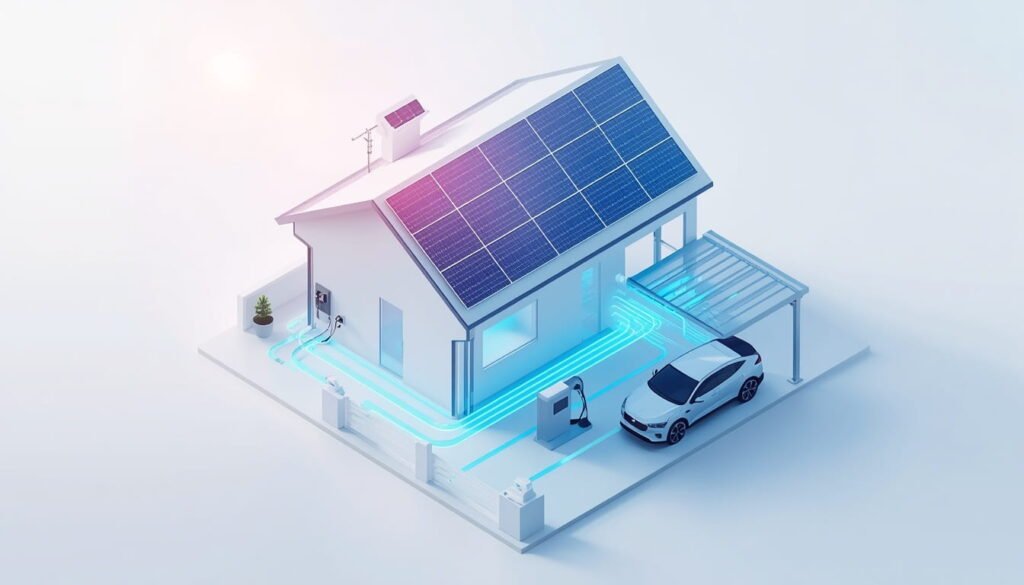
What Affects EV Solar Charging Costs and Savings?
The financial savings of powering an electric vehicle with solar energy depend heavily on how much electricity your EV uses, the proportion of charging supplied directly by your solar system, local utility electricity prices, and the economic value of any exported solar power.
1. How Much You Drive
Annual mileage acts as the foundation of your EV electricity demand. Traveling more miles generally requires more charging energy, whereas driving fewer miles lowers overall electricity consumption. Vehicle efficiency also varies significantly by model and real-world driving habits.
2. Your EV’s Energy Efficiency
Electric vehicles consume varying amounts of electricity per mile traveled. A more efficient EV requires fewer kilowatt-hours to cover the same distance. Note that total battery capacity alone does not determine annual charging costs; actual distance traveled and energy efficiency matter most.
3. Your Local Electricity Rate
Utility pricing dictates how much you pay when drawing power from the grid and defines the baseline financial value of self-generating solar power at home. Additionally, time-of-use (TOU) utility rate structures can make grid electricity more or less expensive depending on the time of day.
4. How Much Solar Electricity Charges Your EV
There is a clear distinction between total solar generation and the exact portion captured by your vehicle. Local weather, seasonal variation, household appliance electricity demand, and charging schedules all influence whether you can charge entirely on solar or must import power from the grid.
5. Solar Export Credits and Utility Rules
Excess solar electricity exported back to the utility grid often receives credits at a rate distinct from the retail electricity price. The net financial benefit of using solar energy for vehicle charging depends partly on the compensation you would otherwise receive for exporting that power. Full retail-rate net metering is not universal.
6. Charging Equipment and Installation Costs
Upfront investments—such as home Level 2 charging stations, main electrical panel upgrades, installation labor, or solar system expansion—represent separate initial expenses. These capital costs vary by home infrastructure and are distinct from ongoing electricity operational expenses.
7. Weather, Seasons, and Solar Production
Sunlight hours, roof pitch, compass orientation, surrounding shade, local weather, and seasonal changes alter photovoltaic production. A fixed panel count does not guarantee an identical amount of EV charging energy across every month of the year.
Illustrative EV Solar Charging Savings Example
To understand how operating costs and opportunity costs interact under specific assumptions, consider this sample scenario:
- Annual EV electricity demand: 3,810 kWh
- Portion supplied by solar: 70%
- Grid electricity rate: $0.18 / kWh
- Solar export-credit rate: $0.05 / kWh
1. Solar electricity used by the EV: 3,810 kWh × 70% = 2,667 kWh / year.
2. Electricity still purchased from the grid: 3,810 kWh − 2,667 kWh = 1,143 kWh / year.
3. Annual cost if all EV electricity were purchased from the grid: 3,810 kWh × $0.18 = $685.80.
4. Grid electricity cost with solar supplying 70%: 1,143 kWh × $0.18 = $205.74.
5. Gross avoided grid-electricity cost: $685.80 − $205.74 = $480.06.
6. Illustrative export-credit opportunity cost: 2,667 kWh × $0.05 = $133.35.
7. Illustrative net benefit after accounting for forgone export credits: $480.06 − $133.35 = $346.71 / year.
Disclaimer: This calculation serves as an illustrative example rather than a savings guarantee. The opportunity-cost calculation assumes that the solar electricity used by the EV could otherwise have been exported to the grid at $0.05/kWh. Actual financial results vary according to utility regulations, charging schedules, household energy usage patterns, and the physical source of your solar generation. The $346.71 figure does not represent total solar panel system savings; it is an isolated comparison of charging operating costs that excludes equipment purchasing, installation labor, maintenance, financing, and other overhead system expenses.
Achieving a realistic financial estimate requires incorporating your true annual driving distance, vehicle efficiency specs, local utility rates, solar generation yield, and export-credit details. We encourage users to evaluate multiple scenarios rather than depending on a single assumed savings figure.
Is Charging an EV With Solar Panels Worth It?
Solar-powered EV charging can reduce reliance on grid electricity and potentially lower ongoing charging expenses. However, whether it represents a worthwhile investment depends entirely on your existing solar system, driving habits, local electricity rates, utility export credit policies, and upfront equipment costs.
The Main Benefits of Charging an EV With Solar
Potentially Lower Charging Costs
Using available solar electricity can decrease the amount of electricity your household needs to purchase from the utility provider to keep your vehicle moving.
Better Use of Existing Solar Panels
Homeowners who already generate excess daytime solar power can redirect some of that clean energy into vehicle charging instead of exporting it back to the grid.
More Control Over Home Energy Use
Coordinating your charging routine with peak solar production hours gives you greater insight into managing when and how your electric vehicle consumes household energy.
When Solar EV Charging May Make the Most Sense
Favorable Conditions
- Your home already operates a residential solar system that produces surplus energy.
- You have the flexibility to charge your vehicle at home during peak sunlight and solar production hours.
- Grid electricity rates are relatively expensive compared with the financial value of exported solar power.
- Your property features suitable roof space and structural conditions for installing a new solar system, if you are considering a fresh array.
When the Financial Case May Be Less Attractive
Limiting Factors
- Most of your vehicle charging happens away from home or overnight when solar generation is unavailable.
- Your existing solar array operates close to capacity with little surplus electricity available.
- Utility export credits are high enough that consuming solar energy for EV charging carries a meaningful opportunity cost.
- Installing a brand-new solar system or expanding your current setup would require substantial upfront capital outlay.
- You anticipate moving out of the property before financial savings offset initial system expenses.
Should You Add Solar Panels Just for Your EV?
Evaluating New vs. Existing Systems
There is a fundamental difference between utilizing an existing solar surplus and purchasing a new system primarily to fuel an electric vehicle. Before investing in new panels, weigh the full installation cost against your vehicle's expected annual electricity demand, the realistic percentage of charging that can be solar-powered, local utility net metering tariffs, and your expected duration of property ownership.
Compare Your Charging Scenarios
| Charging Approach | Potential Advantage | Main Consideration |
|---|---|---|
| Grid-Only Home Charging | No upfront solar equipment costs required. | Subject entirely to standard residential utility electricity rates. |
| Existing Solar System | Uses clean energy from panels you already own. | Surplus output depends heavily on household loads and charging times. |
| New or Expanded Solar Array | Generates dedicated clean power tailored to EV demand. | Requires substantial upfront capital investment and roof suitability. |
| Solar Plus Home Battery | Offers maximum flexibility to shift solar energy to evening hours. | Significantly increases upfront equipment costs and requires careful financial modeling. |
Before You Decide
- Estimate your precise annual EV electricity demand using driving distance and efficiency.
- Review actual historical solar production and baseline household energy consumption.
- Determine how much solar electricity can realistically reach your vehicle based on your schedule.
- Compare your utility's grid electricity rates against local solar export-credit rates.
- Factor in any new equipment purchasing, professional installation, or system expansion expenses.
- Compare realistic operating scenarios rather than relying on a single best-case estimate.
By evaluating these practical variables carefully, U.S. homeowners can determine whether integrating solar panels with electric vehicle charging aligns effectively with their energy goals and household budget.
Frequently Asked Questions
Explore detailed answers about EV solar charging calculations, panel requirements, vehicle efficiency, costs, and existing rooftop solar integrations. Use this guide alongside our EV Solar Charging Calculator to plan your clean energy setup.
No matching questions found
Try searching using different keywords like "panels", "Tesla", "cost", or "mileage".
Determining how many solar panels are needed to charge an electric vehicle typically requires between 6 and 12 solar panels. This exact total depends heavily on your annual driving distance, your vehicle's electricity efficiency, local sunlight conditions, charging system losses, and the wattage rating of your installed panels.
For example, a typical driver traveling 12,000 miles per year with an efficiency of 3.5 miles per kWh will draw roughly 3,810 kWh annually. Assuming an annual solar production rate of 1,200 kWh per installed kW and 400-watt panels, you would need approximately 8 solar panels dedicated to your EV charging demand.
Charging a Tesla requires between 6 and 10 solar panels on average, depending on whether you drive a Model 3, Model Y, Model S, or Model X, along with your annual driving mileage and local climate. High-efficiency sedans like the Model 3 generally require fewer panels than larger performance SUVs or trucks.
- Model 3: Typically requires 6 to 8 panels due to high aerodynamic efficiency.
- Model Y: Usually requires 7 to 10 panels given its heavier crossover frame.
- Model S & X: May require 8 to 12+ panels depending on dual-motor power draws and long-distance commutes.
The cost of adding solar panels for EV charging depends on the additional system capacity required, hardware components, installation labor, roof conditions, electrical panel upgrades, and whether you are installing a new system or expanding an existing rooftop array. Upfront equipment costs vary widely by region and system scale.
Homeowners should evaluate whether their current solar inverter can handle extra wattage or if new microinverters are necessary. Integrating a Level 2 home charger and securing local building permits also factor into total project budgets.
Using an EV Solar Charging Calculator involves entering your electric vehicle make and model, your estimated annual driving distance in miles, the percentage of charging performed at home, your local electricity rate, and any existing solar system specifications. The calculator then estimates your annual charging electricity demand and panel needs.
- Select your vehicle to load default efficiency (miles per kWh).
- Input annual mileage to calculate total kWh consumption.
- Adjust advanced settings like charging losses and local solar production yield for precision.
EV energy efficiency measures how many miles a vehicle can travel on a single kilowatt-hour (kWh) of electricity, typically ranging from 2.5 to 4.5 miles per kWh. Higher efficiency means your car travels further on less energy, directly reducing the number of solar panels required to cover your annual charging footprint.
For instance, an EV averaging 4 miles per kWh consumes significantly less electricity over 12,000 miles than a larger electric SUV achieving 2.5 miles per kWh, requiring a noticeably smaller solar panel array.
Yes, homeowners with an existing rooftop solar system can use their current setup to charge an electric vehicle, provided the system generates surplus electricity beyond what household appliances consume. However, total annual solar production is not automatically equivalent to surplus energy available for vehicle transport.
If your household already utilizes most of your solar generation during the day, plugging in your EV may require drawing supplementary power from the grid or adding extra solar panels to maintain high clean energy coverage.
Whether you need to add more solar panels depends on your current system's production surplus and your annual driving distance. Households with substantial excess solar generation may already cover an EV's charging needs, while homes with tight energy margins will experience increased grid electricity bills without system expansion.
Before purchasing additional hardware, evaluate your historical solar monitoring data, inverter capacity headroom, roof space availability, and whether adjusting your charging schedule to daytime hours utilizes existing surplus.
Potential financial savings depend on replacing retail grid electricity purchases with self-generated solar power. For example, if an EV draws 3,810 kWh annually and 70% is supplied by solar under an $0.18/kWh utility rate, you avoid roughly $480 in annual grid electricity costs, offset by any forgone export credits.
Total savings vary widely based on regional utility pricing, time-of-use tariffs, your annual driving distance, and whether you are utilizing existing panels or paying off a newly installed solar array.
EV charging system losses refer to the electrical energy lost during the conversion of alternating current (AC) from your home supply into direct current (DC) stored in the vehicle battery, typically accounting for a 5% to 15% efficiency loss.
Because of these thermal and electronic losses, the electricity drawn from your home or solar panels must slightly exceed the actual energy stored in the car battery, which calculators factor in when determining precise solar panel sizing.
Charging an electric vehicle with solar panels is generally worth it for U.S. homeowners with high annual driving mileage, expensive utility electricity rates, and existing solar arrays with daytime surplus generation. It significantly reduces ongoing fueling costs compared to gasoline or grid-dependent charging.
However, the financial return is less attractive if you primarily charge overnight away from home, face low utility electricity rates, or must finance a costly new solar array solely for a low-mileage commute.
Your home-charging percentage dictates what share of your total annual EV energy demand must be supplied by your residential solar panels. Drivers who perform 80% or 90% of their charging in their home garage require a larger solar capacity than drivers who frequently refuel at public commercial charging stations.
Public DC fast chargers draw electricity from commercial utility grids rather than your rooftop, meaning public charging volume does not impact your home solar sizing calculations.
Local solar production yield measures the annual kilowatt-hours (kWh) generated per installed kilowatt (kW) of solar panels, typically ranging from 1,100 to 1,600 kWh/kW/year depending on regional sunlight, weather patterns, cloud cover, and geographic latitude.
A home in the sunny American Southwest generates significantly more annual energy per panel than an identical rooftop system in the Pacific Northwest, altering the total number of panels needed to power an EV.
Net metering and export credit policies dictate how utility companies compensate you for excess solar electricity sent back to the grid. When you use solar power directly to charge an EV, you save on retail electricity costs, but you forgo any export credit you would have earned for sending that energy outward.
Understanding your specific utility export tariff is crucial because the opportunity cost of consumed solar energy depends entirely on whether your utility offers full retail net metering or a lower wholesale avoidance rate.
Yes, charging your electric vehicle during peak daylight hours maximizes direct self-consumption of your solar generation, whereas plugging in overnight means your car draws power from stored battery systems or utility grid electricity.
Smart EV chargers and programmable vehicle timers allow homeowners to align charging sessions with midday solar production peaks, optimizing clean energy capture even if they leave home for work during the day.
A home battery storage system is not strictly required to charge an electric vehicle with solar panels. Many homeowners charge their EVs directly during peak daytime sunlight hours or rely on utility net metering credits to offset nighttime grid charging.
While a home battery provides added flexibility to store daytime solar energy for evening or nighttime vehicle charging under complex time-of-use utility rates, it also significantly increases upfront equipment costs.
Solar panel wattage determines how much electrical capacity (measured in DC kilowatts) a single module contributes, while roof orientation, tilt angle, and shading dictate how effectively those panels capture sunlight throughout the year.
South-facing roofs tilted at an angle matching local latitude generally capture maximum annual solar production, whereas east- or west-facing roofs produce slightly less total energy, requiring additional panels to meet identical EV charging goals.
Annual mileage is the primary driver of your EV's yearly electricity consumption. A low-mileage driver traveling 6,000 miles annually requires roughly half the charging electricity—and consequently half the solar panel capacity—of an intensive commuter driving 18,000 miles per year.
Accurately estimating your personal driving habits prevents under-sizing your solar array or over-investing in unnecessary panel capacity.
Yes, electric pickup trucks and large SUVs can be charged using residential solar panels, though their lower energy efficiency (often between 2.0 and 2.8 miles per kWh) means they require a larger solar panel array than standard electric sedans.
Because larger battery packs and heavy towing loads demand more kilowatt-hours per mile, truck owners often need 12 to 18+ solar panels dedicated solely to covering their annual vehicle transport energy requirements.
Eligible U.S. homeowners installing solar panels and home EV charging equipment may qualify for federal tax credits, state clean energy rebates, or local utility incentives that reduce upfront installation costs.
Because incentive availability, tax credit percentages, and eligibility criteria vary by location and change over time, homeowners should verify current program rules with qualified tax professionals or relevant state energy offices.
Solar panel electricity generation fluctuates across seasons due to variations in daylight hours, sun angle, and regional weather conditions, producing higher yields in long summer months and reduced output during winter.
Calculators estimate annual energy balances to account for these seasonal fluctuations, ensuring your total yearly solar production matches your vehicle's cumulative annual charging electricity demand despite monthly generation swings.
Our Trusted Sources
Our EV solar charging estimation models, battery efficiency metrics, photovoltaic production guidelines, and utility rate frameworks are built upon verified insights from leading government agencies, independent energy research organizations, automotive standards boards, and top renewable energy associations.
Accurate EV solar charging estimations, photovoltaic system sizing calculations, and clean energy savings forecasts rely heavily on standardized metrics like solar irradiance yields, vehicle energy efficiency ratings, and utility rate structures. By aligning our calculator tools and educational content with recognized government research, national laboratory datasets, and renewable energy standards, we ensure that the financial and practical insights provided match real-world building capabilities and driving patterns.
Related Calculators
Explore more Calculante solar calculators to plan your solar investment, understand your home's energy needs, and compare potential costs and savings. Each tool helps you make more informed decisions about solar energy and home electrification.