
Solar Battery Storage & Backup Calculator
Estimate your home's energy storage needs with our free solar battery storage calculator. Find out how much battery capacity you need, how long a solar battery can power essential appliances during an outage, and how many batteries your home may require with our solar battery backup calculator.
Solar production is a simplified daily estimate, not a weather forecast. It does not guarantee charging during a particular outage.
- Compare usable kWh, not just nominal battery capacity.
- Check continuous and surge power ratings separately from energy capacity.
- Confirm whether your inverter, battery, transfer equipment and solar system can provide backup during a grid outage.
- Consider cold-weather performance, battery reserve settings, degradation, warranty, installation space and local electrical requirements.
- A 13.5 kWh unit is used as a reference example only. This calculator does not establish compatibility with any specific brand or model.
How to Use the Solar Battery Storage & Backup Calculator
Use the Calculante solar battery storage calculator and solar battery backup calculator to estimate how much usable battery capacity your home may need and how long a battery could power your selected appliances during an outage. Adjust your energy use, backup duration, and battery settings to explore different scenarios before comparing home energy storage options.
Choose Your Calculation Mode
Start with Quick Estimate for a general view of your storage needs. Choose Appliance Planner when you want to build a more detailed estimate from individual appliances, their power ratings, and how long you expect to use them.
Estimate Your Daily Energy Use
Enter your estimated daily electricity consumption or select the appliances you want to keep running. Focus on the loads you actually need during a power outage, such as refrigeration, lighting, internet equipment, or essential medical devices. More realistic usage estimates produce more useful results.
Set Your Backup Duration and Reserve
Adjust the target number of backup hours or days and choose how much energy to reserve. A longer outage target generally requires more usable storage. Keeping a reserve can provide a buffer, but it also reduces the energy available for normal use during the outage.
Review Battery Capacity and Power Limits
Select a reference battery capacity or enter a custom value if the calculator offers that option. Review both usable energy in kWh and power output in kW. The battery must store enough energy for the planned duration and support the appliances' running and startup power requirements.
Account for Solar Recharging
If your system includes solar panels, review the solar array size, expected sunlight, and system-efficiency assumptions. Solar generation during an outage depends on your equipment and conditions. Many standard grid-tied systems shut down during a grid outage unless they have suitable backup equipment and islanding capability.
Compare the Results and Adjust
Review the estimated storage requirement, battery quantity, runtime, power-limit warnings, and potential solar contribution shown by the calculator. Try reducing nonessential loads or changing the backup target to see how your estimated requirements change. Use the results to guide further research and discussions with a qualified installer.
What Can the Calculator Help You Estimate?
A well-prepared estimate can help you understand the relationship between stored energy, power demand, outage duration, and solar recharging. Use the results as a starting point when comparing home battery storage and backup options.
- Estimated usable battery storage requirements
- Potential backup runtime for selected loads
- Whether battery power limits may constrain appliance use
- How changes in energy use affect storage needs
- Potential solar contribution to battery recharging
- Scenarios to discuss with a qualified solar installer
Estimates depend on the information entered and the assumptions used. Actual performance varies with battery condition, inverter limits, temperature, appliance cycling, weather, and system configuration. This calculator is for planning and educational purposes, not electrical-system design or a guarantee of backup performance.

Understanding Home Energy Storage and Battery Backup
Home energy storage lets you store electricity for use later, helping you manage when your home draws power from the grid or uses energy generated by solar panels. A properly configured battery system can also supply selected circuits during a power outage. Understanding how these systems work is the first step toward estimating your needs with a solar battery storage calculator or planning outage protection with a solar battery backup calculator.
Solar Energy Storage
Solar panels generate electricity when sunlight is available. Depending on system design and household demand, surplus energy can charge a compatible battery instead of being used immediately or exported to the grid.
Grid-Connected Batteries
A battery connected to the home's electrical system can store energy for later use. Depending on the equipment, utility rules, and settings, it may support self-consumption, time-of-use energy management, or backup power.
Backup During Outages
A backup-capable system can supply designated circuits or, if appropriately designed, more of the home when grid power fails. The available loads depend on battery capacity, inverter power, wiring, and backup configuration.
How Does a Home Battery Storage System Work?
A home battery stores electrical energy in chemical form and releases it when the home needs power. An inverter or compatible power-conversion equipment manages the flow of electricity between the battery, household circuits, solar panels, and the grid. The exact arrangement varies by system.
In a solar-plus-battery installation, solar electricity may serve household loads first, charge the battery with surplus production, or follow another control strategy selected by the system. When solar production is low, the home may draw energy from the battery or the utility grid, depending on the system's settings and available stored energy.
Generate
Solar panels produce electricity when sunlight is available.
Use or Store
Power supplies household loads, and compatible surplus may charge the battery.
Discharge
Stored energy can supply loads when needed, within system limits.
Recharge
The battery may recharge from solar or the grid if the equipment and settings allow it.
Home Energy Storage vs. Battery Backup: What's the Difference?
Energy storage describes the ability to save electricity for later use. Battery backup describes the ability to provide power when the usual electricity supply is unavailable. A battery can offer energy-storage benefits without automatically providing backup during an outage.
Many standard grid-tied solar systems shut down during a utility outage for safety, even when their panels receive sunlight. Outage operation generally requires compatible equipment that can isolate the home from the grid and safely supply backup loads. Some systems also need a designated backup interface or additional electrical components.
What Determines How Much Home Battery Storage You Need?
The right storage capacity depends on how much electricity you plan to use, which appliances you need to keep running, and how long you want stored energy to last. A larger battery can store more energy, but it does not necessarily deliver enough instantaneous power for every appliance.
- Daily energy consumption: The amount of electricity used by the loads you want to support.
- Backup duration: How many hours or days you want the battery to supply those loads.
- Usable battery capacity: The energy available after the system's reserve and operating limits are considered.
- Power output: Whether the inverter and battery can support running loads and appliance startup surges.
- Conversion losses: Energy lost while charging, storing, and delivering electricity.
- Solar recharge potential: Available sunlight, array size, system efficiency, and outage-compatible equipment.
A solar battery storage calculator helps you explore capacity requirements, while a solar battery backup calculator helps you consider outage duration and the loads you want to power. Looking at both together gives you a more useful starting point than choosing a battery based on its advertised capacity alone.
Actual performance depends on battery chemistry and condition, temperature, inverter ratings, installation design, control settings, household demand, and local conditions. Use estimates for preliminary planning and consult a qualified professional for system design and electrical safety.
How Much Battery Storage Does Your Home Need?
The amount of battery storage your home needs depends on how much electricity you want to use from the battery and how long you need it to last. A household seeking a few hours of backup for essential appliances may need a different system from one aiming to power most of the home overnight or through a longer outage. The best starting point is to estimate your energy use, choose your backup duration, and account for the battery's usable capacity and power limits.
Essential Appliances Only
If you only need refrigeration, lights, Wi-Fi, phone charging, and a few other essentials, you may be able to use a smaller battery system. The actual requirement depends on appliance consumption and hours of operation.
Overnight Backup
To cover evening and overnight use, estimate the energy consumed by your chosen appliances during those hours. Heating, cooling, cooking, and water pumps can significantly increase the amount of storage required.
Whole-Home Backup
Supporting most household loads generally requires more careful sizing. Central air conditioning, electric heating, electric ranges, and other high-demand equipment can require substantial energy and inverter power.
Solar-Assisted Backup
Solar panels may help recharge a battery during an outage if the system supports backup operation. How much energy can be replenished depends on sunlight, array output, household demand, and equipment configuration.
Longer Outages
Preparing for a multi-day outage means estimating daily essential energy use and whether solar or another permitted charging source will be available. A battery sized for one night may not last several days unaided.
Energy and Power Limits
Battery capacity, measured in kilowatt-hours (kWh), describes stored energy. Power output, measured in kilowatts (kW), determines how much equipment can run at the same time. Both need to fit your requirements.
Start With the Energy You Want to Power
Your total household electricity use is useful background, but it is not always the right number for backup sizing. First decide whether you want to run only essential appliances, selected rooms, or most of your home. Then estimate the electricity those loads will consume during the intended backup period.
If you have an electricity bill, look for your daily or monthly consumption in kWh. For a more targeted estimate, list the appliances you want to keep running, their approximate power consumption, and the number of hours you expect to use each one.
For multiple appliances, calculate each load's energy use and add the results. Appliances that cycle on and off may consume less energy than their rated power multiplied by the entire elapsed time.
Calculate the Usable Battery Capacity
A battery's advertised capacity is not necessarily the amount of energy available to your appliances. The system may reserve some energy to protect the battery or maintain a minimum state of charge. Conversion losses can also reduce the energy delivered to household loads.
For a preliminary estimate, divide the energy you want delivered to your appliances by the combined usable-capacity fraction and delivery efficiency. Use the actual specifications for your chosen battery when available.
Example: Planning for an Overnight Outage
Suppose your selected appliances are expected to use 6 kWh during an outage. For illustration, assume that 90% of the battery's nominal capacity is usable and that delivery efficiency is 90%.
The estimated nominal capacity is: 6 ÷ (0.90 × 0.90) ≈ 7.4 kWh.
A battery with roughly 7.4 kWh of nominal capacity is the mathematical estimate under these assumptions, not a guarantee of real-world performance or a final equipment recommendation. Actual battery specifications, operating limits, and load requirements must be checked.
Why Backup Duration Changes the Answer
The longer you want to run appliances without recharging, the more stored energy you generally need. If your selected loads consume 2 kWh per hour on average, a four-hour period represents 8 kWh of delivered energy before accounting for reserves and losses. Reducing consumption can extend runtime without increasing battery size.
Energy consumption is not always constant. Refrigerators cycle, pumps operate intermittently, and heating or cooling demand can vary with weather and building conditions. Use realistic operating assumptions rather than treating every appliance as if it runs at full power continuously.
Check the Inverter's Power Rating, Too
A battery may contain enough energy for several hours of use but still be unable to power all selected appliances simultaneously. The inverter and battery must provide sufficient continuous power, and they may need to accommodate short startup surges from motors and compressors.
- Estimate the combined running power of appliances that may operate at the same time.
- Check startup or surge requirements for equipment such as pumps, refrigerators, and air conditioners.
- Confirm that the battery and inverter support the intended backup configuration.
- Identify any high-demand loads that should be excluded or managed during an outage.
Can Solar Panels Reduce the Battery Size You Need?
Solar panels can help replenish stored energy during an outage when paired with equipment designed to operate in backup mode. This can reduce the amount of energy that must be stored in advance, but solar production is variable. Cloud cover, season, shading, panel orientation, and daytime appliance use all affect how much energy is available to recharge the battery.
If uninterrupted power is important, avoid assuming that solar will fully recharge the battery every day. Consider the possibility of poor weather, especially when planning for essential medical equipment, refrigeration, water pumps, or extended outages.
Practical Checklist Before Choosing a Battery
- Decide which appliances and circuits need backup power.
- Estimate their energy consumption over your desired backup period.
- Account for usable battery capacity, reserve settings, and conversion losses.
- Verify continuous output and startup surge capability.
- Determine whether solar recharging will be available during an outage.
- Check battery compatibility, installation requirements, warranties, and local electrical rules.
A solar battery storage calculator can help estimate how much stored energy your household may need. A solar battery backup calculator can help you explore backup duration, essential appliance loads, and power requirements. Treat the results as preliminary planning estimates, then have a qualified installer verify the system design.
Battery sizing varies with equipment specifications, temperature, battery condition, inverter efficiency, load profiles, and system configuration. This guide provides general educational estimates and is not a substitute for a site-specific electrical assessment.
Which Appliances Can a Solar Battery Run During a Power Outage?
A home solar battery can power many everyday appliances during a blackout, but what you can run depends on the battery's usable energy, its power output, your inverter, and how much electricity each appliance consumes. A small backup system may keep your refrigerator, lights, router, and phones running. A larger system designed for higher loads may also support selected heating, cooling, or cooking equipment. The key is to match the system to the appliances you actually need.
Everyday Essentials
LED lights, Wi-Fi routers, phones, laptops, and many refrigerators can be suitable backup loads when their combined energy use and startup demands fit the system.
High-Demand Appliances
Air conditioners, electric ovens, clothes dryers, water heaters, and some space heaters can consume substantial power and may quickly drain a battery.
Two Limits to Check
Battery capacity determines how long energy may last. Inverter output determines whether the system can run the required appliances together.
Common Appliances and Their Approximate Power Use
The table below provides illustrative running-power ranges for common household equipment. Actual wattage varies by model, size, operating mode, age, and conditions. Check the appliance label or manufacturer specifications when planning a real backup system.
| Appliance | Illustrative running power | Backup planning note |
|---|---|---|
| LED light bulb | 5–15 W each | Several lights can often be supported with relatively little energy. |
| Wi-Fi router | 8–20 W | Low running demand, but it needs an active internet connection to provide service. |
| Laptop | 30–100 W | Consumption depends on charging, workload, and device model. |
| LED television | 50–150 W | Actual demand varies with screen size and brightness. |
| Refrigerator | 100–300 W while running | Cycles on and off; compressor startup may briefly require more power. |
| Microwave | 1,000–1,800 W input | High power while operating, usually for relatively short periods. |
| Coffee maker | 600–1,500 W | Heating elements can create a short but substantial load. |
| Sump pump | 500–1,500 W while running | Motor startup and the consequences of losing power deserve special attention. |
| Portable space heater | 750–1,500 W | Can consume considerable battery energy if used for hours. |
| Central air conditioning | Often several thousand watts | Requires checking both running and startup power, along with inverter compatibility. |
These ranges are for initial planning, not equipment specifications. Also distinguish an appliance's electrical input from its advertised heating or cooling capacity. For example, an air conditioner's cooling capacity is not the same as its electrical power consumption.
Example: What Could a 10 kWh Battery Run?
Imagine a household with a battery rated at 10 kWh. If its usable energy and conversion losses leave 8 kWh available to household loads, that is the energy budget for the example below. The exact usable amount depends on the battery and system settings.
A Night of Essential Backup
| Appliance | Example use | Energy used |
|---|---|---|
| Refrigerator | 150 W average over 8 hours | 1.2 kWh |
| LED lights | 40 W total over 5 hours | 0.2 kWh |
| Wi-Fi router | 12 W over 8 hours | 0.096 kWh |
| Television | 100 W over 3 hours | 0.3 kWh |
| Laptop and device charging | 100 W combined over 2 hours | 0.2 kWh |
| Additional selected loads | Combined illustrative allowance | 2.204 kWh |
| Total | Example energy budget | 4.2 kWh |
In this simplified scenario, the listed loads use about 4.2 kWh, leaving approximately 3.8 kWh from the assumed 8 kWh available. That remaining energy could support additional use or help extend backup time, provided the loads remain within the system's power limits.
The example is not a prediction for every home. The refrigerator's actual energy use, for instance, depends on room temperature, door openings, age, and efficiency. The “additional selected loads” allowance is illustrative; a real estimate should replace it with measured or estimated appliance use.
Why a Battery May Not Run Every Appliance at Once
Consider a battery with enough stored energy for the evening but an inverter rated to deliver only 3 kW continuously. If a microwave draws 1.5 kW while a space heater draws another 1.5 kW, those two appliances alone use the inverter's entire continuous rating. Starting a refrigerator or pump at the same time could exceed the system's capability.
Appliances That Need Extra Care
- Medical equipment: Confirm the manufacturer's power requirements and arrange a suitable backup plan with the relevant healthcare provider. Do not rely on an unverified battery estimate for life-sustaining equipment.
- Well and sump pumps: Check motor startup power and the consequences of losing water supply or drainage.
- Heating and cooling: Check electrical demand, compressor startup requirements, and whether the backup system supports the equipment.
- Electric cooking and water heating: These can use a large share of stored energy in a short period.
- Electric vehicle charging: EV charging can be a major load and usually needs separate consideration from essential household backup.
How to Choose the Right Backup Loads
Start with the equipment that matters most during an outage. Many households prioritize food refrigeration, lighting, communication, device charging, and selected pumps or medical devices. Then calculate how much energy those appliances use over the period you want to cover.
- List the appliances and circuits you want to back up.
- Record each appliance's running watts and estimated daily operating hours.
- Identify motor-driven equipment that may have high startup demand.
- Add the energy use for the planned outage period.
- Check usable battery capacity, inverter output, surge rating, and backup wiring.
A solar battery backup calculator can help estimate how much energy selected appliances may require and how long stored energy could last under your assumptions. A solar battery storage calculator can help translate that energy requirement into a preliminary battery-capacity estimate. Both calculations should account for real equipment specifications before a system is selected.
Appliance wattages and energy figures in this guide are illustrative and should not replace the ratings on your equipment. Backup operation depends on a properly designed and installed system, compatible equipment, and compliance with local electrical requirements.
How Long Will a Solar Battery Power Your Home?
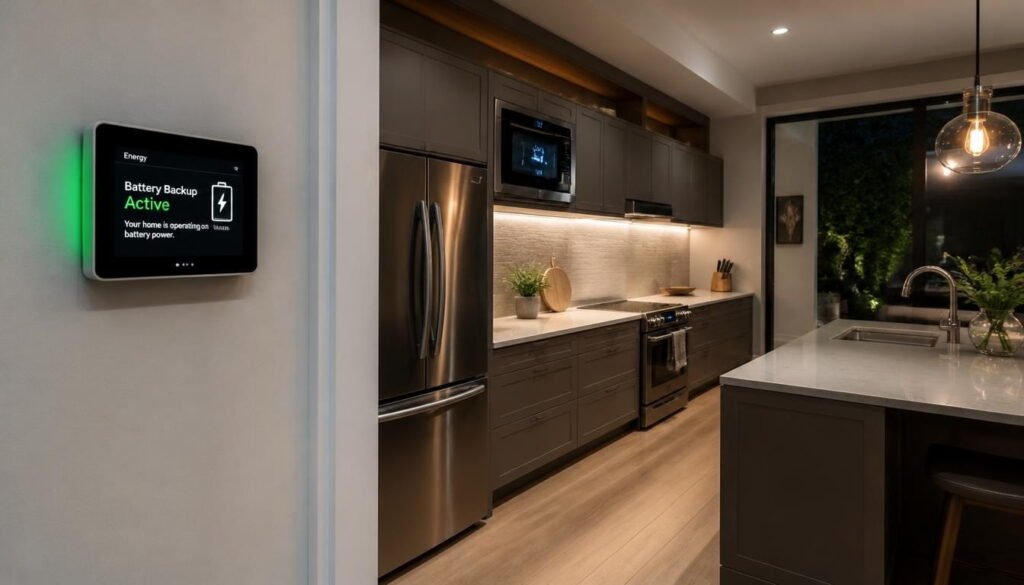
A solar battery may power essential appliances for several hours, cover an overnight period, or provide longer backup when energy use is low and recharging is available. There is no single runtime for every home. The answer depends on usable battery energy, the appliances you run, their operating patterns, and whether solar panels can safely recharge the system during an outage.
Usable Battery Energy
A battery's advertised kWh rating is not always the energy delivered to your appliances. Reserve settings and conversion losses can reduce the amount available for use.
Household Demand
Running a refrigerator, lights, and Wi-Fi usually uses less energy than powering air conditioning, electric heating, or several high-demand appliances at once.
Solar Recharging
A compatible solar-plus-battery system may replenish stored energy during daylight. Weather, sunlight, system design, and daytime usage affect the amount available.
The Basic Formula for Battery Runtime
A useful first estimate is to divide the usable energy available to your appliances by their average combined power demand. This gives an approximate runtime under the stated assumptions.
For example, 6 kWh of usable energy divided by an average 0.5 kW load gives an estimated 12 hours before accounting for any additional losses or changes in demand not already included in the usable-energy figure.
Example: How Long Could a 10 kWh Battery Last?
Imagine a battery with 10 kWh of nominal capacity. For this example, assume 8 kWh is available to the household after reserves and conversion losses. The estimated runtime then changes with the average power demand.
One Battery, Three Usage Patterns
These figures use the same assumed 8 kWh of usable energy. They illustrate why the same battery can last much longer when you run only essential appliances instead of a wider range of household equipment.
Typical Runtime Scenarios by Household Load
The table below shows how the same assumed 8 kWh of usable energy translates into different runtimes. The average loads are examples, not fixed consumption figures for a particular home.
| Example backup setup | Assumed average load | Estimated runtime |
|---|---|---|
| Lights, router, and device charging | 150 W | About 53 hours |
| Essential loads with intermittent refrigerator use | 300 W | About 27 hours |
| Moderate selection of household appliances | 500 W | About 16 hours |
| Several larger appliances in regular use | 1,000 W | About 8 hours |
| High household demand | 2,000 W | About 4 hours |
Runtime is not a guarantee. Appliance cycling, startup loads, battery temperature, inverter efficiency, and changing household demand can affect the result. A system must also have sufficient continuous and surge power to operate the selected appliances safely.
How to Estimate Your Own Household Runtime
Start by choosing the appliances you intend to use during an outage. Estimate their energy consumption over the period you want to cover, rather than assuming the entire house will consume its usual daily electricity.
- Check usable capacity: Use the battery manufacturer's specifications and your configured reserve.
- Estimate the average load: Add the expected power demand of the appliances you plan to run.
- Account for operating time: A device that cycles or runs intermittently may use less energy than one running continuously.
- Check inverter limits: Ensure that the system can handle the combined load and any startup surges.
- Plan for uncertainty: Allow for longer outages, changing weather, and unexpected electricity use where relevant.
Can Solar Panels Keep the Battery Running Longer?
They may. If your solar equipment is designed to operate during an outage, daytime production can serve household loads and potentially recharge the battery. This changes the calculation from a fixed amount of stored energy to a changing balance between energy use and energy generation.
For instance, a household might use 4 kWh overnight and receive enough usable solar production the following day to replenish that energy. But cloudy conditions, shading, short winter days, high daytime consumption, and system limitations can prevent a full recharge. Do not assume solar production will always match your consumption.
What Can Shorten Battery Runtime?
- Running electric heating, air conditioning, or other high-demand appliances.
- Using more appliances at the same time than originally planned.
- Having less usable capacity than the nominal battery rating suggests.
- Experiencing higher-than-expected consumption during extreme temperatures.
- Receiving less solar energy than expected during an extended outage.
- Reaching a battery reserve or power limit that restricts further discharge.
Estimate Runtime Before an Outage Happens
A solar battery backup calculator can help estimate how long stored energy may power your selected appliances. A solar battery storage calculator can help you explore the amount of capacity needed for a target backup period. Enter realistic appliance usage, usable battery capacity, and system-efficiency assumptions for a more meaningful preliminary estimate.
These calculations are simplified planning estimates. Actual runtime depends on equipment specifications, temperature, battery condition, system settings, inverter limits, and real-time energy demand. Consult a qualified installer when planning a backup system, especially for essential or high-demand loads.
How Many Solar Batteries Do You Need?
The number of solar batteries your home needs depends on how much electricity you want to store, how long you want backup power to last, and how much usable energy each battery provides. A solar battery storage calculator can help estimate the capacity required, while a solar battery backup calculator can help you plan for essential appliances, longer outages, and overnight use.
Decide what you want to power
Backing up a refrigerator, lights, Wi-Fi, and a few outlets usually requires less stored energy than trying to run most of an entire home. List the appliances you need during an outage and estimate how long you will use them.
Calculate your usable capacity
Battery capacity is measured in kilowatt-hours (kWh). Focus on the energy the system can actually deliver, accounting for its usable-capacity limit and conversion losses—not just the battery's advertised nominal capacity.
Check power and compatibility
Enough stored energy does not guarantee that a system can start or run every appliance at once. Inverter output, surge capability, battery configuration, and equipment compatibility also affect how many units you may need.
Suppose your backup plan needs 12 kWh of usable storage
Imagine each battery provides 5 kWh of usable energy. These values are illustrative, not specifications for a particular product.
Calculation: 12 ÷ 5 = 2.4, so you would round up to three batteries. Three batteries provide 15 kWh of usable capacity under these assumptions, giving you some additional storage above the 12 kWh target.
Example battery counts by storage target
The table below shows how the number of batteries changes with the target. It assumes each battery provides 5 kWh of usable storage and ignores any additional requirements for power output, reserve, or equipment compatibility.
| Required usable storage | Usable capacity per battery | Estimated battery count |
|---|---|---|
| 5 kWh | 5 kWh | 1 |
| 8 kWh | 5 kWh | 2 |
| 12 kWh | 5 kWh | 3 |
| 20 kWh | 5 kWh | 4 |
| 25 kWh | 5 kWh | 5 |
Why the battery count can be higher than the calculation suggests
Power demand
Several appliances running simultaneously can exceed the system's continuous power rating. Motors and compressors may also require a brief surge of extra power when starting.
Backup reserve
You may choose to keep a portion of the battery charged for unexpected outages or later use. That reserve reduces the energy available for ordinary consumption.
System limits
Some batteries must be installed in specific quantities or configurations. Inverter limits, electrical-panel design, and manufacturer-approved combinations can affect the final design.
Before choosing a battery system
- Estimate the daily energy use of the appliances you want to back up.
- Choose how many hours—or days—you want the system to support those loads.
- Account for usable capacity, conversion losses, and any backup reserve.
- Check continuous output and surge capacity against your expected simultaneous loads.
- Determine whether solar panels can recharge the batteries during an outage.
- Verify equipment compatibility, local electrical requirements, and installation guidance with a qualified professional.
These examples are simplified estimates for planning and education. Actual battery requirements vary with household consumption, battery specifications, inverter performance, temperature, system configuration, and backup goals. Always confirm final sizing with the equipment manufacturer and a qualified solar installer.

Can Solar Panels Recharge Your Battery During a Power Outage?
Yes. A properly configured solar-plus-battery system can often recharge its battery during a power outage, allowing you to use stored energy after sunset and replenish it when sunlight returns. However, solar panels do not automatically keep every home powered when the grid goes down. Your inverter, backup equipment, system settings, sunlight, and household electricity use all affect whether recharging is possible.
Solar panels need a backup-capable setup
Many standard grid-tied solar systems shut down during an outage to protect utility workers. To operate independently from the grid, your system generally needs compatible backup equipment and an approved way to form a stable local power supply.
Solar power can serve loads and recharge
When sunlight is available, solar energy may power selected household loads while sending surplus energy to the battery. If the home uses all the available solar production, little or no energy may remain for charging.
Weather changes the outcome
Clouds, shade, short winter days, panel orientation, and snow or dirt can reduce production. A battery may recharge quickly on a sunny day but take much longer when sunlight is limited.
How solar battery recharging works during an outage
Example: How much solar energy could recharge a battery?
Imagine a solar array produces 4 kWh of usable energy during a particular part of the day after system losses. If essential household loads use 1.5 kWh during that period, about 2.5 kWh could remain available for charging—assuming the equipment supports this operation and the battery can accept the power.
This is an energy-balance example, not a forecast. Actual charging may be lower because of battery charging limits, conversion losses, variable sunlight, system controls, and other electrical loads.
What affects how quickly a battery recharges?
| Factor | Why it matters | What to check |
|---|---|---|
| Solar array size | A larger array may produce more energy in suitable conditions. | Array capacity in kW and actual daily production. |
| Sunlight and weather | Clouds, shade, and seasonal daylight can reduce output. | Local solar conditions and shading. |
| Household loads | Energy used by appliances is not available to charge the battery. | Which circuits stay on during an outage. |
| Battery charge limit | The battery can only accept energy up to its permitted charging rate. | Maximum charging power and battery state of charge. |
| Inverter and backup configuration | Equipment must support the required operating mode during a grid failure. | Manufacturer specifications and system design. |
Can solar panels recharge a battery while your home is using electricity?
Yes, if the system is designed for it. Solar production can be divided between active household loads and battery charging. For example, if the panels provide 3 kW and supported loads are using 1 kW at that moment, the remaining power may be available for charging, subject to inverter behavior, battery charge limits, and system losses.
Remember that kilowatts (kW) measure the rate of power at a given moment, while kilowatt-hours (kWh) measure energy over time. A battery's charging rate and its total storage capacity are different limits.
Before relying on solar recharging during an outage
- Confirm that the system can operate safely without the utility grid.
- Verify that solar charging is supported during backup operation.
- Identify which household circuits and appliances receive backup power.
- Estimate daytime energy use as well as overnight battery demand.
- Plan for cloudy weather and outages lasting multiple days.
- Ask a qualified installer to confirm equipment compatibility and local code requirements.
Solar production, battery charging, and backup behavior vary by equipment, installation, weather, and electrical configuration. Use the solar battery storage calculator and solar battery backup calculator estimates as planning aids, then confirm your system's capabilities with the manufacturer or a qualified installer.
Battery Capacity vs. Power Output: What's the Difference?
When choosing a home battery, two specifications matter especially: energy capacity, measured in kilowatt-hours (kWh), and power output, measured in kilowatts (kW). Capacity helps determine how long your stored energy can last. Power output helps determine which appliances you can run at the same time. A solar battery storage calculator estimates the energy you need, while a solar battery backup calculator also helps you consider the loads your system must support.
Capacity: how much energy is stored
Think of capacity as the size of your energy reserve. A battery with more usable kWh can generally run the same set of appliances for longer, assuming the system can deliver enough power to operate them.
Best question: How much energy do I need for the evening, overnight, or a longer outage?
Power: how much can run at once
Power output is the rate at which a battery system can deliver electricity. It helps determine whether several appliances can operate simultaneously without exceeding the system's limits.
Best question: Can my system run the appliances I need at the same time?
Surge power: starting demanding equipment
Some motors and compressors briefly draw more power when starting than they use while running. The battery and inverter may need to support this surge for equipment such as pumps or air conditioners.
Best question: Can the system handle startup demand as well as normal operation?
Example: the same battery capacity, different power demand
Suppose a battery has 10 kWh of usable energy and can continuously deliver 5 kW. For a simplified estimate, assume the household load stays constant and ignore further losses.
At a steady 2 kW load, 10 kWh ÷ 2 kW gives approximately five hours of runtime. At a steady 4 kW load, the same energy would last about 2.5 hours. Both loads are below the assumed 5 kW continuous power limit, but actual runtime can be shorter because of conversion losses, reserve settings, and other system limits.
Why appliance combinations matter
Imagine you want to run a refrigerator, lights, a microwave, and a well pump during an outage. Each appliance may use a manageable amount of energy over time, but several running together can push the total instantaneous demand above the inverter's continuous rating. A motor's startup surge can create an additional challenge.
| Specification | What it tells you | Why it matters for backup |
|---|---|---|
| Usable capacity (kWh) | How much energy is available for use. | Helps estimate how long selected loads can run. |
| Continuous output (kW) | How much power the system can supply continuously. | Helps determine which appliances can operate simultaneously. |
| Surge output | How much extra power may be available briefly. | Can matter when starting motors and compressors. |
| Charging power (kW) | How quickly the battery can accept charging energy. | Can limit how quickly solar production replenishes the battery. |
| Round-trip efficiency | How much energy remains after charging and discharging losses. | Affects the energy you can ultimately use from stored or solar energy. |
How to estimate runtime from capacity and power
What to check before selecting a home battery
- Compare usable capacity rather than relying only on nominal battery capacity.
- Add up the running wattage of appliances you expect to use at the same time.
- Check the startup or surge requirements of motors, pumps, and compressors.
- Confirm the battery and inverter continuous output ratings.
- Review charging limits if you plan to recharge from solar during an outage.
- Check manufacturer specifications and have the final configuration reviewed by a qualified installer.
The figures in this section are examples for explanation, not product recommendations. Actual performance varies with equipment specifications, load profiles, temperature, conversion losses, battery settings, and installation design.

Home Solar Battery Types: Lithium-Ion, LFP, and Other Options
Choosing the right battery is about more than how many kilowatt-hours your home needs. Battery chemistry can affect usable capacity, expected service life, safety considerations, installation requirements, and overall cost. When using a solar battery storage calculator or solar battery backup calculator, treat the results as a guide to the storage you need, then compare compatible battery systems that meet your backup goals.
Lithium-ion batteries
Lithium-ion is a broad battery category used in many modern home energy storage systems. These batteries can offer high energy density and good efficiency, but their characteristics depend on the specific chemistry, product design, controls, and installation.
Consider: usable capacity, power rating, warranty, thermal management, and system compatibility.
Lithium iron phosphate (LFP)
LFP is a type of lithium-ion chemistry commonly used for stationary energy storage. It is often selected for its thermal stability and cycle-life characteristics, although actual performance varies by product and operating conditions.
Consider: warranty terms, usable energy, continuous output, temperature limits, and manufacturer requirements.
Lead-acid batteries
Lead-acid batteries are an older storage technology still used in some backup and off-grid applications. They may have a lower initial purchase price in some situations, but usable capacity, maintenance needs, lifespan, and replacement frequency matter when comparing long-term value.
Consider: allowable depth of discharge, maintenance, ventilation, cycle life, and total lifetime cost.
Lithium-ion vs. LFP: are they the same?
LFP stands for lithium iron phosphate. It is one particular lithium-ion battery chemistry, not a completely separate category from lithium-ion. Other lithium-ion chemistries can have different energy density, thermal characteristics, and performance profiles. For a home storage system, compare the specifications of the actual products rather than assuming every battery using the same broad label will perform identically.
Battery type comparison at a glance
| Feature | Lithium-ion, including LFP | Lead-acid |
|---|---|---|
| Usable energy | Depends on chemistry, product specifications, and settings. | Depends on battery design and recommended discharge limits. |
| Cycle life | Can be high, but varies by chemistry, temperature, and usage. | Often more limited in frequent deep-cycle applications; product type matters. |
| Maintenance | Many home systems are designed for relatively low routine maintenance. | Requirements depend on whether the battery is flooded or sealed. |
| Space and weight | Generally higher energy density than lead-acid. | Typically heavier and bulkier for comparable usable energy. |
| Safety and installation | Requires compatible battery management, protection, and approved installation. | Requires appropriate electrical protection and, for some types, ventilation and maintenance. |
| Long-term cost | Compare purchase price, warranty, usable energy, and expected service life. | Include maintenance, reduced usable capacity where applicable, and potential replacement costs. |
Example: why the lowest upfront price may not be the best value
Imagine two battery systems are being considered for the same backup goal. System A costs less initially but provides less usable energy per unit and may require replacement sooner. System B costs more upfront but offers more usable energy or a longer applicable warranty. The better value depends on the actual purchase price, installation cost, expected use, efficiency, warranty conditions, and replacement assumptions.
Rather than comparing price alone, calculate the cost per usable kilowatt-hour and consider the expected energy delivered over the system's service life. Use manufacturer-backed figures and realistic assumptions; do not treat advertised cycle counts or warranty length as a guarantee of actual lifespan.
Questions to ask before buying a home battery
- What is the battery's usable capacity in kWh?
- What are its continuous power and surge ratings?
- Can it work with the inverter and backup equipment already installed or planned?
- What charging temperatures and installation conditions are permitted?
- What does the warranty cover, and are there throughput or operating-condition limits?
- What are the total installed costs, expected maintenance needs, and likely replacement costs?
- Does the complete system support solar charging during a grid outage?
Battery performance and suitability vary by product, chemistry, temperature, installation, operating settings, and usage. Compare current manufacturer specifications and warranty documents before making a purchase decision.
How We Calculate Solar Battery Backup Requirements
The Calculante Solar Battery Storage & Backup Calculator helps estimate how much energy you may need to store, how long a battery may support selected loads, and whether your planned system's power output and solar charging assumptions fit your goals. Results are estimates based on the information entered—not a guarantee of real-world performance or a substitute for a professional system design.
Estimate energy consumption
We use your estimated appliance use or daily energy requirement to establish how much electricity the backup system may need to supply. Appliance wattage, quantity, and hours of use can all affect the result.
Account for backup duration
Your selected backup period helps determine the energy needed. Running essential loads for a few hours generally requires less stored energy than supporting them overnight or for multiple days.
Estimate required battery storage
The calculation considers usable battery capacity, reserve settings, and system losses where included by the calculator's inputs. The result helps translate your energy target into an approximate storage requirement.
1. Estimating appliance energy use
Electrical energy use is estimated from the power an appliance draws and how long it runs. If the appliance's power rating is given in watts, convert watts to kilowatts before calculating kilowatt-hours.
For example, a 100-watt device running for five hours uses 0.5 kWh. Actual consumption may vary if the appliance cycles on and off or its power draw changes during operation.
Estimating a small group of essential loads
| Appliance | Assumed power | Daily use | Estimated energy |
|---|---|---|---|
| LED lighting | 60 W total | 5 hours | 0.30 kWh |
| Wi-Fi router | 12 W | 10 hours | 0.12 kWh |
| Television | 100 W | 4 hours | 0.40 kWh |
| Refrigerator | 150 W average while running | 8 equivalent running hours | 1.20 kWh |
| Total estimated daily energy | 2.02 kWh | ||
These figures are illustrative. Refrigerators cycle, and appliance ratings do not always reflect average energy use. For a more accurate estimate, use measured consumption or the appliance manufacturer's energy information where available.
2. Estimating usable battery capacity
A battery's advertised capacity may not equal the energy available to your home. Usable capacity, permitted depth of discharge, conversion losses, reserve settings, and the battery's operating conditions can affect how much energy can actually be delivered.
If the calculator uses a reserve or efficiency adjustment, the required nominal battery capacity may be higher than this usable-energy target. Follow the calculator's displayed assumptions when interpreting the result.
Planning for one day of essential loads
Suppose the selected appliances use an estimated 6 kWh per day and you want one day of backup. The initial target is 6 kWh of usable energy. If you want two days with no meaningful solar recharge, the initial target becomes 12 kWh of usable energy.
These targets do not automatically include all conversion losses, reserve settings, or extra demand. Actual system sizing should account for those factors and the battery's specifications.
3. Checking power output as well as energy
Energy capacity tells you how much electricity is stored; power output determines how much can be delivered at once. A battery may have sufficient kWh for an outage but still be unable to operate all selected appliances simultaneously if their combined demand exceeds the continuous output rating. Motor and compressor startup surges can also matter.
Stored energy
Used to estimate how long the battery can support a given load profile before the usable energy is depleted.
Continuous power
Used to assess whether the system can supply the expected simultaneous appliance demand.
Startup surge
Important for some pumps, air conditioners, and other equipment with motors or compressors.
4. Estimating runtime
For example, 8 kWh of usable energy divided by an average 1 kW load gives an estimated runtime of eight hours. This is a simplified estimate: real loads fluctuate, and conversion losses, reserve settings, temperature, and system limits may shorten runtime.
5. Considering solar recharge
If the calculator includes solar array size, sunlight hours, and a production adjustment, those inputs can help estimate potential solar energy production. Energy used by household loads during daylight is not available to recharge the battery, and actual production varies with weather, shading, orientation, season, and equipment.
The production factor is a simplified allowance for system losses. It is not a universal constant; choose a realistic assumption for the location and system, and use local production estimates for more detailed planning.
What the calculator can—and cannot—tell you
| The calculator can help estimate | It cannot independently verify |
|---|---|
| Approximate energy required for selected loads and backup duration. | Your home's exact future energy consumption or outage conditions. |
| Approximate usable battery storage and runtime under entered assumptions. | Real-world performance of a specific battery, inverter, or installation. |
| Whether entered power demand appears to fit a stated system rating, when those specifications are provided. | Electrical-panel compatibility, startup behavior, wiring capacity, or code compliance. |
| A planning estimate for potential solar production and recharging. | Guaranteed solar output or successful recharging during every outage. |
How to get a more useful estimate
- Use realistic wattage and operating hours for each appliance.
- Choose only the loads you actually intend to back up, unless planning for whole-home backup.
- Set the backup duration to match your goal, and consider a longer outage scenario.
- Enter usable battery capacity and system power ratings from the actual product specifications.
- Account for reserve energy and conversion losses when the calculator offers those settings.
- Use a realistic solar production assumption for your location and season.
- Review the final design with a qualified solar and electrical professional.
Calculante aims to make solar battery storage and backup planning easier to understand by showing the relationship between energy use, storage capacity, power demand, runtime, and potential solar recharge. Always check the calculator's actual input settings and displayed results when making decisions.
Solar Battery Storage Costs, Savings, and Return on Investment
The cost of a home solar battery system depends on its usable storage capacity, power output, equipment, installation requirements, and whether it is added to an existing solar array or installed as part of a new system. A solar battery storage calculator helps you estimate the size of the system you may need, while a solar battery backup calculator helps connect that size to your outage-preparation goals. Neither calculation alone determines whether a battery will pay for itself.
Upfront system cost
Consider the battery, compatible inverter or power electronics, electrical work, backup circuits, permits, labor, and any required upgrades. A battery-only advertised price may not represent the complete installed cost.
Potential bill savings
Savings depend on your utility rates, time-of-use pricing, export compensation, battery efficiency, and how often the battery can store energy that would otherwise be more expensive to purchase later.
Backup value
A battery can provide useful electricity during an outage, but that resilience benefit is different from a direct reduction in your electric bill. Consider both goals separately when evaluating value.
What affects the installed price?
| Cost factor | Why it matters | What to include in an estimate |
|---|---|---|
| Usable battery capacity | More stored energy can support loads for longer, but may increase equipment costs. | Usable kWh and number of battery units. |
| Power output | Higher power capability may be needed for larger simultaneous loads or demanding equipment. | Continuous output, surge requirements, and inverter specifications. |
| Backup integration | Operating during an outage may require additional controls, transfer equipment, or backed-up circuits. | Backup gateway, electrical-panel work, and circuit configuration. |
| Existing solar equipment | Not every existing inverter or solar installation is compatible with every battery. | Compatibility checks and any replacement or upgrade work. |
| Installation and permitting | Labor, site conditions, code requirements, and utility rules vary by location. | Labor, permits, inspections, and required electrical upgrades. |
| Warranty and service | Coverage conditions and expected service needs affect long-term ownership costs. | Warranty limits, service terms, and likely replacement expenses. |
How can a battery save money on electricity?
Depending on your utility plan and system configuration, a battery may store solar energy during the day and supply some of your household demand later. It may also shift grid charging to lower-priced periods where the utility plan and system controls permit it. However, charging and discharging losses mean that not all the energy put into a battery is returned for household use.
Use more of your solar energy
If your solar panels produce more electricity than the home needs during the day, a battery may store some of the surplus for later use instead of exporting it to the grid.
Shift electricity use
Where time-of-use rates apply, a battery may reduce some purchases during expensive periods by supplying stored energy. The benefit depends on rate differences and system efficiency.
Reduce outage disruption
Backup power may help keep selected appliances and devices running during an outage. Its value depends on your needs and should not automatically be counted as cash savings.
Example: estimating possible annual bill savings
Suppose a battery supplies 2,000 kWh of household electricity per year that would otherwise have been purchased from the utility. Assume the avoided electricity price is $0.25 per kWh and the value of the solar energy used to charge the battery is $0.08 per kWh of energy entering it. For simplicity, assume 90% round-trip efficiency, so supplying 2,000 kWh requires about 2,222 kWh of charging energy.
Calculation: 2,000 × $0.25 = $500 in avoided purchases. Charging energy is approximately 2,000 ÷ 0.90 = 2,222 kWh, valued at about 2,222 × $0.08 = $178. The illustrative net benefit is approximately $500 − $178 = $322 per year, before maintenance, financing, degradation, and other costs.
This example is not a typical or guaranteed savings figure. The value of charging energy may be the forgone export credit for solar electricity, a grid electricity price, or another amount depending on how the battery is charged and how the utility compensates exports.
How to estimate simple payback
For example, if a system costs $9,000 after applicable incentives and produces an estimated $450 in annual net bill savings, simple payback is 20 years. This is a mathematical example, not a price or savings forecast for your home.
Simple payback does not account for financing, battery degradation, future electricity-rate changes, maintenance, replacement costs, or the time value of money. If annual net savings are zero or negative, this formula does not produce a meaningful positive payback period.
Costs and benefits to consider over time
| Item | How it affects the financial picture |
|---|---|
| Net installed cost | Use the full quote, less only incentives you are eligible to receive and can reasonably substantiate. |
| Annual bill savings | Estimate using your actual utility rates, export credits, expected battery use, and efficiency. |
| Financing costs | Loan interest and fees can increase the total amount paid. |
| Battery degradation | Usable storage and performance may decline with time and use, affecting future savings and backup duration. |
| Maintenance and replacement | Include expected service, warranty limitations, and any components that may need replacement. |
| Backup resilience | Provides a practical benefit during outages, but the value varies by household and is not automatically a bill saving. |
Are solar batteries worth it without solar panels?
A battery installed without solar panels may be useful in some circumstances, such as backup power or shifting grid electricity use under certain rate plans. However, it generally cannot store free solar energy if no solar array is present. The financial case depends on electricity prices, charging rules, outage needs, equipment costs, and how the battery is operated.
Before deciding whether a battery is worth the cost
- Get a complete installed quote with usable capacity and power ratings clearly stated.
- Review your utility's current import rates, export credits, and time-of-use schedule.
- Estimate how much energy the battery is likely to deliver each year.
- Account for round-trip efficiency and the value of energy used to charge it.
- Separate expected bill savings from the personal value of backup power.
- Check current federal, state, local, and utility incentive rules before including them in your calculation.
- Compare warranty conditions, expected degradation, financing, and potential replacement costs.
This section provides general educational guidance, not a quote, guaranteed savings estimate, tax recommendation, or investment advice. Use actual installation quotes, utility bills, applicable rate schedules, and manufacturer specifications to evaluate a system for your home.
Common Solar Battery Backup Sizing Mistakes to Avoid
Choosing a home battery based only on its advertised capacity can lead to disappointing results. A properly sized system should reflect how much electricity you need, how long you want backup power to last, which appliances must keep running, and whether your solar panels can recharge the battery during an outage. A solar battery storage calculator and a solar battery backup calculator can help you explore these requirements before comparing equipment or requesting installation quotes.
Using total household consumption without prioritizing loads
Your home's normal daily electricity use may include air conditioning, electric cooking, laundry, water heating, and other large loads. You may not need all of them during an outage.
Better approach: List essential appliances first, then estimate their wattage and daily operating hours. Add optional loads separately to see how they change your storage needs.
Confusing nominal capacity with usable capacity
A battery's advertised capacity may not equal the amount of energy available to your home. Manufacturer limits, reserve settings, and system configuration can reduce usable storage.
Better approach: Compare usable kWh across products and confirm how the manufacturer defines that figure.
Ignoring inverter power and startup surges
A battery may store enough energy for several hours but still be unable to power all selected appliances at once. Motors, pumps, refrigerators, and some HVAC equipment can have high startup demands.
Better approach: Check continuous output, surge capability, and the starting requirements of important appliances.
Assuming the battery will last a fixed number of hours
Backup runtime changes with actual consumption. A household using 500 watts on average will draw down its battery more slowly than one using 1,500 watts.
Better approach: Estimate the average load during the outage, not just the home's normal daily usage.
Assuming solar panels will always recharge the battery
Cloud cover, short winter days, shading, panel output, household demand, and equipment configuration all affect recharge potential. Some grid-tied solar systems also shut down during outages unless designed for backup operation.
Better approach: Verify outage-compatible solar operation and estimate realistic daily solar production for the season you care about.
Buying too much or too little storage
An oversized battery can add cost without providing proportional value. An undersized battery may run out before the outage ends or fail to cover the loads you consider essential.
Better approach: Compare multiple backup scenarios, such as essential loads overnight, one full day, and extended outages with solar recharge.
Example: why battery capacity alone is not enough
Suppose a home has a battery with 10 kWh of nominal capacity and 8 kWh of usable energy. If the household's average backup load is 1 kW, the simple runtime estimate is:
Runtime = usable battery energy ÷ average load
8 kWh ÷ 1 kW = approximately 8 hours
If the household reduces its average load to 500 watts (0.5 kW), the same simple calculation gives approximately 16 hours. Actual runtime may be shorter because of conversion losses, reserve settings, changing appliance demand, and other system limits.
Battery capacity, measured in kilowatt-hours (kWh), describes stored energy. Power output, measured in kilowatts (kW), describes how much electricity the system can supply at a given moment. A good sizing decision must account for both.
More sizing mistakes to watch for
| Common oversight | Why it matters | What to check |
|---|---|---|
| Forgetting backup reserve settings | Some systems retain a portion of the battery's charge for emergencies or other operating purposes. | Confirm the configured reserve and the energy available during an outage. |
| Not checking electrical compatibility | The battery may require compatible inverters, controls, transfer equipment, or a specific electrical configuration. | Ask a qualified installer to confirm compatibility with the existing solar and electrical system. |
| Overlooking seasonal differences | Solar production and household energy use can vary significantly throughout the year. | Model the season when backup is most important, not only an annual average. |
| Ignoring critical equipment | Medical devices, well pumps, sump pumps, communications equipment, or refrigeration may have special backup requirements. | Check operating time, starting power, reliability needs, and any manufacturer instructions. |
| Choosing solely by lowest price | A low-cost unit may offer less usable energy, lower output, limited backup compatibility, or different warranty coverage. | Compare installed cost, usable kWh, output, warranty, and supported backup features. |
Before choosing a home battery system
- Decide which appliances and circuits must remain powered during an outage.
- Estimate their daily energy use and simultaneous power demand.
- Choose a backup duration, such as overnight, 24 hours, or longer.
- Use usable battery capacity rather than relying only on nominal capacity.
- Check continuous output and surge capability against your largest loads.
- Confirm whether the solar system can operate and recharge the battery during a grid outage.
- Compare equipment compatibility, installation requirements, warranties, and complete installed quotes.
Calculator results are planning estimates, not a final electrical design or installation quote. Actual performance depends on the battery, inverter, appliance loads, settings, weather, and installation configuration.
Solar Battery Storage & Backup Calculator: Frequently Asked Questions
Choosing a home battery involves more than comparing storage capacity. These frequently asked questions explain how to size a solar battery, estimate backup runtime, calculate energy needs, understand solar recharging, compare battery types, and evaluate installation costs. Use this guide alongside our Solar Battery Storage & Backup Calculator to explore realistic scenarios for your home.
No matching questions found
Try a different term, such as battery size, kWh, Powerwall, solar panels, or backup time.
The right solar battery size depends on how much electricity you want to use during a power outage, how long you need backup, and which appliances must keep running. Calculate your essential loads in kilowatt-hours (kWh), account for usable battery capacity, and check that the system can supply enough power at once.
For example, if your selected appliances use 6 kWh per day, you need at least 6 kWh of usable energy for one day without recharging, before allowing for additional losses or a safety reserve. A longer outage or larger load requires more storage.
- List essential appliances and their wattage.
- Estimate daily operating hours.
- Choose a target backup duration.
- Check usable capacity, continuous output, and surge capability.
A house may need only a few kilowatt-hours for selected essential appliances or substantially more to support larger loads for a full day or longer. The required storage depends on actual energy consumption during backup, the desired runtime, usable battery capacity, and whether solar panels can recharge the system.
For a simple estimate, multiply the average backup load in kilowatts by the number of hours required. A 0.5 kW essential load running for 12 hours uses 6 kWh. The battery must provide that energy after accounting for reserves and system losses.
Your home's total utility consumption can help with planning, but it may overestimate the battery needed if you intend to power only selected circuits during an outage.
The number of solar batteries you need depends on your required usable storage and the usable capacity of each battery. Divide your target storage by the usable capacity per unit and round up to the next whole battery, then confirm that the combined system meets your power and compatibility requirements.
For example, a 12 kWh usable-storage target with batteries that each provide 5 kWh of usable energy gives 12 ÷ 5 = 2.4, so the initial estimate is three batteries.
This calculation estimates energy capacity only. The final design must also account for continuous output, startup surges, manufacturer limits on parallel units, inverter compatibility, and installation requirements.
Nominal capacity is the battery's stated total energy capacity, while usable capacity is the amount of energy the system makes available for use under its specified operating conditions. Usable capacity can be lower because of battery management limits, reserve settings, and manufacturer specifications.
For example, a battery rated at 10 kWh nominal capacity might provide 9 kWh of usable energy, depending on its design and settings. Do not assume that every battery has the same usable percentage.
When comparing batteries or using a solar battery storage calculator, check the manufacturer's usable-capacity rating and whether the quoted figure reflects the system's current configuration.
A solar battery's backup time depends on its usable energy capacity and the average power consumed by the appliances it supplies. A useful first estimate is usable battery capacity in kWh divided by average load in kW. Actual runtime varies with losses, reserve settings, changing demand, and battery-system limits.
For example, 8 kWh of usable energy divided by a 1 kW average load gives approximately 8 hours. At a 0.5 kW average load, the same stored energy gives approximately 16 hours before additional adjustments.
Running air conditioning, electric heating, cooking appliances, or other large loads can reduce runtime considerably. Solar recharge during an outage may extend operation if the equipment is designed to support it and sufficient sunlight is available.
A Tesla Powerwall can provide backup for several hours or longer than a day, depending on the model, available stored energy, household electricity use, and whether solar panels recharge it during the outage. Runtime is not fixed: heavier loads drain the battery faster, while essential-load operation can extend backup time.
As a simplified example, if a particular Powerwall configuration has 13.5 kWh of usable energy available, a steady 1 kW load would use that energy in about 13.5 hours before accounting for additional system effects. A 500 W load would take about 27 hours under the same simplified assumptions.
These are mathematical illustrations, not guaranteed runtime figures for every Powerwall model or installation. Confirm the exact model specifications, current state of charge, backup reserve, supported loads, and solar-recharging capability for your system.
A solar battery can run appliances that fall within the system's available energy, continuous power, surge capability, and supported-circuit limits. Depending on its size and configuration, it may power lights, a refrigerator, internet equipment, televisions, small electronics, pumps, or selected heating and cooling equipment.
Check both the energy each appliance consumes over time and the power required when it starts. A refrigerator may use relatively little energy over a full day but have a brief startup surge. Large HVAC systems, electric ranges, water heaters, and dryers can require much more power.
Make a priority list of essential appliances and have a qualified installer confirm which circuits can be backed up safely.
Kilowatt-hours (kWh) measure how much energy a battery stores, while kilowatts (kW) measure the rate at which it can deliver or receive power. Capacity influences how long appliances can run; power output determines how much equipment can operate simultaneously within the system's limits.
For example, a battery may have 10 kWh of usable energy but an inverter limited to 5 kW of continuous output. It may store enough energy for several hours yet be unable to run a combination of appliances that requires more than 5 kW at once.
Also check surge power for equipment with motors, compressors, or pumps. Both stored energy and power capability matter when sizing a backup system.
Solar panels can recharge a battery during a power outage if the solar and battery system is specifically configured to operate safely while the grid is down. Compatible inverters, backup controls, and sufficient sunlight are required. A conventional grid-tied solar system may shut down during an outage for safety.
Available solar energy must first support household loads and system losses; any remaining energy may charge the battery, depending on system controls. Cloud cover, shade, season, panel orientation, and the size of the solar array all affect recharge performance.
Confirm the outage operating mode and equipment compatibility with your installer rather than assuming existing solar panels will continue supplying power automatically.
The number of solar panels needed to recharge a home battery depends on battery energy requirements, panel wattage, peak sun hours, system losses, and electricity used by the home during charging. Estimate daily solar production first, then determine how much energy remains available to charge the battery.
For an initial estimate, a 5 kW solar array receiving 4 peak sun hours with an assumed 80% overall production factor would generate about 16 kWh per day: 5 × 4 × 0.80 = 16 kWh. Actual production can differ significantly by location and weather.
To estimate panel count, divide the desired solar array size in watts by the rated wattage of each panel, then round up. The resulting panel count does not guarantee a particular recharge time.
Solar battery charging time depends on the energy needed to recharge, available solar power, sunlight conditions, charging limits, and electricity consumed by the home at the same time. A battery may recharge in a few productive hours or take longer when solar output is low or household demand is high.
A simplified estimate divides the energy needed in kWh by the average power actually available for charging in kW. For example, replenishing 8 kWh at an average charging power of 2 kW takes about four hours under idealized constant-power assumptions.
Real charging time varies because solar output changes during the day and the battery's charging rate may be limited by its equipment or state of charge.
A solar battery can continue supplying stored electricity during cloudy weather or winter as long as it has sufficient charge and the system remains operational. However, solar panels generally produce less energy when sunlight is weaker or daylight hours are shorter, which can reduce the amount of energy available for recharging.
If daily household consumption exceeds solar production over several days, the battery may gradually discharge unless another charging source is available. The result depends on local weather, panel orientation, shading, battery size, and household demand.
For critical backup planning, consider lower-production seasons and extended periods of poor weather instead of relying only on average annual solar production.
The cost of a home solar battery storage system depends on usable capacity, power output, battery chemistry, inverter compatibility, installation labor, backup equipment, permits, and local requirements. A battery's advertised equipment price may exclude important expenses needed to make the system ready for household backup.
When comparing quotes, check whether they include electrical-panel work, backup controls, commissioning, monitoring, permits, and any required equipment upgrades. Systems with similar kWh ratings may differ in continuous output, surge capability, warranty, and supported backup features.
Because installed prices and incentives change by location and over time, obtain current itemized quotes for your home rather than relying on a single generic cost figure.
Solar battery storage may be worth it if the value of electricity savings and backup resilience justifies the system's upfront and ongoing costs. The financial case depends on utility rates, export credits, battery use, round-trip efficiency, installation price, financing, and how often outages occur.
A battery may be more financially attractive where electricity prices vary by time of day or exported solar energy receives a low credit. In other situations, the main benefit may be backup power rather than a short financial payback period.
Estimate realistic annual net savings and compare them with the net installed cost. Simple payback is only a starting point because it does not fully account for degradation, financing, maintenance, or future energy prices.
Yes, a battery can often be added to an existing solar system, provided the equipment and electrical configuration are compatible. The installation may require a compatible battery inverter, additional controls, backup switching equipment, electrical-panel changes, or other upgrades depending on the existing system.
Some installations use an AC-coupled battery connected on the home's AC side, while others use a DC-coupled arrangement designed to work with compatible solar equipment. Each approach has different compatibility and installation considerations.
Ask an installer to review your inverter model, solar array, utility connection, electrical panel, and backup goals before choosing a battery. Adding storage does not automatically mean the solar panels will operate during a grid outage.
The best home solar battery depends on your budget, storage needs, power requirements, installation conditions, warranty, and expected usage. Lithium-ion batteries are widely used in residential storage, and lithium iron phosphate (LFP) is one lithium-ion chemistry commonly considered for stationary applications.
LFP products may offer favorable cycle-life and thermal-stability characteristics, while other lithium-ion chemistries can have different energy-density and performance trade-offs. Lead-acid batteries remain an option in some applications but often differ in usable depth of discharge, maintenance needs, and cycle life.
Compare the complete system specifications, usable kWh, continuous and surge output, warranty terms, safety certifications, installation requirements, and expected lifetime rather than choosing by chemistry name alone.
Yes, a properly designed battery system can power an entire house during an outage, but it must have enough usable energy, sufficient continuous and surge power, and compatible whole-home backup equipment. Large loads such as central air conditioning, electric heating, ranges, and water heaters can require substantial capacity and output.
Some homes are better served by backing up essential circuits, such as refrigeration, lighting, internet equipment, and selected outlets. Others may need multiple batteries, load management, or a system specifically designed for whole-home operation.
A qualified installer should assess simultaneous loads, motor-starting requirements, electrical-panel configuration, and the duration of backup you want before recommending a system size.
When a solar battery reaches its configured minimum charge, the system may stop supplying backed-up loads or switch to another available power source if the installation supports it. During a grid outage without another source, backed-up appliances may lose power until the battery can recharge sufficiently.
If the solar and battery equipment supports islanded operation, panels may recharge the battery when sunlight is available. Whether loads remain powered during charging depends on the system design, energy balance, and operating limits.
To reduce the risk of running out, prioritize essential circuits, manage large loads, use an appropriate backup reserve, and plan for periods of weak sunlight or extended outages.
To calculate battery capacity for backup, estimate the energy used by the appliances you want to run, multiply their average load by the required backup hours, and adjust for usable battery capacity, system losses, and reserve settings. Then check that the inverter can supply the required continuous and startup power.
For individual appliances, estimate energy using: Energy (kWh) = Power (W) × Quantity × Hours ÷ 1,000. Add the energy estimates for all selected appliances to calculate the total requirement for the chosen period.
For a quick runtime estimate, divide usable battery energy by average load in kW. These formulas are useful for planning, but final equipment selection must follow the manufacturer's specifications and installation requirements.
Home solar battery lifespan depends on battery chemistry, operating temperature, charge and discharge patterns, system settings, product quality, and warranty conditions. Many residential battery products are designed for years of operation, but their usable capacity can decline over time and actual service life varies by model and usage.
Review the warranty's duration, throughput or cycle limits, retained-capacity terms, and conditions for eligible use. A warranty period is not a guarantee that a battery will fail immediately afterward or remain at its original capacity for its entire life.
When comparing long-term value, consider expected degradation, future storage needs, service availability, and potential replacement costs alongside the upfront price and estimated electricity savings.
These answers provide general educational guidance. Actual battery performance, backup duration, installation costs, and solar production depend on the equipment, household loads, location, weather, utility rules, and installation design. Always confirm product specifications and electrical requirements with qualified professionals.
Our Trusted Sources
Our solar battery storage and backup guidance draws on technical resources from government energy agencies, national laboratories, electrical safety organizations, and established solar industry associations. These references help inform our explanations of battery capacity, backup power, solar charging, system safety, and energy storage performance.
Solar battery backup estimates depend on more than a battery's advertised capacity. Usable energy, inverter power, household demand, conversion losses, reserve settings, and available solar generation can all affect real-world performance. We use established energy and technical resources to inform our educational content, while presenting calculator results as planning estimates rather than guaranteed system performance. Actual equipment specifications, installation requirements, and backup capabilities should always be confirmed with the manufacturer and a qualified installer.
Related Calculators
Explore our solar calculators to estimate your home's solar energy needs, compare potential savings, plan battery storage, and understand how solar power can support your everyday energy use.